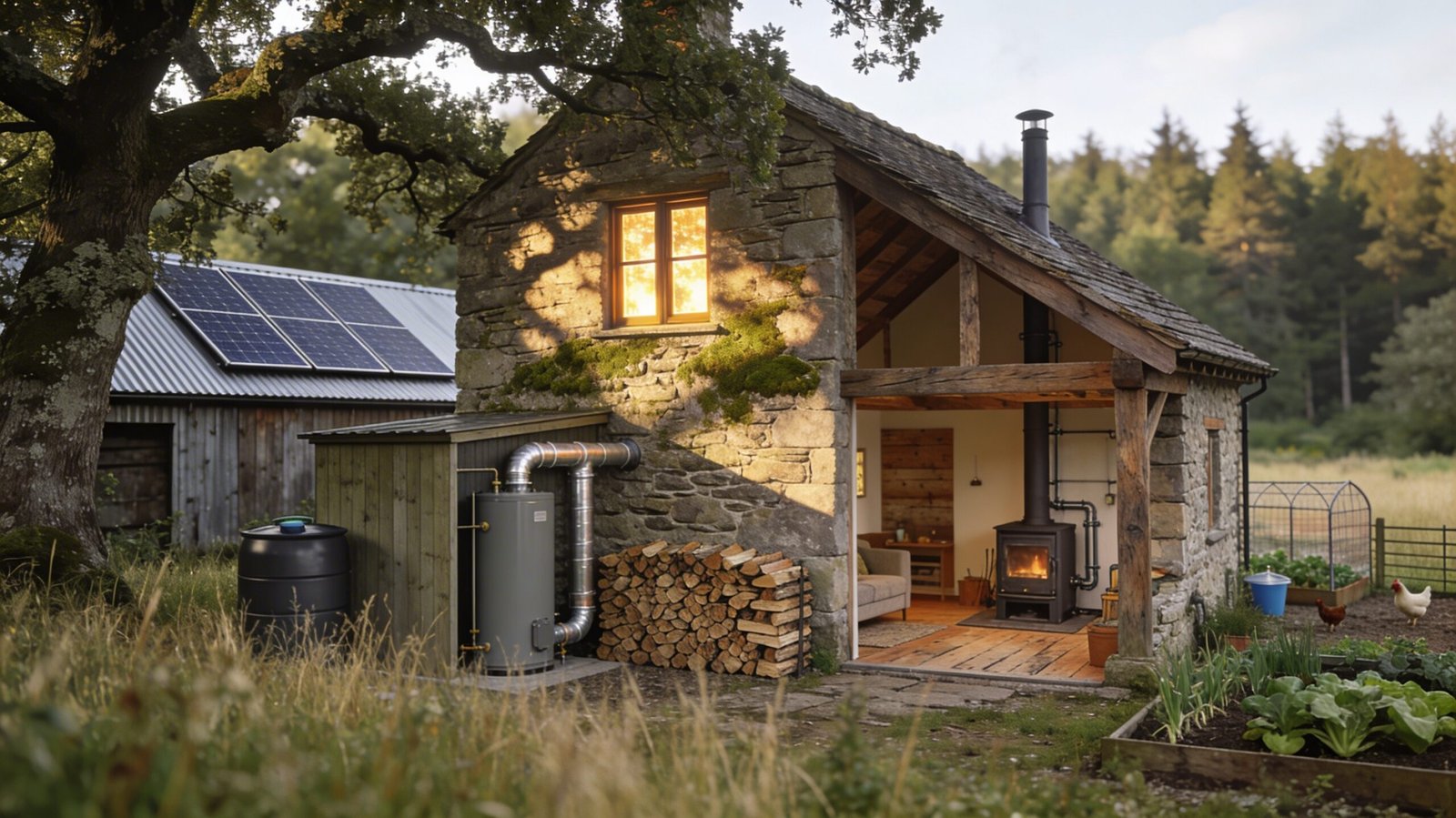
Domestic Biomass Boilers In The UK: Are They The Future of Home Heating?
Biomass boilers occupy a genuinely interesting position in the UK’s low-carbon heating transition. They are not the government’s preferred technology — that role has been firmly assigned to heat pumps, which receive a £7,500 grant under the Boiler Upgrade Scheme compared to only £5,000 for biomass. They are not suitable for most UK homes — a combination of space requirements, fuel logistics, and urban air quality constraints means the addressable market for biomass is structurally limited to rural and off-grid properties. And yet, for a specific category of UK property, biomass remains not just a viable option but in some circumstances the best available option.
Whether biomass boilers will become a mainstream UK technology — comparable to heat pumps in their adoption trajectory — or will remain a niche solution for a specialist market is the central question of this article. The honest answer is that the mainstream trajectory is unlikely, but the niche is both real and enduring.
What a Biomass Boiler Actually Is
Biomass boilers burn organic material — predominantly wood in the form of pellets, wood chips, or logs — to produce heat for central heating and hot water. It functions in the same way as a gas or oil boiler in terms of how it distributes heat: hot water circulated through radiators and to hot water cylinders. The fuel source, the combustion process, and several important practical characteristics differ significantly.
Fuel types:
Wood pellets are the most controllable and most convenient biomass fuel. They are manufactured from compressed sawdust and wood waste to a consistent density and moisture content (typically less than 10% moisture). Pellet boilers are automated — a hopper or bulk store feeds pellets via an auger mechanism to the burner, with automatic ignition and combustion control. Modern pellet boilers operate in much the same way as a gas boiler from the user’s perspective: set the thermostat, and the system manages itself. Ash production is low (approximately 0.3–0.5% of fuel weight), and automated ash removal systems handle this on a weekly basis.
Wood chips are cheaper than pellets but require more storage space (chips have lower energy density per volume than pellets), more management, and larger boilers with more space for the fuel feed mechanism. Chip systems are more common in commercial and community heating applications than in domestic settings.
Logs are the cheapest fuel where a local supply exists, but log boilers require manual loading — they are gasification boilers where the log chamber is filled, the fire lit, and the heat stored in a large buffer tank. The process is more labour-intensive and less controllable than pellet systems, but running costs can be very low where logs are available cheaply or free from managed woodland.
The buffer tank: Unlike gas boilers, biomass systems typically require a large buffer tank (200–1,000 litres) that stores hot water to smooth out the on/off cycling of the combustion process. The buffer allows the boiler to run at optimal efficiency while the heat demand is met from stored hot water rather than from continuous combustion. This buffer tank is typically a significant space requirement and adds to the installation footprint.
The Current State of Biomass in the UK: A Niche Technology
Less than 2% of UK homes have either a heat pump or a biomass boiler installed. The installed base of domestic biomass boilers is small — a few tens of thousands of systems, concentrated almost entirely in rural areas, particularly in the North West, Wales, Scotland, and parts of England with established woodland and fuel supply networks.
This small installed base reflects the structural constraints that limit biomass to a specific market segment, explored below.
What Biomass Does Well: The Case For
The Off-Grid Rural Home
The biomass boilers most compelling case is for rural properties that are not connected to the gas grid and that are using oil or LPG for heating. There are approximately 865,000 oil-heated homes in England and Wales, with usage concentrated in rural areas. These homes face a genuine medium-term challenge: oil boilers are expected to be phased out by 2035, and the government’s preference is for heat pump replacement.
For many of these rural properties, biomass is a genuinely competitive alternative to heat pumps. The reasons:
Fuel cost advantage in some scenarios. Wood pellets at approximately £300–£400 per tonne (where bulk delivery is viable) and wood chips or logs at lower per-unit costs where a local supply exists can provide heating at lower fuel costs than both oil and the electricity used by a heat pump — particularly in larger, poorly insulated properties where the heat pump’s efficiency advantage may be reduced.
Compatibility with existing radiator systems. Biomass boilers operate at flow temperatures (typically 60–80°C) that are compatible with existing radiator systems. Heat pumps operate most efficiently at lower flow temperatures (35–50°C), which may require radiator upgrades in properties with undersized radiators. A biomass boiler can be installed without any changes to the distribution system — directly replacing an oil boiler.
Performance in large, hard-to-insulate buildings. The properties where heat pumps struggle most — large, older, solid-wall rural buildings where the heat demand is high and insulation upgrading is difficult or uneconomical — are also the properties where biomass performs relatively well. A biomass boiler with a large output does not have the diminishing efficiency characteristics that a heat pump shows at higher output levels.
Local fuel supply and community integration. In areas with active woodland management, short-rotation coppice, or agricultural residues, biomass fuels can be sourced locally at low cost and with low transport-related carbon impact. This creates a genuinely local renewable energy economy that heat pumps — powered by the national electricity grid — do not deliver.
The Carbon Case (With Caveats)
Biomass fuel is officially classified as carbon neutral in UK and EU renewable energy accounting frameworks — on the basis that the CO₂ released when wood burns is equal to the CO₂ that the growing trees absorbed during their lifetime, and that sustainably managed forests replace what is harvested.
This carbon neutrality claim is contested by some scientists and environmental organisations, who argue that the carbon cycle timing matters — a tree felled and burned releases its carbon today, while a replacement tree takes decades to re-absorb it — and that the claim depends entirely on the sustainability of the fuel source.
The practical position for UK domestic biomass users: burning locally sourced, FSC-certified or sustainably managed wood fuel produces significantly lower lifecycle emissions than oil or LPG heating. It does not produce zero emissions and is not equivalent to a heat pump powered by green electricity in terms of operational carbon. For the specific circumstances of off-grid rural properties where heat pumps may not be practical, biomass represents a genuine reduction in carbon emissions from the status quo of oil or LPG heating.
What Biomass Does Poorly: The Case Against
Space and Installation Complexity
Biomass systems require significantly more space than gas or oil boilers:
- The boiler itself is larger than an equivalent gas boiler
- A buffer tank of 200–1,000 litres is required
- Fuel storage — a hopper for automated systems, or a dedicated fuel store for bulk delivery systems — requires either an indoor store with adequate access for deliveries or an external fuel store connected to the boiler
This space requirement rules out biomass for virtually all urban and suburban properties and for many rural properties where the installation footprint cannot be accommodated. A detached rural farmhouse with outbuildings has the space; a Victorian terrace in a market town does not.
Installation Cost Without Adequate Grant Support
Biomass boilers are expensive. A domestic pellet boiler system including boiler, buffer tank, flue, fuel store, and installation typically costs £15,000–£25,000 fully installed. The Boiler Upgrade Scheme provides a £5,000 grant, reducing this to £10,000–£20,000 — still significantly more expensive than an equivalent heat pump installation (£15,000–£20,000 before the £7,500 BUS grant, or £7,500–£12,500 after grant).
The disparity in grant levels — £5,000 for biomass versus £7,500 for heat pumps — reflects the government’s clear policy preference for heat pumps as the primary replacement technology for off-grid heating. Biomass is supported but not prioritised.
The Energy Saving Trust cites an average cost of approximately £18,000 for a fully installed automated pellet boiler system for a typical home. This upfront cost, even after the BUS grant, requires a long payback period before the fuel cost savings offset the capital investment.
Air Quality and Smoke Control Zones
Wood combustion produces particulate matter (PM2.5) and nitrogen oxides, even from modern, high-efficiency boilers. This is a real environmental and health concern, and it has regulatory consequences:
Smoke control zones: Properties within designated smoke control areas — which cover most of urban England, including all London boroughs, most city centres, and many towns — must use only appliances approved for use in smoke control areas, or use authorised fuels. Most domestic biomass boilers are not approved for use in smoke control areas. Even where the technology of the boiler itself might produce low emissions, the fuel diversity and variable combustion conditions of domestic wood burning in dense populations has been judged incompatible with air quality management.
This is not a technical obstacle that better boiler design can overcome — it is a policy and air quality management constraint that applies to the combustion of wood at scale in population centres. Biomass heating is effectively confined to rural and semi-rural areas by this constraint, regardless of how efficient the individual boiler is.
Fuel Logistics and Dependency
Pellet delivery requires bulk delivery access — a large vehicle with a blower system that can fill a fuel store. Properties on narrow lanes, with restricted access, or without appropriate fuel storage infrastructure face logistics challenges that limit pellet boiler viability. Log supply chains are more flexible but require manual handling.
The fuel supply chain for biomass is also less developed and less convenient than gas or electricity distribution. In the UK’s gas grid areas, gas is delivered through infrastructure already installed; in electricity-supplied areas, a heat pump plugs into the grid. Biomass requires physical delivery, storage management, and in the case of logs, manual loading. For households willing to manage this, it is workable. For households expecting the convenience of gas or oil heating, it is a significant change of lifestyle.
Will Biomass Become Popular and Cost-Effective in the UK?
This is the question this article was written to answer. The honest assessment, looking at where the technology, the policy, and the market are heading, is:
Biomass will not become a mainstream UK heating technology. The combination of structural constraints (space requirements, urban smoke control zones, fuel logistics, air quality limitations) and policy direction (£7,500 for heat pumps vs £5,000 for biomass, with the government’s Warm Homes Plan explicitly focused on heat pumps and low-temperature heating) means that the addressable market for domestic biomass is, and will remain, structurally limited to rural off-grid properties.
The UK has approximately 1.5 million off-grid homes (oil, LPG, and other non-gas heated). Of these, perhaps 500,000–800,000 are genuinely suitable candidates for biomass on the basis of space, fuel logistics, and property characteristics. At current installation rates, this represents a meaningful but niche market — not the mass adoption trajectory that heat pumps are following.
Within its addressable market, biomass will remain a viable and in some cases superior alternative. For the rural off-grid property with adequate space, access to cost-effective wood fuel, and existing radiator systems that are compatible with higher flow temperatures, biomass remains a strong option — often preferable to a heat pump for those specific properties. The government’s decision to include biomass in the Boiler Upgrade Scheme (albeit at a lower grant level) reflects its role as a legitimate low-carbon heating technology for this market segment.
The technology will continue to improve but will not transform the cost picture fundamentally. Modern biomass boilers are already highly efficient (90%+ combustion efficiency in best-in-class pellet systems), highly automated, and increasingly integrated with smart home systems. The remaining cost challenges are principally in the capital cost of the system and the logistics of fuel supply — neither of which is likely to change dramatically.
The competitive pressure from heat pumps will intensify. As heat pump installation costs fall (driven by increasing installer capacity, technology learning curves, and greater product availability), as electricity grid decarbonisation continues to improve heat pumps’ carbon performance, and as heat pump technology improves at lower ambient temperatures (addressing one of biomass’s relative advantages in cold weather), the comparison shifts in favour of heat pumps for many properties that might otherwise consider biomass.
For most rural off-grid properties, the current financial calculation in 2026 favours a heat pump (£7,500 BUS grant, improving efficiency, lower long-term complexity) over biomass (£5,000 BUS grant, higher installation cost, fuel logistics). The exceptions — where biomass may be preferable — are large, poorly insulated properties with high heat demand; properties with access to very cheap or free local wood fuel; and properties where the space, access, and infrastructure required for biomass is already present or straightforward to create.
The Practical Bottom Line
Biomass boilers are a real, credible, and in specific circumstances excellent technology for UK homes. They will not disappear, they will not become irrelevant, and for a specific segment of the UK housing stock they represent the best available low-carbon heating solution. But they will not become the standard UK heating technology, they will not overtake heat pumps in the policy priority order, and their addressable market will remain geographically and physically constrained.
If you live in a rural property currently heated by oil or LPG, with adequate space for a boiler and fuel store, with access to a bulk pellet supplier or local wood fuel supply, and with a property size and insulation standard where the high flow temperature of biomass is advantageous — biomass deserves serious consideration alongside heat pumps. The comparison should be made with specific costs and fuel prices for your location and property, not with national averages that do not reflect your situation.
If you live anywhere else — urban, suburban, on the gas grid, in a smoke control zone, in a property without adequate installation space — biomass is not a realistic option, and the comparison is largely academic.
The future of UK heating is predominantly heat pumps and, eventually, hydrogen or low-carbon gas for properties where heat pumps are least suitable. Biomass is a valued part of the transitional toolkit for the specific properties where it works. It is not, and will not be, the mainstream answer.
About the Author