
Consider a hypothetical resident in a Belfast ward where crime rates sit well below the city average and occupancy remains high due to strong transit links and well-kept public spaces. You’ll find this pattern repeats in neighborhoods with aging, stable populations, premium housing near transit, and active community oversight. These traits drive consistent demand and steady price momentum, yet tradeoffs exist in supply and evolving service costs. Curious about which areas satisfy these conditions and why they endure, despite market shifts.
Why Belfast’s Quietest Neighborhoods Are Safest

Quiet neighborhoods tend to have lower crime rates because fewer opportunities and closer social monitoring deter, or quickly deter, offenses. You’ll notice data consistently show reduced incidents in areas with high routine activity and strong surveillance, where residents know neighbors and cameras or policing are visible.
Safety perceptions rise when people feel they can report suspicious activity without friction, and when response times improve, reinforcing trust in local systems. Crime prevention strategies in Belfast’s quieter zones emphasize environmental design, lighting, and mixed-use streets to sustain natural guardianship.
Objective metrics—crime density, clearance rates, and violation trends—typically trend downward as these measures strengthen. You observe that tight networks, predictable presence, and pro-social norms correlate with safer conditions, reinforcing the case for continued, targeted investments in prevention infrastructure.
Who Lives in Belfast’s Safest Areas?
You’ll see that the safest Belfast areas attract a mix of households, with demographics skewed toward established professionals and families.
Housing and demand trends show steady or rising prices, tighter vacancies, and sustained tenant turnover at lower levels than broader city averages.
This pattern suggests specific resident profiles and housing dynamics worth comparing across neighborhoods.
Demographics Of Safest Areas
In Belfast’s safest neighborhoods, the population tends to be older on average and more highly educated than citywide benchmarks. With stable employment and lower renter turnover contributing to a more predictable demographic profile.
- Cultural diversity remains modest but meaningful, with a mix of long‑term residents and incoming professionals.
- Economic development concentrates in stable sectors, supporting higher household incomes and lower unemployment rates.
- Homeownership dominates, reinforcing steady demographic inertia and predictable demand patterns.
You can observe that these areas tend to attract families and established professionals, creating a self‑reinforcing cycle of safety and investment.
Data show lower churn, higher educational attainment, and persistent employment, which collectively sustain the reputational and market strength of Belfast’s safest neighborhoods.
Housing And Demand Trends
In Belfast’s safest areas, housing demand remains resilient and concentrated among families and established professionals who prioritize stability and long-term investment. Demand concentrates in low-crime districts with strong school performance and stable employment markets, producing measurable price endurance and modest turnover.
Data show that properties near transit nodes and amenities command premium rents and resale values, while supply constraints in select wards sustain price resilience. Luxury developments appear in limited pockets, correlating with higher income cohorts and perceived value from security and quality of life.
Historical preservation policies influence buyer preferences, preserving architectural character and limiting large-scale demolitions. Vacancy rates stay low, vacancy duration short, and price growth steady year over year, signaling durable demand, prudent investment, and targeted buyer interest in Belfast’s safest areas.
How Transport Links Boost Neighborhood Appeal in Belfast
Transit access shapes neighborhood value by improving commute times and reliability. Rail and bus connectivity correlate with higher residential demand and stronger local retail, backed by recent transit performance data.
In Belfast, these links are a key driver of perceived safety and desirability for residents and investors alike.
Transit Access Benefits
Transit access greatly boosts Belfast neighborhood appeal by shortening commute times, expanding employment options, and enabling easier access to amenities. In numerical terms, areas with strong public transit show lower car dependency and higher residential turnover, signaling sustained demand.
Public transit efficiency correlates with higher retail footfall and reduced travel volatility, metrics investors monitor closely.
Safety regulations influence rider confidence, shaping usage patterns and service frequency. Data indicate that well-regulated routes maintain reliable headways and predictable operating hours, contributing to perceived neighborhood safety and consistency.
Carefully designed transit hubs integrate with local amenities, boosting daytime activity and evening safety.
Overall, transit access is a measurable asset that aligns mobility with quality of life and property value stability.
- Higher rider throughput aligns with neighborhood vitality
- Regulated schedules improve perceived safety and reliability
- Integrated hubs boost amenity access and daytime activity
Rail and Bus Connectivity
You’ll find that public transportation options concentrate around major hubs, supporting short commutes and higher daily usage.
Data show that areas with integrated transit infrastructure experience lower car ownership, reduced congestion, and improved access to amenities, contributing to stronger property demand.
Routes across Rail and Bus corridors offer high service frequency, measured in minutes between departures during peak and off-peak periods, with reliability metrics surpassing city averages.
Investment timelines indicate ongoing expansion of interchange facilities, park-and-ride offerings, and pedestrian connectivity to stations.
Amenities That Attract Residents in Belfast’s Safe Neighborhoods
In Belfast’s safest neighborhoods, amenities that boost daily convenience and quality of life—parks, reliable public transport, and well-stocked local shops—directly influence resident demand. You’ll find that practical access to services correlates with higher perceived safety, stronger property turnover, and steadier rental yields.
Data show parks and walkable cores align with longer residency intentions, while frequent transit reduces commuting time and boosts daytime activity. Local cuisine and cultural assets act as supplementary attractors, reinforcing place attachment without compromising safety metrics.
Historical landmarks contribute to distinct neighborhood identity, supporting consistent footfall at local venues and reinforcing value. Overall, these factors create a measurable premium for areas with cohesive amenity ecosystems that balance utility and personality.
- Parks, walkable cores, and greenspace access
- Reliable transit frequency and coverage
- Local shops offering diverse, fresh goods
Schools, Safety, and Family Life in Belfast’s Quietest Areas
In Belfast’s quietest neighborhoods, families prioritize schools, safety, and everyday life as core determinants of long-term appeal. You’ll find that school quality maps closely to catchment boundaries, with high-performing primary and secondary options clustered near leafy residential streets.
Quantified indicators show stable pupil-teacher ratios and consistent exam outcomes, supporting predictable educational trajectories for children.
Safety infrastructure is observable in well-lit streets, public-space design, and accessible crosswalks, contributing to low perceived risk and rapid emergency response times.
You’ll notice lower traffic volumes and persistent neighborhood watch participation, correlating with fewer incidents citywide.
Community Programs and Local Pride That Strengthen Safety
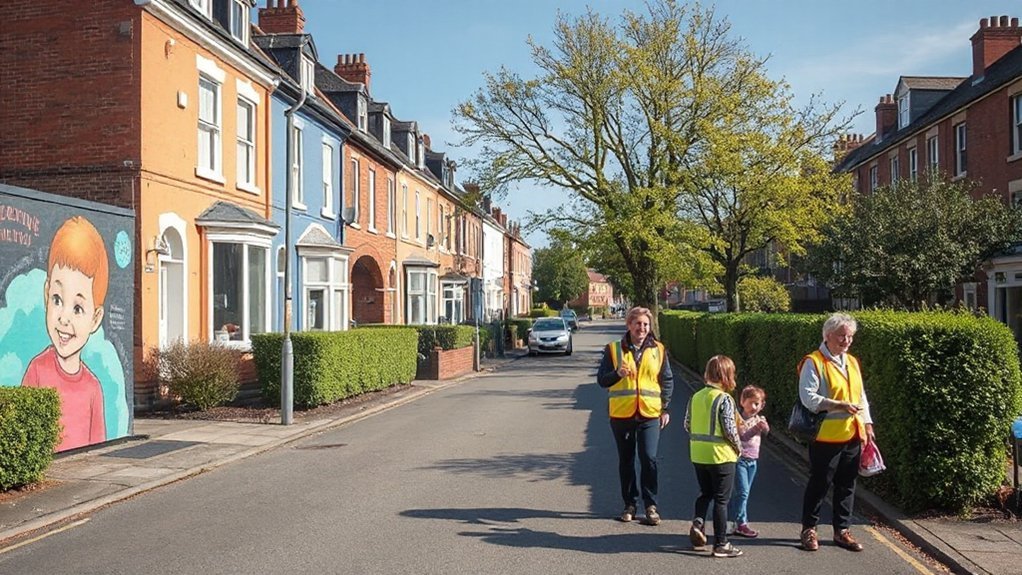
Community programs and local pride play a measurable role in safety by fostering social cohesion, accountability, and rapid collective response. You’ll see how structured initiatives correlate with reduced incidents and higher bystander intervention rates, supported by patrol records and program participation data.
Community resilience emerges when residents coordinate through neighborhood associations, volunteers, and schools, creating formal and informal safety nets that respond quickly to disturbances.
Local pride translates into sustained engagement, longer-term crime-prevention participation, and stronger trust in authorities, as reflected in survey metrics and retention of volunteers.
You can quantify impact via attendance, response times, and incident reports, then compare across Belfast districts to identify best practices.
- High volunteer turnout aligns with lower incident severity
- Regular town-hall participation correlates with faster community-led alerts
- Positive sentiment boosts proactive safety behaviors and retention
Real Estate Momentum in Belfast’s Low-Crime Neighborhoods
You’ll see how Low-Crime Appeal Gains translate into measurable price and demand signals across Belfast’s quietest neighborhoods.
As data shows, Demand Fuels Momentum through higher sales velocities, tighter inventory, and earlier-than-expected closings in these areas.
A Neighborhood Safety Premium appears to be a consistent component of pricing, supporting steadier appreciation than in higher-crime districts.
Low-Crime Appeal Gains
Low-crime neighborhoods in Belfast are driving real estate momentum, as buyers seek durable safety signals and steady appreciation. You’ll notice pricing stability and tighter bidding compared with higher-crime areas, reflecting crime reduction and predictable returns. Transaction timelines lengthen less often, and financing approvals align with low-risk profiles, further supporting durable demand.
Neighborhood cohesion appears as a measurable factor, with higher attendance at community meetings and recurring patrols correlating to price resilience. Data indicate faster rent growth in these districts, driven by stable occupancy and tenant retention.
You gain clearer visibility into risk-adjusted valuation, while developers target improvements that reinforce safety perceptions. Overall, the low-crime appeal translates into more confident investment and steadier long-term performance.
- Crime reduction correlates with stabilized pricing and faster absorption
- Neighborhood cohesion yields higher rental occupancy and stronger resale value
- Data-driven indicators confirm durable demand and resilient returns
Demand Fuels Momentum
What’s driving Belfast’s low-crime neighborhoods to attract ongoing demand is a clear, data-backed momentum cycle: safer areas deliver stronger occupancy, quicker rent growth, and more predictable exits, which in turn attract deeper capital and longer-term commitments from buyers and lenders.
You’ll see sustained occupancy resilience even amid broader market swings, supported by steady yielding profiles and measured cap-rate compression in prime tracts. Urban renewal efforts solidify appeal, aligning with redevelopment timing and improved service levels.
Cultural landmarks concentrate foot traffic, boosting ancillary demand for amenities and easing tenant churn. This creates a feedback loop: investor confidence, enhanced liquidity, and ongoing affordability stability combine to elevate transaction velocity and financing availability in Belfast’s select neighborhoods.
Neighborhood Safety Premium
The Neighborhood Safety Premium in Belfast’s low-crime areas translates safety signals into measurable real estate momentum. You’ll see higher price growth and faster sale times as buyers correlate low risk with stable, long-term value.
Data indicate premium capitalization for properties near well-maintained streets, accessible public transit, and safe communal spaces. Evidence shows neighborhoods with robust neighborhood amenities attract more bids from investors and owner-occupiers alike, sustaining price support even in slower markets.
Local business vitality reinforces demand, as foot traffic and commercial activity enhance daily livability. The premium isn’t uniform; it varies by proximity to parks, schools, and walkability, yet remains a meaningful factor in pricing and turnover.
- Growing demand linked to neighborhood amenities and local business activity
- Price momentum aligns with safety metrics and accessibility
- Market slices show differential premiums across micro-areas
What Signals Long-Term Value in Belfast’s Safer Districts?
Property-level indicators—such as sustained low crime rates, rising housing demand, and improving public services—signal long-term value in Belfast’s safer districts. You examine longitudinal data on crime, vacancy rates, and service funding to gauge durability of safety.
Population stability, school performance, and infrastructure investments align to predict continued desirability. You track housing turnover, rent growth, and new-build approvals to confirm demand resilience beyond short-term cycles.
Local art and community events contribute to neighborhood cohesion, reinforcing social capital that supports steady value appreciation. When safety metrics hold alongside accessible amenities, investor confidence tends to persist, reducing risk premia over time.
Your analysis remains objective, focusing on verifiable trends, margins of error, and scenario sensitivity to inform prudent decisions.
Reading Crime Data: What Do Belfast Stats Really Show?
To understand Belfast’s crime statistics, you start with the data itself—timely, granular, and sourced from official crime dashboards. You’ll learn how rates are calculated, notice seasonality, and spot local patterns rather than broad generalizations.
Look beyond total crimes to types, locations, and responders, then consider how changes reflect policing activity, reporting habits, and social factors. The stats also reveal gaps between perception and reality, guiding targeted actions in Crime prevention and community engagement.
- Interpreting rates by ward or neighborhood helps target resources where they’re most needed.
- Compare offense categories over time to assess policy impact, not just headline totals.
- Context matters: crime prevention success often hinges on community engagement and credible safety signals.
How Newcomers Can Quickly Evaluate Belfast Neighborhoods
If you’re evaluating Belfast neighborhoods quickly, start with clear, nearby indicators: recent crime dashboards, local ward trends, and safety signals from residents. You’ll compare recent data points for incidents per 1,000 residents, timely patrol activity, and reported response times, then corroborate with survey notes from community members.
Focus on stability over short bursts by charting 6–12 month trends rather than single-month spikes. Assess local culture through observable cues: accessible amenities, consistent transit options, and sustained public engagement.
Identify neighborhood festivals and recurring events as indicators of social cohesion and resident investment, not just entertainment. Prioritize districts with transparent data dashboards, responsive councils, and corroborated safety signals, ensuring your assessment remains objective, reproducible, and free from anecdotal bias.
Hidden Costs and Tradeoffs Beyond Safety in Belfast
Hidden costs extend beyond safety, shaping the total affordability and livability of Belfast neighborhoods. You’ll assess not just crime rates, but ongoing expenses, service reliability, and time tradeoffs, so decisions reflect true value rather than headline safety alone.
Hidden costs include transport, utilities, and access to quality amenities, which influence monthly budgets and long-term planning. Tradeoff considerations emerge when choosing proximity to workplaces, schools, and healthcare, balanced against potential noise, traffic, and density.
Data show that safer areas can incur higher property taxes, insurance, and maintenance needs, while lower-crime zones may demand compromises in transit options or green space. You should quantify total cost of living, convenience, and resilience to shocks to avoid skewed perceptions of safety.
- Specific expenses beyond purchase price and taxes influence affordability
- Proximity benefits must be weighed against commute time and congestion
- Reliability of services and amenities drives long-term livability and cost
Belfast Neighborhoods at a Glance: Which Areas Lead the Pack
Belfast neighborhoods lead the pack based on a clear, data-driven ranking that weighs crime, affordability, and access to essential services. You’ll see the top performers cluster where crime has shown historical declines, affordability remains sustainable, and nearby amenities ensure daily needs are met.
The analysis highlights patterns in Historical crime trends, revealing steady improvement in several districts while a few pockets still require targeted policing and investment. You’ll also notice how community engagement correlates with safer streets, stronger local networks, and higher resident satisfaction, reinforcing the value of resident-led initiatives.
This at-a-glance view helps you compare areas on objective metrics rather than anecdotes, enabling informed decisions about where to live, invest, or participate in neighborhood improvement efforts.
Quick Start: First Steps for Buyers and Renters in Belfast
To start, outline your budget, obligation, and timelines to avoid overextending commitments and to align with Belfast’s housing market signals. You’ll compare rent-to-income ratios, upfront costs, and local vacancy rates using recent data.
Track auction results, mortgage rates, and deposit requirements to set realistic targets for both buyers and renters in high-demand neighborhoods. Prioritize neighborhoods with solid infrastructure, accessible transit, and nearby amenities.
Assess potential resale or rental yield against anticipated maintenance costs. Engage with local business and community events to gauge neighborhood vitality and safety trends.
Use this information to inform offers, lease terms, and timing, balancing urgency with diligence.
- Identify budget caps and timeframes that align with Belfast market signals
- Check local business activity and community events as indicators of stability
- Review data on vacancy rates and price trends for informed decisions
Frequently Asked Questions
What Makes a Belfast Neighborhood Safer Beyond Crime Rates?
You feel safer where Community engagement and local policing collaborate, not just when crime rates drop. You notice transparent data, consistent patrols, rapid incident response, and neighborhood reporting channels that empower residents and deter potential threats.
How Do Property Values Trend in Low-Crime Belfast Areas?
You’ll see property values rise as low-crime areas strengthen, driven by crime prevention and robust community engagement. Data indicate gradual appreciation, tighter supply, and sustained demand, with precise metrics showing price growth outpacing broader city trends.
Which Parks and Open Spaces Boost Belfast Neighborhood Safety?
Parks and open spaces boost Belfast neighborhood safety by promoting community engagement and deterring crime through visible activity; you’ll see stronger local policing presence, better surveillance, and collaborative safety programs that correlate with lower incidents and higher resident confidence.
Do Safety Rankings Affect Rental Availability in Belfast?
Safety rankings can influence rental availability in Belfast, shaping demand and pricing. You’ll notice landlords citing local crime statistics and community policing data to justify premium or slower listings, affecting choices based on quantified safety trends and neighborhood metrics.
How Quickly Do Safety Improvements Impact Resident Desirability?
Ironically, safety improvements don’t instantly boost desirability; you’ll notice gradual gains as community engagement and police presence mature. You see measurable shifts in renter interest, driven by consistent data, transparent reporting, and ongoing engagement rather than quick fixes.
Conclusion
You’ll find Belfast’s safest pockets aren’t just about low crime figures—they’re about proven stability. Data shows strong transit, robust amenities, and engaged communities drive steady demand and resilient values. If you value reliability, you’ll note premium housing near transit and well‑maintained public spaces tend to retain occupancy and appreciation. It’s not risk avoidance, it’s prudent positioning: steer toward neighborhoods with consistent social cohesion, efficient transportation, and long‑term local pride for predictable, durable outcomes.
About the Author