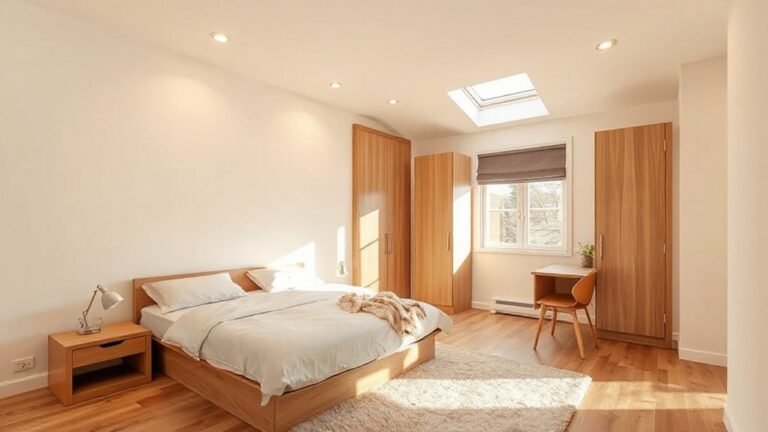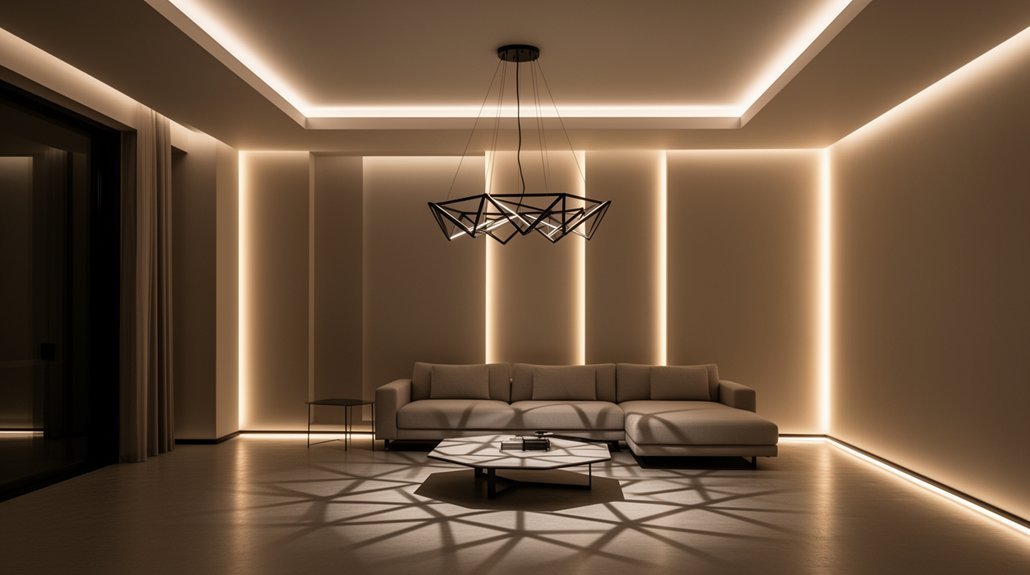
Ultra-modern lighting upgrades your living spaces with clean lines, layered ambient, task, and accent lighting. You’ll gain mood, focus, and texture by combining warm, high-CRI LEDs with dimmers and smart controls, while hidden LED systems keep ceilings and coves clean. Adapt to scale with small rooms or open plans, using proportioned fixtures and glare-conscious placements. Treat lighting as art with sculptural centerpieces and thoughtful finishes. Ready to explore more ways to refine ambiance and efficiency? Keep going.
How Ultra-Modern Lighting Transforms Contemporary Living Rooms
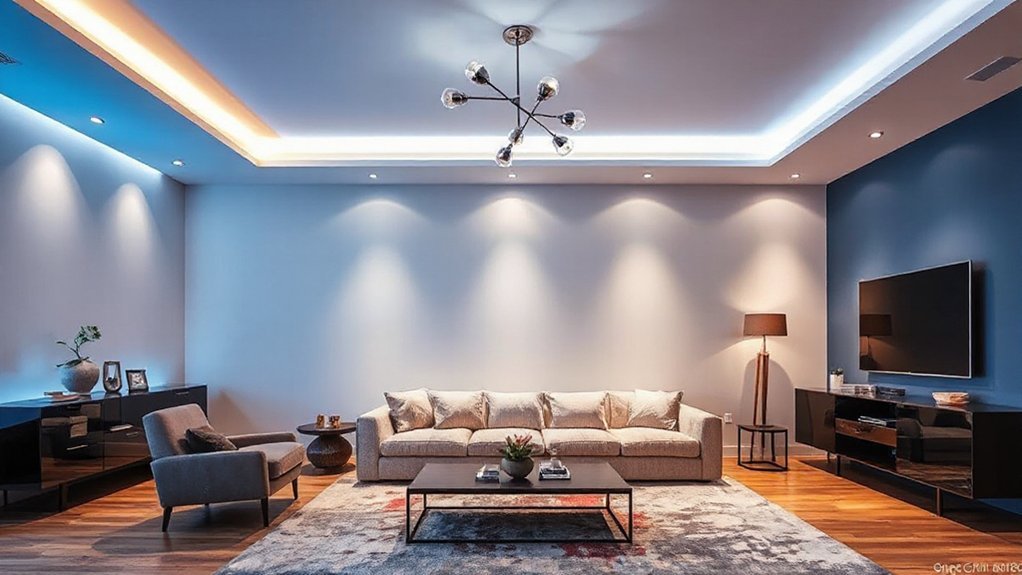
Modern, ultra-modern lighting turns living rooms into focused, functional spaces. You’ll see how sleek fixtures contour sightlines, carve zones, and reduce clutter with glare-free outputs.
When you choose lines, you guide emphasis: architectural shelves glow softly, seating areas gain depth, and focal art stays legible at every hour. You’ll balance efficiency with warmth by pairing cool, high-CRI LEDs with dimmers, creating moods without sacrificing clarity.
Vintage charm appears when you blend retro silhouettes with contemporary LEDs, proving heritage can coexist with future-forward tech.
Natural materials surface through warm-toned wood accents and stone textures that interact with light, softening edges and enhancing tactility.
Your room becomes purposeful, inviting, and adaptable, as lighting design channels function while respecting style.
The Core Concepts: Ambient, Task, and Accent Lighting Demystified
Ambient, task, and accent lighting form the backbone of effective modern lighting design. You’ll use each layer deliberately to shape mood, function, and focal points without clutter.
Ambient light provides general coverage; choose fixtures with diffuse illumination to avoid harsh glare.
Task lighting targets work zones—under-cabinet LEDs, desk lamps, or reading sconces—boosting accuracy and reducing eye strain.
Accent lighting highlights architecture, art, or textures, creating depth and drama.
Color psychology guides color temperature and balance: cooler temps for focus, warmer tones for relaxation.
Energy efficiency matters; opt for LEDs, dimming controls, and smart sensors to minimize waste while preserving ambiance.
Mastery comes from balancing layers, not overloading one. You’ll achieve a cohesive, efficient, and inviting space with measured, purposeful light placement.
Layering Light: A Practical Framework for Mood and Space
Layering light isn’t a guesswork trick; it’s a practiced method that combines ambient, task, and accent layers into a cohesive mood and functional space. You can tailor each layer to support natural illumination while avoiding glare, creating a balanced, usable environment.
Think of color layering to influence atmosphere without overpowering the room. Use warm ambient sources, crisp task lighting for work zones, and selective accents to define focal points. This framework guides you to harmonize daylight with artificial light, enhancing depth and texture.
- Align ambient, task, and accent lighting for daily activities
- Use dimmers to modulate mood and flow
- Incorporate daylight-responsive fixtures to maintain natural illumination
- Apply color layering to reinforce mood without color fatigue
Statement Fixtures That Define and Elevate a Room
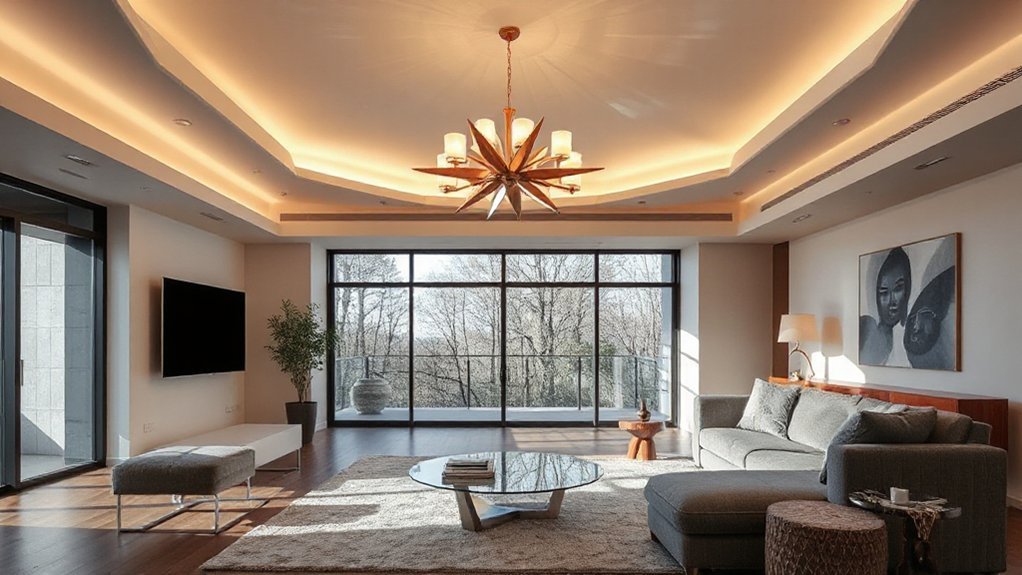
Your layering framework sets the stage for a room, but statement fixtures take the spotlight and define it. Statement fixtures aren’t just illumination; they become focal points that convey personality and scale.
Choose pieces that contrast in form or finish to create color tension, then balance them with the surrounding architecture. Consider fixture placement: hang a sculptural ceiling piece to anchor the center, pair wall sconces to frame art, and position floor lamps to sculpt shadows along textures.
Aim for cohesive height relationships and deliberate spacing so one element enhances another rather than competes. Test lighting at multiple times of day to verify impact.
Prioritize bold silhouettes, refined materials, and practical brilliance that supports function while elevating the room’s mood and style.
Hidden LED Systems: Seamless Illumination, Clean Lines
Hidden LED integration lets you hide lighting within walls, ceilings, or coves for a clean, uninterrupted silhouette.
With seamless lighting control, you gain precise mood shifts and adapt lighting exactly to the moment without visible fixtures.
This approach prioritizes clean line aesthetics, keeping your spaces calm, modern, and visually expansive.
Hidden LED Integration
How can you achieve seamless illumination without visible fixtures? Hidden LED integration delivers clean lines by concealing strips in coves, stair treads, cabinetry, and millwork. You’ll notice balanced color, controlled glare, and consistent lighting symmetry that enhances architecture rather than cluttering it.
Choose high-CRI LEDs with tunable white to heighten color contrast between surfaces and fixtures, while preserving true hues. Use diffusers to soften hotspots and guarantee uniform spread across planes. Dimmable drivers let you adapt scenes without revealing sources.
- Install LEDs behind cornices or within negative reveals for discreet glow
- Align strips to emphasize architectural features and create even carpet-to-wall brightness
- Select size-appropriate channels to minimize shadows and maximize efficiency
- Schedule calibration for consistent color and intensity across zones
Seamless Lighting Control
Wireless dimming lets you to tailor brightness without visible hardware, preserving the room’s calm silhouette while supporting adaptable scenes. Voice activation adds convenience, enabling you to adjust ambience from across the room, during gatherings, or while relaxing.
The system prioritizes reliability, using low-profile drivers and silent power management to avoid hums or flicker. Calibration happens at install, aligning color temperature and intensity with architectural intent so progressions stay smooth.
Maintenance stays minimal, thanks to robust wireless links and centralized monitoring that catch issues before impact. In practice, seamless control elevates contemporary living with precision and ease.
Clean Line Aesthetics
- Pendant clusters tucked into ceilings or coves create floating luminance without interruptions.
- Wall sconces recessed into plaster or wood for subtle accents that read as architectural details.
- Linear luminaires concealed behind lips, moldings, or under shelves for continuous lines.
- Backlit panels paired with inset diffusers to soften edges and maintain clean silhouettes.
This approach supports modern materials and finishes, enhancing textures rather than competing with them. You gain flexibility in layout and color rendering, elevating ambiance while keeping focal points clear and uncluttered.
Pendant clusters, wall sconces, and hidden LEDs converge for refined, functional aesthetics.
Color Temperature for Mood and Color Rendition: A Quick Guide
Color temperature guides how warm or cool a space feels, and choosing the right temp can shape mood and task performance. In practical terms, you’ll select warm tones (around 2700–3000K) for cozy living areas that invite conversation, and cooler tones (4000–5000K) for tasks requiring focus.
For color rendition, aim for a high CRI (85+), which preserves natural hues and details, essential for art, fabrics, and furniture.
Layering lighting—ambient, task, and accent—lets you adjust mood creation without changing fixtures. Consider tunable white options to shift atmospheres without rewiring.
Avoid extremes that flatten textures or induce glare. In summary, balance temperature with CRI and layered lighting to achieve purposeful ambiance that adapts to activities and times of day.
Smart Lighting in Living Areas: Protocols, Apps, and Scenes
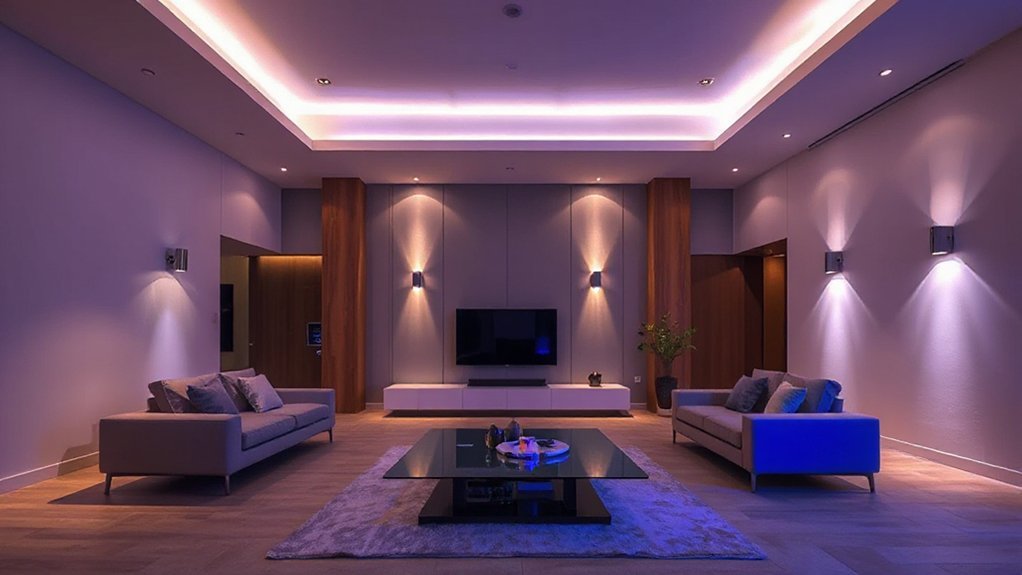
Smart lighting in living areas hinges on robust protocols, intuitive app controls, and thoughtfully crafted scenes that adapt to your routines. You’ll explore how protocols guarantee reliable communication between devices, apps simplify scene management, and automation elevates comfort without overdoing it. Let’s examine practical setups that balance performance, privacy, and ease of use while meeting your daily lighting needs.
Smart Lighting Protocols
Among modern living spaces, smart lighting protocols define how your bulbs communicate, coordinate, and respond across scenes and routines. You’ll leverage standards and ecosystems to guarantee reliable color, timing, and brightness. Protocols determine how devices negotiate power, band, and priority, letting scenes execute smoothly without gaps.
With color synchronization, hues stay consistent across rooms, while voice activation lets you trigger changes hands‑free. Expect robust mesh networks, conflict‑free command handling, and predictable latency, so your ambiance aligns with your moments—work, relaxation, or entertainment.
- Color synchronization across fixtures for cohesive scenes
- Bidirectional control via voice activation and local hubs
- Mesh networking to reduce dropouts and latency
- Cross‑brand compatibility through open profiles and routines
App-Controlled Scenes
Scenes tie together color temperature, brightness, and power states so one tap or voice directive adjusts multiple fixtures simultaneously. Use voice commands to activate mood settings without rummaging for controls, and rely on app-based triggers for scheduled ambiance shifts.
When configuring scenes, consider room groups, fixtures with dimming curves, and color rendering quality to guarantee consistent results across zones.
Privacy and security matter: enable strong authentication and limit third-party access. Regularly review scene naming, share permissions, and compatibility across devices to maintain predictable performance and a cohesive, polished living space ambiance.
Living Area Automation
In living areas, automation hinges on a cohesive setup of protocols, apps, and scenes that work together to deliver consistent, comfortable illumination. You’ll optimize control by choosing a unified hub, standardizing device compatibility, and tagging scenes for quick access. Prioritize reliability over bells and whistles; stable routines reduce latency and misfires.
Use scenes that respect circadian rhythm, with dimming and warm tones at evening and brighter, cooler light during work hours. Include backup controls like physical switches for accessibility. Integrate vintage fixtures and outdoor lighting thoughtfully, ensuring harmonized color temperature and power needs.
Keep security and firmware updates current to maintain seamless performance.
- Choose a single platform for devices
- Create energy-saving, automated schedules
- Integrate vintage fixtures with modern controls
- Test outdoor lighting routines regularly
Energy-Smart Design: Efficiency Without Compromising Style
Energy-smart design blends efficiency with style by making every lighting choice count. You’ll focus on strategic layering: ambient, task, and accent lighting that work together rather than compete.
Choose high-efficiency LEDs with dimming capabilities to align brightness with mood and time of day, reducing energy waste without sacrificing atmosphere. Prioritize color rendering and warmth that suit each space, so you don’t feel compelled to over-illuminate.
Implement smart controls and occupancy sensors to automate energy conservation while preserving convenience. Favor sustainable design principles by selecting fixtures with recyclable components and long lifespans.
Optimize daylight integration through window placement and glare control, letting natural light complement artificial layers. This approach delivers elegant, functional environments where sustainability informs every luminaire choice.
Metals, Glass, and Finishes: Refining Modern Lighting Materials
Metal finishes are trending toward warmth and subtle texture, while glass seeks clarity and nuanced transparency to enhance light.
You’ll explore how metallic tones pair with glass to shape mood, durability, and visual hierarchy.
Consider how material pairing techniques can unify form and function across contemporary fixtures.
Metal Finishes Trends
Metal finishes are shaping modern lighting by balancing durability with refined aesthetics, pairing warm brass with cool brushed nickel and the timeless practicality of matte black. You’ll see a clear move toward tactile textures, subtle patinas, and durable coatings that resist wear while maintaining clarity of design.
In practice, metal finishes guide how you mix fixtures, hardware, and accents, supporting cohesive spaces that feel deliberate. You should monitor trend forecasting to anticipate color warmth, reflectivity, and corrosion resistance, selecting finishes that endure without dated echoes.
The result is a calm, tailored glow that reads as crafted, not fussy.
- Brass-aged blends with nickel for nuanced contrast
- Matte black foundations grounding bright accents
- Brushed metals adding depth without glare
- Textured surfaces improving durability and tactile appeal
Glass Transparency Aesthetics
Glass transparency shapes how you perceive space and light, guiding the way glass, metals, and finishes interact to refine modern lighting. You’ll notice how clear or frosted panes influence glare, diffusion, and mood, shaping the room’s perceived depth and clarity.
This aesthetic appeal hinges on controlled visibility: choose glass with low iron content for crisper whites, or textured surfaces to soften reflections without sacrificing brightness. Metallic accents—brushed nickel, chrome, or warm brass—play off glass by echoing light paths, creating balanced contrast rather than overpowering it.
Finishes should complement, not compete, with the luminosity of the source. In practice, align transparency with scale and purpose: large panels for openness, smaller details for intimacy, always prioritizing unobstructed illumination and cohesive visual rhythm.
Material Pairing Techniques
To refine modern lighting materials, pair metals, glass, and finishes with intention so the elements enhance rather than compete with light. You’ll balance warm textures with cool surfaces, creating contrast without glare. Material pairing anchors design, guiding how glow travels through every fixture. Choose finishes that reflect or absorb differently, shaping ambience and focus.
Favor innovative textures—hammered, brushed, or frosted surfaces—that subtly alter luminance while maintaining clarity. You’ll align metal tones with glass permeability, ensuring coherence across fixtures and accents.
When in doubt, test scale and sheen under actual lighting conditions, not just samples. By prioritizing purposeful contrasts, you achieve a cohesive, radiant room.
- Material pairing for cohesive glow
- Innovative textures that soften glare
- Harmonizing metals with glass permeability
- Finishes that refine light distribution
Small Rooms vs. Open Spaces: Adapting Light for Scale
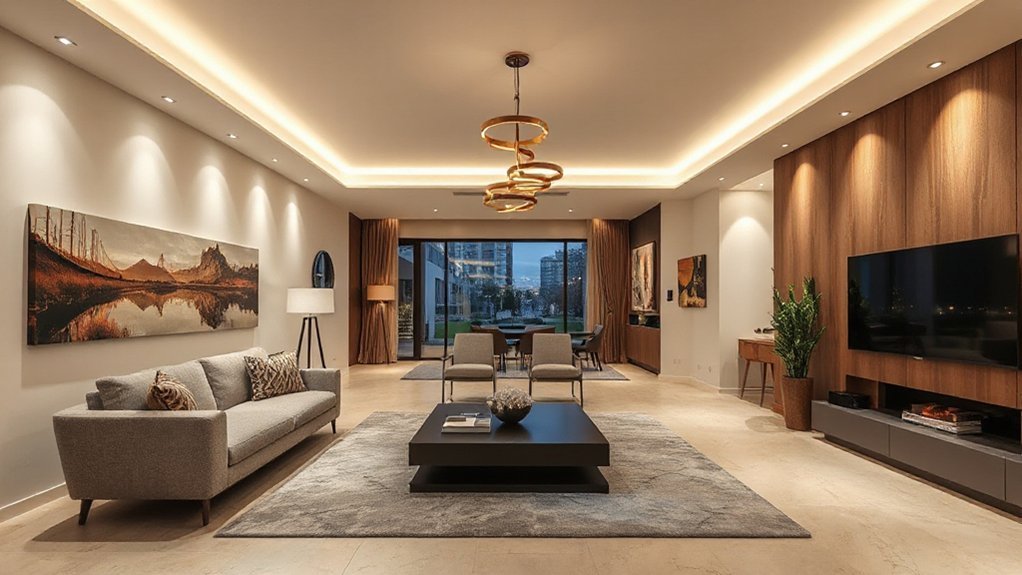
When lighting a small room, every watt counts, and you should plan for brightness that feels generous without overpowering the walls or ceiling. In compact spaces, prioritize layered lighting: a mix of ambient, task, and accent that builds perceived space rather than ballooning brightness.
Use narrower profiles and higher-quality sources to reduce glare while preserving depth. Open spaces benefit from continuity: align color temperature and fixtures to create a cohesive flow that guides the eye across areas without abrupt changes.
Consider color psychology to influence mood—cooler tones for focus, warmer hues for coziness—while appreciating historical influences in fixture shapes and finishes for timeless appeal.
Balance scale by proportioning luminaires to furnishings, avoiding oversized statements that suffocate openness.
Lighting as Art: Sculptural Pieces That Command a Center
Lighting as art isn’t just about illumination; it’s a sculptural statement that centers a room and defines its rhythm.
- Embrace Sculptural elegance with bold, oversized forms that pull focus without overwhelming the space.
- Choose pieces of Artistic illumination that double as sculpture, marrying light quality with silhouette.
- Position a single centerpiece at eye level to anchor furniture groupings and guide traffic flow.
- Use contrasts—soft ambient glow around the periphery, crisp accents at focal points—to sculpt depth.
You’ll notice the room’s tempo shift as the piece reframes volume, texture, and color. This approach treats lighting as a living art form, not mere utility, elevating your space with purposeful, gallery-grade presence.
Controlling Glare: Curtains, Surfaces, Reflections, and Placement
Curtains, surfaces, reflections, and placement can make or break the mood you set with your lighting. You control glare by choosing window treatments that diffuse or block direct light, preventing hotspots without darkening rooms excessively.
Consider surface reflectivity; matte finishes absorb harsh rays, while textures break up glare on glossy walls. Position luminaires to avoid facing screens or mirrors, and align task lighting with work zones rather than your eyes’ line of sight.
Use three-layer lighting strategies—ambient, task, and accent—to balance brightness and reduce glare risks across activities. Choose materials with consistent color temperatures and low-bleed fabrics to maintain color accuracy.
Test samples at different times of day to confirm comfort, then refine placement for steady, inviting illumination. Surface reflectivity considerations guide your design outcomes.
Zoning and Scenes: Daily Rhythms, Automation, and Personalize
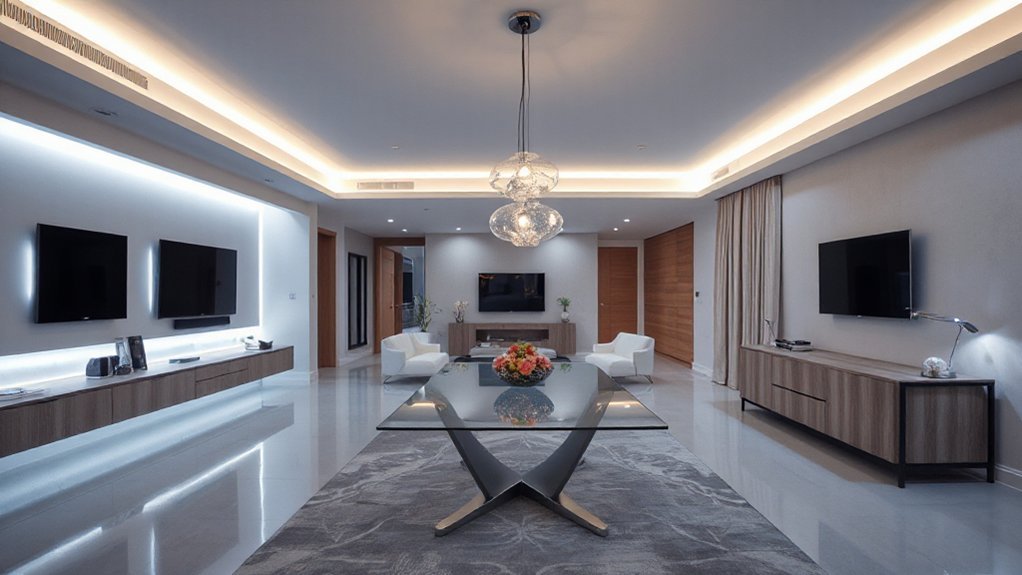
Zoning and scenes let you tailor lighting to how you live each day, shifting brightness and color to match activities and moods. You’ll automate routines, switch contexts with presets, and personalize scenes for work, meals, or winding down.
Aligning lighting with color psychology helps you feel focused, relaxed, or energized, while smart controls conserve energy—boosting lighting sustainability without sacrificing comfort. You gain predictable ambience at any hour, reducing glare and decision fatigue.
Integrate sensors, timers, and voice commands to simplify daily rituals, then fine-tune intensity and hue per space. Consistency across rooms reinforces a cohesive aesthetic, yet allows expressive variation when needed.
- Create mood-specific scenes for work, dining, and relaxation
- Use adaptive brightness to mirror natural rhythms
- Schedule energy-saving presets for off-peak hours
- Pair colors with activities to reinforce intents and wellbeing
Frequently Asked Questions
How Do We Choose Lighting for Small Spaces Versus Large Rooms?
For small spaces, prioritize ambient ambiance with layered lighting and compact fixtures; for large rooms, layer task and accent lights to sculpt zones. Balance color coordination, avoid harsh contrasts, and let ambient light set the tonal mood.
What Are Budget-Friendly Ultra-Modern Lighting Options?
Budget-friendly ultra-modern options include vintage fixtures and artistic installations; you can mix affordable LEDs with retro silhouettes, layering light for depth. Choose statement pieces cautiously, prioritize insulation and dimmers, and shop secondhand for authentic character and budget-conscious impact.
How Can Lighting Influence Perceived Room Height and Depth?
You’ll alter perceived room height and depth by layering ambient ambiance with strategic lighting, casting shadows that elongate ceilings and revealing architectural features, guiding visual perception toward greater openness and balance throughout your space.
Which Fixtures Best Complement Minimalist Interior Styles?
Minimalist fixtures that stay slim and understated best complement your space; think recessed scales and simple pendants. You’ll achieve ambient glow with precise fixture placement, echoing quiet sophistication while you maintain clean lines and functional depth.
What Maintenance Practices Extend LED Longevity in Homes?
To extend LED longevity, practice proper cooling, choose high-quality drivers, and replace failing components promptly. Regularly update firmware through lighting automation, monitor heat, and enhance dimming. Prioritize energy efficiency and routine cleaning to maintain ideal performance.
Conclusion
In embracing ultra-modern lighting, you shape atmosphere as you shape space—singular, purposeful, and relentlessly refined. You layer ambient, task, and accent to sculpt mood, highlight architecture, and elevate texture. You’ll lean on hidden LEDs for clean lines, while statement fixtures punctuate. Can you envision your room bathed in scenes that switch with your day? You’ll control glare, scale, and drama with precision, crafting environments that feel inevitable, modern, and unmistakably yours.
About the Author