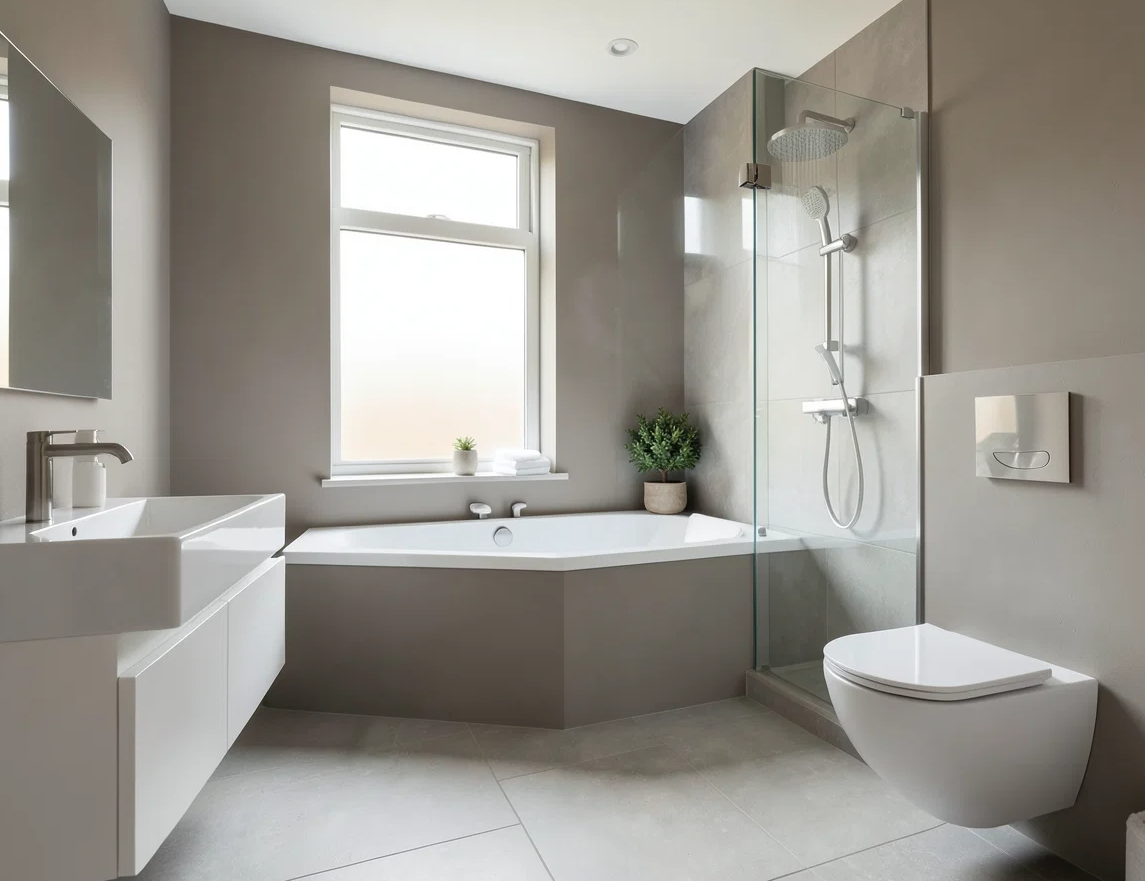
3 Bathroom Essentials: Plumbing, Ventilation & Floor Heating
We are looking at the important bathroom essentials, that come together in a project. A bathroom renovation tends to be driven by aesthetics — the tiles, the sanitaryware, the taps, the layout. These are the elements that appear in the mood boards and that shape the finished room’s character. But the three building services systems that sit behind and beneath the visible surface are the ones that determine whether the bathroom actually works: the plumbing that delivers and removes water with adequate pressure and flow, the ventilation that manages moisture and prevents the damp that destroys bathrooms from the inside, and the underfloor heating that makes a tiled floor habitable in winter.
Getting these three systems right is the difference between a bathroom that is a genuine pleasure to use and one that looks beautiful in photographs but creates frustrations every time it is occupied. Getting them wrong — or specifying them as afterthoughts once the aesthetic decisions have already been made — is one of the most reliable routes to an expensive remedial project.
Here is what you need to understand about each of the three, and why they deserve more design attention than they typically receive.
1. Plumbing
Pressure and Flow: The Foundation of Everything
The single most common bathroom plumbing complaint is inadequate water pressure — the shower that delivers a trickle rather than a spray, the taps that take forever to fill a bath, the frustrating variation in temperature that occurs when another tap is opened elsewhere in the house. All of these are symptoms of a plumbing system that has not been designed with adequate pressure and flow capacity for the demand being placed on it.
Water pressure in a domestic plumbing system is determined at the point of supply by the mains pressure (which varies by location and time of day and is outside the homeowner’s direct control), but it is then shaped by the internal plumbing system — the diameter of the pipes, the number of restrictions and bends in the circuit, the height difference between the supply and the outlet, and whether any pressure-boosting equipment has been installed.
In the UK, older properties commonly supply bathrooms from a cold water storage tank in the loft, fed by gravity — a system that provides relatively consistent pressure but at a level that is often inadequate for modern shower fittings and thermostatic valves that require a minimum operating pressure to function correctly. The solution for gravity-fed systems that cannot provide adequate pressure is a shower pump or a pressurised unvented cylinder that upgrades the whole system. This is a plumbing decision that needs to be made at the planning stage of a bathroom renovation, not after the shower enclosure has been installed and the performance proves disappointing.
Hot Water Delivery
The time lag between opening a hot tap and hot water arriving at the outlet is determined by the length of the pipe run between the hot water cylinder or combi boiler and the outlet, the diameter of that pipe, and whether any form of hot water circulation or trace heating has been installed. In a large house, the hot water pipe run from a cylinder to a distant bathroom can be long enough to deliver a substantial volume of cold water before hot water arrives — a comfort issue, a water waste issue, and a frustration that can be designed out.
Secondary hot water circulation — a small pump circulating water continuously or on a timer around the hot water pipework — ensures that hot water is available almost immediately at every outlet, regardless of distance from the cylinder. It uses more energy than a static system but significantly less water, and the comfort benefit in daily use is substantial. This is an option worth specifying for any new bathroom installation that involves a significant pipe run from the hot water source.
Drainage: Getting It Right Before the Floor Goes Down
Bathroom drainage design is effectively irreversible once the floor structure or screed is installed, which makes it the plumbing decision that most demands advance planning. The positions of the WC, basin, bath, and shower all determine where drainage connections need to be made, and moving any of these connections after the floor is closed up involves significant remedial work.
The critical drainage consideration for shower installations in particular is the fall to the drain. A wet room or walk-in shower requires a very precise fall in the floor surface — sufficient to carry water reliably to the drain without allowing it to pool elsewhere, but not so steep as to be uncomfortable underfoot or to cause water to rush in a way that prevents it from falling accurately. The standard minimum fall is 1:60 to 1:80 (approximately 12–17mm fall per metre of floor), and achieving this precisely requires either a specialist pre-formed shower former/tray, a skilled screeder working to levels, or a specialised wet room drainage system with a pre-sloped former that handles the gradient engineering.
Linear drains — the long, narrow floor drains that create the minimal, architectural drainage look common in contemporary wet room design — require the entire floor to fall to a single edge rather than from all directions toward a central point. This changes the structural and screeding specification significantly and needs to be communicated clearly to every contractor involved in the floor build-up.
Water Supply to Fixtures: Pipe Sizing and Material
The diameter of supply pipes to bathroom fixtures determines the flow rate available at each outlet. Standard residential pipework in the UK uses 15mm copper or plastic pipe for branch connections to individual outlets, with 22mm or 28mm for main circuits. If a shower fitting specifies a minimum flow rate that the existing 15mm supply cannot deliver, the supply pipe needs to be upsized — a straightforward intervention if done before plastering, an expensive and disruptive one afterwards.
Pipe material has become a genuine choice in modern domestic plumbing, with plastic push-fit systems (such as Speedfit or Hep2O in the UK) now widely used alongside traditional copper. Plastic push-fit is faster to install, does not require soldering, and is compatible with the thermal movement that occurs in hot water systems. Its main limitation is that push-fit connections can fail if not properly made or if the fitting is subsequently subjected to significant vibration or movement; within a properly constructed floor or wall, this is not typically a problem.
2. Ventilation
Why Bathroom Ventilation Matters More Than Most People Think
A bathroom generates more moisture per hour of use than almost any other domestic space. A shower produces approximately 1–2 litres of water vapour per session; a bath produces somewhat less but still a substantial moisture load. This moisture, if not extracted from the space, will condense on the coldest surfaces — typically external walls, window reveals, and ceiling corners — and create the conditions for mould growth, paint failure, and the gradual deterioration of the building fabric.
Mould in bathrooms is not primarily a decorative problem. The mycotoxins produced by common bathroom moulds (Aspergillus and Cladosporium species are the most common, with Stachybotrys in chronic damp situations) are associated with respiratory health effects including allergic rhinitis and asthma exacerbation. For households with children, elderly occupants, or anyone with a respiratory condition, inadequate bathroom ventilation is a health risk that is worth taking seriously.
The UK Building Regulations (Part F) specify minimum ventilation rates for bathrooms: 15 litres per second for intermittent extract (a fan that runs during use and for a period after), or 8 litres per second continuous extract. These are minimum requirements — in bathrooms with particularly intensive use, or where the construction details create significant thermal bridging that encourages condensation at the walls, higher extract rates may be appropriate.
Fan Selection and Specification
The choice of bathroom extract fan is one of the most frequently underspecified decisions in a bathroom renovation — a decision often made on the basis of appearance or price rather than on the basis of performance.
Extract rate (litres per second). This is the fundamental specification. A fan rated at 15 l/s or more will meet Building Regulations for an intermittent fan; a fan rated below this will not, regardless of how quiet or aesthetically pleasing it is. Extract rate should be matched to the bathroom’s size and use intensity — a small WC and a large family bathroom with a wet room shower do not have the same requirement.
Noise level (sone or dB rating). Bathroom fans are rated for noise, and the difference between a fan that generates 0.5–1.0 sone (barely perceptible) and one that generates 3.0–4.0 sone (noticeably noisy) is the difference between a fan that is used willingly and one that occupants avoid using. Investing in a quieter fan — which typically means a better quality motor and more carefully designed impeller — produces a bathroom that is better ventilated simply because occupants are less reluctant to run it.
Run-on timer and humidity sensor. A fan with a run-on timer that continues extraction for 15–20 minutes after the occupant has left removes the moisture that has been released during the session and has not yet reached the extract point. A humidity sensor that triggers the fan when relative humidity exceeds a set threshold (typically 70–75%) and runs until humidity falls below it is more responsive to actual bathroom use patterns than a timer and is particularly useful in households where bathroom use is irregular. Some modern fans combine both functions.
Duct diameter and length. The performance of a bathroom extract fan is dramatically affected by the ductwork connecting it to the external discharge point. A fan rated at 15 l/s may actually deliver significantly less than this if the duct is too narrow (the minimum recommended diameter is 100mm for most bathroom fans), too long (duct length significantly increases resistance and reduces effective flow rate), or has too many bends (each 90° bend is equivalent to approximately 1–2 metres of additional straight duct in resistance terms). Specify the ductwork as part of the fan specification, not as an independent afterthought.
Ventilation in Wet Rooms and Steam Showers
A wet room or steam shower installation imposes significantly higher moisture loads than a standard bathroom and requires a ventilation specification to match. A standard intermittent fan at 15 l/s may be inadequate for a steam shower — in this application, a higher-rated fan, or a mechanical ventilation with heat recovery (MVHR) system that provides continuous background ventilation, is the appropriate specification.
In wet rooms without a door to separate the shower area from the rest of the bathroom (the defining characteristic of a true wet room), the moisture generated during a shower disperses throughout the entire bathroom space rather than being concentrated in the shower enclosure. This increases the requirement for extract capacity and means that the fan placement — typically in the ceiling above or adjacent to the shower area — needs to be considered in the context of the whole-room airflow.
3. Underfloor Heating
Why Tile Floors Need Underfloor Heating
Ceramic and porcelain tile, and natural stone, are the dominant floor finishes in bathrooms for good reason — they are hygienic, durable, easy to clean, and water-resistant. They are also excellent thermal conductors, which means they feel cold to bare feet at ambient room temperatures. A tiled bathroom floor in a house heated to 20°C will feel noticeably colder than the room temperature because the high thermal mass and conductivity of the tile surface draws heat rapidly from the foot.
Underfloor heating warms the floor surface itself, rather than the air in the room, which changes the experience of a tiled floor from cold to comfortable — and does so efficiently, because raising the floor surface temperature by a few degrees requires much less energy than raising the room air temperature by the same amount.
Electric vs. Hydronic Underfloor Heating
Electric underfloor heating (UFH) uses a resistive heating cable or mat laid in or under the floor build-up, connected to an electrical supply and controlled by a thermostat. It is the standard specification for bathroom retrofit applications because it is relatively thin (an electric mat adds approximately 3–4mm to the floor build-up), straightforward to install as part of a floor refurbishment, and does not require connection to the central heating wet system.
Electric UFH in bathrooms is most appropriately specified as a supplementary comfort heating system rather than the primary heat source for the room. It warms the floor and the air immediately above it effectively, providing the warm floor experience that is the primary goal, but it is not typically efficient enough to heat the entire room air volume during cold weather. A bathroom towel radiator or electric towel warmer usually complements the UFH as the primary room heater.
Running costs for electric bathroom UFH depend on electricity tariff and usage patterns. A typical bathroom of 5–8 square metres, with the heating running for one to two hours per day during the heating season, might use 100–200 kWh per year — equivalent to approximately £30–£60 per year at current UK electricity tariffs.
Hydronic underfloor heating (warm water UFH) circulates heated water from the central heating system through a network of pipes in the floor screed, providing the same warm floor benefit but integrated with the main heating system. Hydronic UFH is more energy-efficient for whole-room heating and integrates well with heat pumps (which produce water at lower flow temperatures than gas boilers, which suits UFH systems ideally). It is the appropriate specification for new-build bathrooms where the floor construction is being installed from scratch, but it is more invasive and expensive to retrofit than electric UFH.
Installation: What the Floor Build-Up Needs
The floor build-up for electric underfloor heating requires insulation beneath the heating element — without it, a significant proportion of the heat generated will be lost downward into the floor structure rather than upward into the tile surface. A minimum of 6mm rigid insulation board beneath the heating mat (a dedicated thermal board such as Wedi, Schlüter Ditra-Heat, or Kerdi Board is typical) improves system efficiency significantly and is now considered essential practice by most specification-conscious installers.
The heating element — cable or mat — is embedded in or under a tile adhesive bed, which must be specified to be compatible with the heating system. Standard tile adhesives are generally suitable, but flexible adhesive (which accommodates the slight thermal movement of the system as it heats and cools) is recommended, particularly for larger-format tiles which have less grout joint movement tolerance than smaller ones.
The thermostat and its sensor need to be correctly positioned. The thermostat body is typically mounted on the wall at a convenient operating height; the temperature sensor — a probe in a conduit in the floor — needs to be positioned between the heating elements, not on top of one (which would read a falsely high temperature and cause the system to cut out prematurely). Incorrect sensor placement is one of the most common commissioning errors in electric UFH installations.
Control and Smart Thermostat Integration
A bathroom UFH thermostat should provide programmable timing — set the heating to turn on 20–30 minutes before the bathroom is typically used, so the floor is warm before the first occupant steps onto it. Modern Wi-Fi enabled thermostats allow scheduling from a smartphone and can integrate with broader smart home systems, including voice control platforms.
The floor temperature sensor should be set to a maximum surface temperature — typically 27°C for most tile types, or lower for some natural stone finishes that are sensitive to thermal cycling. Running the floor at maximum temperature continuously uses more electricity and may stress the tile and grout over time; the thermostat’s function is to maintain a comfortable temperature efficiently, not to run at maximum.
Designing the Three Together
The most successful bathroom projects treat plumbing, ventilation, and underfloor heating as an integrated system rather than three independent specifications. The decisions in each discipline affect the others: underfloor heating raises the floor build-up level, which affects waste pipe gradients and drainage connection heights; ventilation ductwork routing requires coordination with the plumbing routes in the ceiling void; the thermal mass of a heated tile floor affects the room’s condensation dynamics and therefore the required ventilation extract rate.
Specifying these three systems carefully — ideally with a consultant or experienced bathroom designer who understands all three — and resolving the coordination issues before any floor is laid or any plastering begins is the discipline that separates bathroom renovations that work completely from those that work mostly but with lingering frustrations. The three systems are behind the walls and beneath the floor precisely because they are servicing the visible things that the bathroom is for. Getting them right is what makes all the visible things work as they should.
About the Author