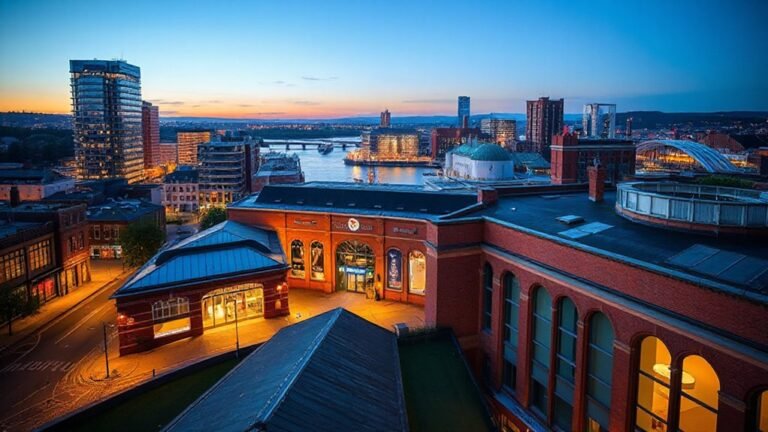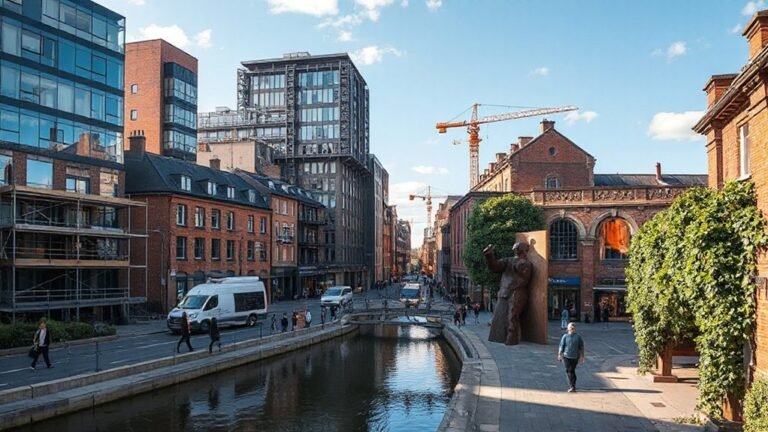
To restore a Victorian villa in Liverpool, start by defining restoration goals that balance authenticity with durability, then assess structural fabric—foundations, walls, roof, and damp—using non-invasive methods. Understand Liverpool planning rules and listed-building considerations, securing approvals as needed. Prioritize safety-critical repairs first, and develop a period-appropriate design brief and budget with phased milestones. Plan permits, documentation, and a phased workflow that aligns finishes, systems, and heritage detailing. If you keep exploring, you’ll uncover how to implement these steps in sequence.
Define Your Victorian Villa Restoration Goals

Defining your Victorian villa restoration goals sets the project’s direction and scope. You begin by mapping the core objective: preserve authentic character while ensuring long‑term performance.
Identify target outcomes for aesthetic fidelity, spatial utility, and mechanical upgrades, then translate them into measurable criteria. Consider Victorian architecture typology—parcellated rooms, decorative plaster, sash windows, and decorative cornices—and decide which elements are essential versus optional.
Assess Liverpool neighborhoods to anticipate urban context, zoning, and stylistic conformity, guiding facade decisions and material choices.
Establish a prioritized wish list, budget allowances, and a phased timeline, including permitting milestones and critical restoration sequences.
Document success metrics, such as period‑correct finish, energy efficiency, and structural reliability, ensuring stakeholders share a unified vision and clear acceptance criteria.
Assess Structural Fabric: Foundations, Walls, Roof, and Damp
You’ll begin by evaluating the building’s structural fabric to establish a sound baseline for restoration work. You’ll map foundations, walls, and roof lines, recording material types, joint conditions, and settlement indicators with precise notes.
For foundations, perform non-invasive assessments, verify trench integrity, and confirm bearing adequacy against historic loads.
Inspect walls for verticality, crack patterns, and moisture-related efflorescence, prioritising brick and lime-render behavior under seasonal cycles.
Examine the roof structure for timber rot, strap connections, tie beams, and slate integrity, documenting sag or deflection risks.
Assess damp dynamics by locating high-moisture zones, moisture profiles, and ventilation efficacy.
Plan foundation inspections and remedial sequencing early, coordinating damp treatment strategies with cure timelines, materials compatibility, and breathable timber preservation to sustain long‑term fabric performance.
Liverpool Planning Rules for Victorian Renovation
Understanding Liverpool’s planning framework is essential for Victorian renovation projects, since it shapes approvals, listed-building considerations, and any fabric-altering interventions. You’ll operate within the statutory process overseen by Liverpool City Council and national guidance.
For Victorian architecture, expect meticulous design reviews, especially where alterations affect exterior façades, chimneys, or rooflines. You’ll assess whether listed-status applies, requiring listed-building consent in addition to planning permission.
Conservation officers may request alternatives that preserve architectural features, such as sash windows, decorative cornices, and cornice work, while enabling essential upgrades.
If your project touches public interest, you’ll engage stakeholders and document materials, methods, and fidelity to Liverpool heritage.
Compliance spans planning conditions, energy performance, and heritage-led design; your submission should demonstrate authenticity, feasibility, and risk mitigation across the renovation scope.
Prioritize Safety-Critical Repairs in Phase One

Align actions with current safety regulations, ensuring compliant containment, access, and sequencing. Isolate dangerous zones, install temporary supports, and dewater or dry any affected areas to prevent further degradation. Prioritize load-bearing repairs, stabilize foundations, and address roofing defects that drive moisture intrusion.
Schedule trades with clear, documented safety protocols, and verify ventilation, dust control, and fire-safety measures. Document every step, linking findings to budget controls and timeframes to maintain disciplined scope management.
Create a Period-Appropriate Design Brief and Budget
You establish a period-accurate design brief by defining essential Victorian details, from materials and finishes to authentic scale and silhouette. Ensuring every choice supports the era’s character.
You align the budget with clear metrics for materials, labor, and contingencies. Mapping each line item to design priorities and risk factors.
You’ll present a concise brief that guides trades and stakeholders, balancing authenticity with feasibility through precise requirements and measurable thresholds.
Define Period Details
To define period details for the restoration, you’ll establish a design brief that specifies authentic Victorian-era features, materials, and construction methods, aligned with a realistic budget.
- Identify key Victorian architecture elements—parapets, cornices, sash windows, natural timber joinery—and confirm their reinstatement to satisfy historical preservation requirements.
- Specify materials and finishes that match era aesthetics and durability, including lime plaster, limewash, ceramic tile, and solid hardwoods, with provenance notes and sourcing standards.
- Establish performance criteria, detailing structural repairs, moisture management, and conservation practices that preserve original craft techniques while meeting current building codes.
This approach guarantees precise scope, supports risk assessment, and maintains alignment with historical preservation goals throughout the project.
Budget Alignment Metrics
Budget alignment hinges on translating the period-appropriate design brief into a realistic, line-by-line cost framework. You’ll establish clear cost drivers from authentic detailing, materials, and craftsmanship expectations, then map them to a contemporary procurement process.
Begin with a budget taxonomy that separates hard costs, soft costs, and contingency, assigning traceable units for each line item. Budget planning requires defining unit costs, frequencies, and lead times for trades aligned to Victorian specifications, including sourcing period-accurate fixtures, finishes, and timber.
Implement a cost estimation methodology that uses quantity surveying inputs, risk-adjusted allowances, and escalation curves tailored to Liverpool’s market, while maintaining design intent.
Regularly benchmark against staged milestones, updating forecasts as scope clarifications emerge and supplier quotes refine the final budget.
Design Brief Essentials
A period-appropriate design brief anchors the restoration by translating Victorian design intent into precise, actionable requirements. You’ll define scope, materials, and finishes that respect Victorian architecture while accommodating modern performance standards, budgeting, and Liverpool landmarks context.
This brief guides procurement, contractor selection, and scheduling, ensuring consistency across phases. You’ll balance authenticity with durability, acoustics with daylight, and heritage constraints with contemporary code compliance, delivering a measurable program for approval and tracking.
Clear baselines prevent scope creep and align stakeholders around deliverables, risks, and milestones. The result is a documented, auditable vision that preserves character without excess.
- Define authentic detailing, sourcing period-appropriate fixtures, mouldings, and finish palettes, mapped to approved Liverpool landmarks references.
- Establish measurable budgets, contingencies, and procurement milestones, tied to performance criteria and compliance benchmarks.
- Create a change-control process for design evolution, ensuring traceability and timely decision-making within Victorian architecture constraints.
Source Period-Correct Materials and Trusted Trades
Choosing period-correct materials and reliable trades is essential to authentic restoration. You’ll source authentic timber, lime plaster, lime mortar, and hand-applied finishes that align with Victorian architecture, ensuring breathability and compatibility with masonry.
Prioritize reclaimed or certified compatible timber for structural components, joinery, and flooring to preserve patina and load dynamics.
For brickwork and masonry, select lime-based mortars and traditional techniques to avoid modern cement reactions.
Vet tradespeople skilled in plastering, stonework, carpentry, and lime plaster application; ask for demonstrable experience with heritage projects and familiarity with Liverpool’s building stock.
Demand insurer-ready documentation, material provenance, and method statements that support heritage conservation goals.
Document choices, maintain a traceable materials log, and communicate constraints to collaborators to sustain authenticity without compromising safety or performance.
Plan Victorian Detailing: Mouldings, Finishes, and Ornament
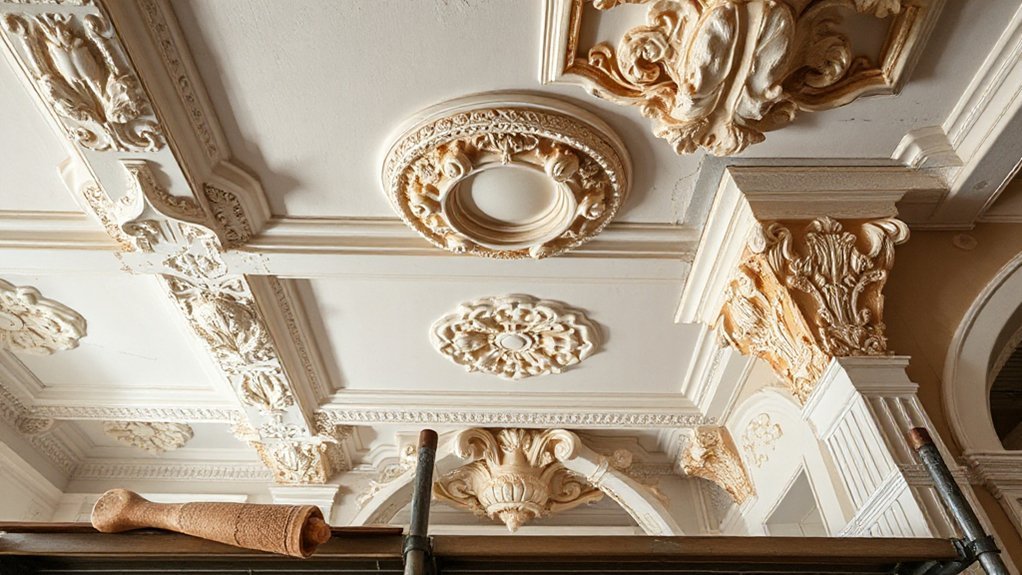
To implement the authentic Victorian aesthetic you’ve outlined, you’ll map detailing before work proceeds. You focus on precise scale, profiles, and finish textures to ensure cohesion across spaces.
Plan Victorian detailing by cataloging moulding profiles, ornamental finishes, and ceiling comps, then align with lighting, color, and joinery. This forethought minimizes retrofits and preserves structural integrity while delivering authentic character.
Victorian mouldings set rhythm from entrance hall to parlour, while ornamental finishes convey depth through sheen, patina, and glaze.
Document workmanship expectations, supplier tolerances, and maintenance implications early to avoid costly revisions.
- Define moulding profiles, joints, and reveal depths to match original rooms.
- Specify finishes and sheen levels, including base, glaze, and protection coats.
- Map ornamental details to lighting and plasterwork for cohesive drama.
Update Systems With Minimal Aesthetic Impact
Integrating modern systems with minimal aesthetic impact requires a disciplined, targeted approach that respects Victorian character while delivering functional upgrades. You’ll map routes for concealed cabling and plumbing, prioritizing existing service risers and chimney cavities to avoid room disruption.
Choose compact, retrofit units with smart features for efficiency, planning replacement to occur during least-visible periods to preserve plaster detail and cornice lines. Use low-profile panels, flush-mounted outlets, and color-matched coverings to blend with the architectural palette.
Document pathways with precise diagrams, then execute with careful mounting and vibration isolation. In historic gardens and surrounding grounds, install outdoor infrastructure discreetly, prioritizing heritage-safe materials.
Tie system upgrades to historic landscaping plans so utilities coexist with Victorian gardens, enhancing overall site stewardship without compromising period authenticity.
Mitigate Damp and Improve Thermal Comfort
Damp protection and thermal comfort must be addressed as a coordinated system, not as separate upgrades. You’ll implement precise detailing to curb moisture ingress while elevating warmth and stability in rooms, corners, and joinery.
Focus on reducing condensation, managing rising damp, and selecting materials with proven hygrothermal performance. By combining damp prevention with high-performance thermal insulation, you create enduring comfort and protection for historic fabric.
- Assess moisture pathways, then install targeted damp barriers and concealed drainage to minimize capillary rise without compromising plaster integrity.
- Upgrade thermal insulation using breathable, retrofit-friendly systems that preserve character while reducing heat loss and interior surface dampness.
- Seal air leaks strategically around floors, doors, and skirting, balancing ventilation needs with energy performance.
Ventilation, Lighting, and Energy Efficiency in a Victorian Villa
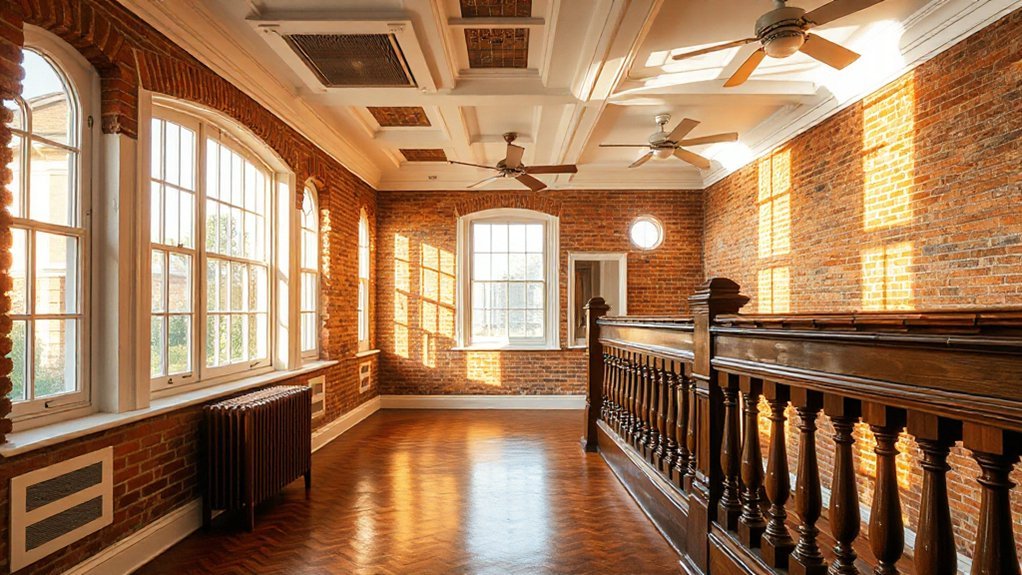
You’ll optimize ventilation by balancing mechanical and natural methods to maintain indoor air quality without compromising historic fabric. Consider targeted exhaust strategies, controlled openings, and heat-recovery approaches that suit high-ceiling Victorian layouts, stairwells, and sash windows.
For lighting and energy efficiency, prioritize daylighting plans, high-CRI LED upgrades, and intelligent controls to reduce cooling loads while preserving the villa’s character.
Ventilation Optimization Tactics
Would you rather breathe easier in a Victorian villa than endure stale air and uneven humidity? You optimize ventilation by tailoring airflow paths, sealing breaches, and using controllable intake/exhaust to sustain stable indoor air quality and comfort. Implement balanced strategies that respect historic fabric while maximizing performance.
- Assess existing corridors and high‑risk rooms for cross‑ventilation potential, then upgrade dampers and grilles to maintain natural ventilation where feasible.
- Install humidity‑responsive ventilation controls and discreet air‑change monitoring to maintain consistent moisture levels without overventilation.
- Match mechanical backup to demand, prioritizing filtration and low‑noise operation to preserve indoor air quality with minimal architectural intrusion.
Lighting Efficiency Upgrades
Why settle for dim, inefficient lighting when a Victorian villa can glow with purpose-built efficiency? Start with a thorough lighting assessment, then replace legacy fixtures with high-efficacy LED retrofits featuring relevant color rendering.
Align luminance levels to room function: task illumination for kitchens, ambient depth for living spaces, and accent highlights for architectural details. Implement smart lighting controls—occupancy sensors, daylight harvesting, and tunable white options—to minimize waste without sacrificing mood or practicality.
Prioritize dimmable fixtures and standardized color temperatures to preserve period character while improving performance. Conduct energy audits to quantify savings, verify performance against benchmarks, and identify remaining gaps.
Document commissioning results, schedule regular maintenance, and review system health periodically to sustain long-term efficiency gains.
Permits and Documentation: A Practical Timeline
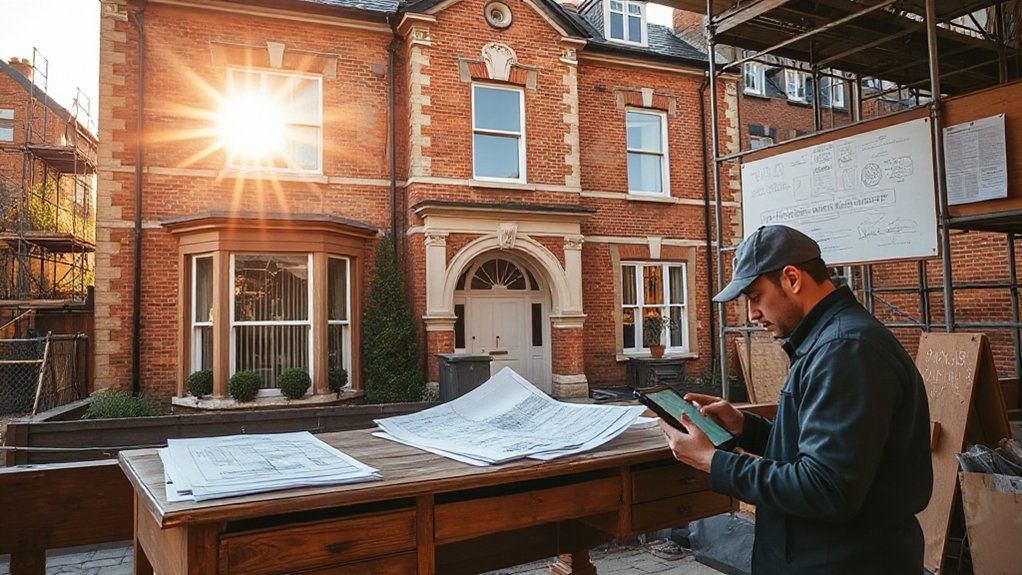
Finding permits and documentation begins with a clear map of the approvals required for a Victorian villa restoration in Liverpool. You’ll identify authorities, timelines, and submission formats to minimize delays, then align design intent with regulatory expectations.
This practical timeline keeps compliance front and center, ensuring your project proceeds without ambiguities.
1) Compile required permissions, from planning to listed-building consent, and note submission windows and fees.
2) Create a document trail detailing surveys, heritage impact assessments, and technical specifications for trades.
3) Schedule approvals against the project plan, incorporating contingencies for public consultations and potential appeals, while preserving historic gardens and Victorian landscaping objectives.
Phased Renovation: Aligning Workstreams and Milestones
You’ll synchronize milestones across trades to prevent bottlenecks and guarantee steady progress.
By sequencing phased workstreams, you’ll align dependency timing so each discipline starts only when prerequisites are complete.
This upfront mapping creates clear handoffs, reduces rework, and keeps the restoration on schedule.
Aligning Milestones Across Trades
Coordinating the phased renovation requires a precise alignment of milestones across trades so each sequence flows into the next without bottlenecks. You’ll set a master schedule that links design, structural, and finishing tasks, then validate dependencies with lead times and risk buffers. This keeps critical path activities visible, enabling proactive adjustments without disruption to heritage-sensitive work like Victorian architecture and heritage conservation.
1) Establish precedence maps that reflect inspection windows, materials lead times, and seasonal constraints to avoid rework.
2) Synchronize procurement and site access so trades arrive exactly when their tasks begin, reducing idle time.
3) Implement weekly milestone reviews with clear owners, documenting deviations and corrective actions to restore cadence.
Sequenced Phased Workstreams
Detailed scope definitions accompany baselined milestones, so trades synchronize handoffs and avoid idle periods. You map critical-path tasks, assign resource buffers, and implement weekly progress reviews to detect deviations early.
Victorian aesthetics guide finish sequence, ensuring period detailing aligns with enclosure and mechanical installations, while Modern integrations are threaded in at appropriate stages to minimize rework.
You maintain a closed-loop change control process, documenting revisions against baselines and updating related workstreams without compromising cadence. The result is predictable throughput, high-quality outcomes, and a historically faithful yet contemporary villa.
Dependency Mapping And Timing
Dependency mapping translates the renovation’s scope into a network of interdependent tasks, revealing how each activity constrains or enables others across phases. You’ll inventory sequences, identify critical paths, and align milestones with budget and regulatory windows.
This approach preserves Historical significance while safeguarding aesthetic authenticity, ensuring decisions reflect architectural intent and heritage constraints. By mapping dependencies, you forecast bottlenecks, compress idle time, and set realistic buffers between trades.
You’ll also synchronize procurement, permitting, and access, minimizing downtime and rework. Documentation translates into actionable calendars, dashboards, and daily targets, so your team stays aligned, informed, and accountable throughout each phase.
- Establish critical paths and phase handoffs
- Align procurement, permits, and access windows
- Monitor buffers, risk, and milestone adherence
Finishes and Fixtures for Liverpool-Villa Authenticity
To achieve Liverpool-Villa authenticity, select finishes and fixtures that echo late-Victorian craftsmanship while offering modern practicality. You’ll pair period timber with contemporary finishes, choosing joinery profiles that read as handcrafted yet install with low maintenance.
Opt for high-quality ceramic tiles or encaustic-look floors in entrance halls and kitchens, emphasizing durable finishes and subtle patination. For plasterwork, specify ribbed or chalk-finish plaster to reflect authentic depth without cracking, and integrate decorative plaster ceiling roses where appropriate.
Fixtures should blend brass or dark-oil bronze hardware with concealed modern mechanics for reliability. Ventilation and lighting require discrete, energy-efficient solutions that respect scale and proportion.
Consider a Victorian garden and Historic facade as framing elements in exterior touches—casters, gates, and weathering to harmonize interior rhythm with exterior character.
Maintenance Plan to Preserve Heritage and Modern Comfort
A strategic maintenance plan ties the Liverpool-Villa authenticity you established to reliable, long-term performance. You’ll blend preservation with modern comfort through a disciplined schedule, targeted upgrades, and precise documentation that protects structural integrity while enhancing livability.
- Systematically inspect timber elements, masonry joints, and roof coverings; record deviations, schedule seasonal interventions, and source period-accurate finishes to sustain Victorian fashion cues without compromising safety or energy efficiency.
- Implement climate-aware HVAC and insulation strategies that respect historic fabric, minimize thermal bridges, and preserve interior aesthetics, while enabling adaptable space use.
- Maintain landscape integrity with heritage landscaping practices, ensuring drainage, root protection, and garden alignments support foundations and curb appeal.
This plan foregrounds durability, comfort, and stylistic fidelity in concert.
Frequently Asked Questions
What Is the Typical Budget Range for a Victorian Villa Restoration?
A typical budget range for a Victorian villa restoration varies widely, often £500,000 to £2,500,000, depending on scope. You should plan for contingencies in Victorian architecture projects and prioritize Heritage conservation, procurement, and skilled trades.
How Long Does a Phased Restoration Usually Take?
The phased restoration typically takes several months to years, depending on scope. You’ll prioritize interior preservation and exterior renovation; think of it like restoring a clock—one precise gear at a time, guided by meticulous scheduling and inspections.
Which Trades Are Essential in Early Project Stages?
You need early-stage trades to secure solid framing, moisture control, and structural integrity, plus electrical and plumbing scoping. Architect collaboration and material sourcing guide these decisions, ensuring specifications align with heritage requirements and long-term performance from day one.
How to Balance Modern Comfort With Heritage Accuracy?
Balancing modern comfort with heritage accuracy requires precise architectural preservation, while planning interior modernization. You’ll harmonize materials, daylight, and thermal performance, like weaving a fine tapestry; your choices preserve character yet meet contemporary expectations for durability and usability.
What Are Common Hidden Structural Issues in Liverpool Villas?
Hidden decay and foundation problems commonly lurk in Liverpool villas; you’ll detect cracks, spalling masonry, and sinking floors, then investigate timber rot, corroded ties, and poor damp-proofing to plan targeted, technically sound remedial strategies.
Conclusion
You’ve mapped every rung on the restoration ladder, from solid foundations to era-true finishes. Stay rigorously documented, because a single drop of damp or a shifted beam can unravel years of care. Imagine your villa as a living archive: each retrofit, a page; each maintenance cue, a bookmark. With disciplined phasing and Liverpool’s planning rhythm, you’ll harmonize heritage with modern comfort, turning decay’s whisper into a confident, enduring chorus of brick, light, and lifted life.
About the Author