
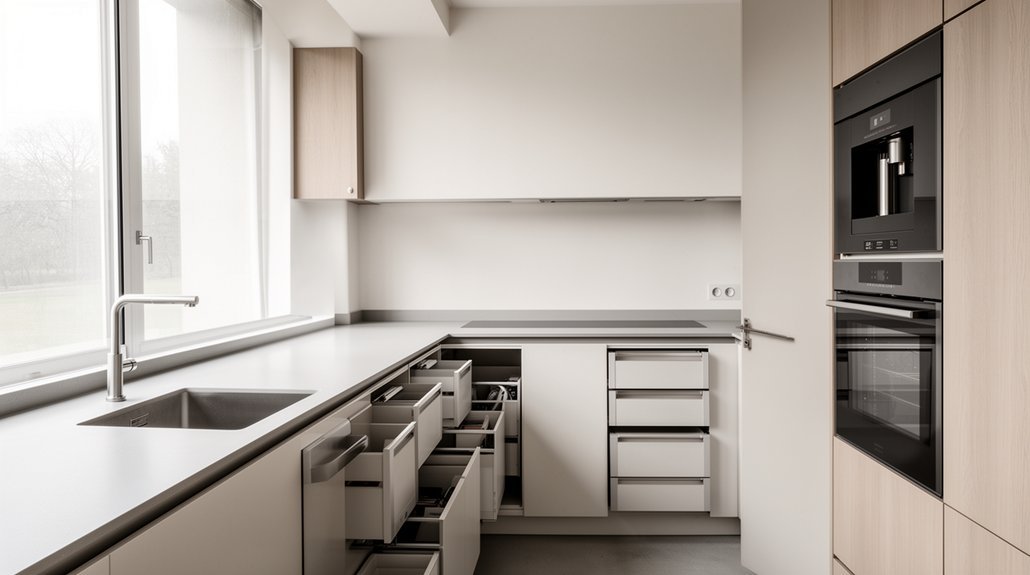
Discover minimalist kitchen designs that prioritize smart storage without sacrificing style. You’ll hide appliances behind integrated cabinetry and panel-ready fronts, use concealed pantry solutions, and employ modular systems that reconfigure as your needs change. Recessed zones, pull-out organizers, and labeled bins keep essentials accessible yet out of sight. Islands conceal clutter yet offer seating, while lighting and reflective surfaces make the space feel larger. Continue, and you’ll uncover practical steps to implement these ideas.
Smart Storage Criteria for a Minimalist Kitchen
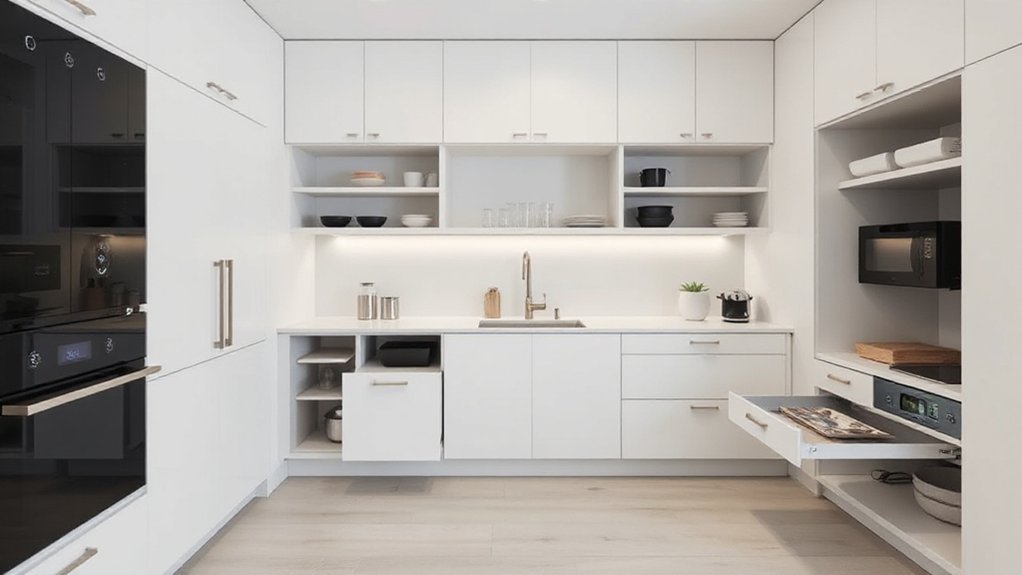
Smart storage is the backbone of a minimalist kitchen. You design around purpose, not clutter, so every cabinet and drawer serves a defined function.
Choose modular racks and pull-out trays that maximize accessibility without crowding surfaces.
Prioritize clarity: label zones, group like items, and keep a running inventory to prevent overstock.
Integrate vertical storage to free counter space, and use shallow bins for easy visibility.
Maintain consistency with your color schemes, opting for subdued tones that extend perceived space.
Vintage accents should be restrained, appearing as purposeful touches rather than clutter generators.
Guarantee doors and hardware are smooth and quiet to reduce friction during daily use.
Finally, rotate seldom-used items to secondary storage to preserve a clean, efficient kitchen workflow.
Conceal Appliances Without Compromising Access
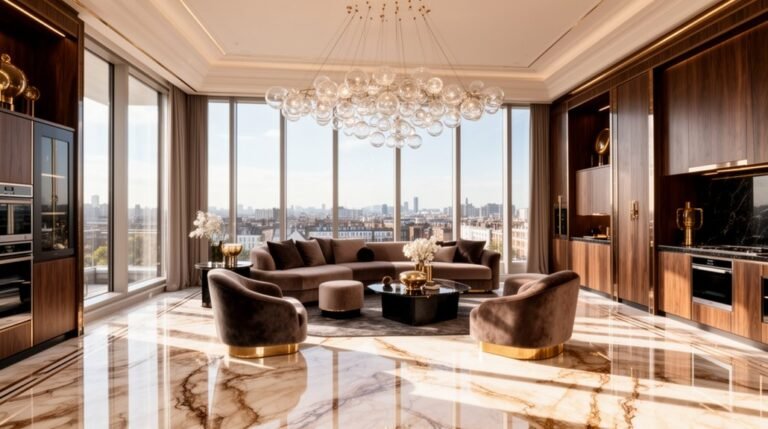
To conceal appliances without compromising access, use integrated cabinetry and panel-ready fronts that blend with your minimalist palette. You’ll maintain a calm, uninterrupted aesthetic while preserving usable space and function.
Choose appliances with magnetic or soft-close panels that align with surrounding cabinetry, reducing visual clutter and enhancing cohesion. Consider tongue-and-groove or flush-mount designs to create seamless lines, and implement ventilation grills that disappear behind discreet panels.
Position heavy gear near service zones to minimize reach and disruption, supporting consistent access optimization. Use shallow-depth units where possible to preserve counter workspace, and opt for concealed controls or hidden panels that reveal only when needed.
Focus on clear sightlines, predictable ergonomics, and deliberate hardware choices. appliance concealment, access optimization.
Hidden Pantry and Drawer Solutions for Food Storage
Hidden pantry organization and sleek drawer dividers streamline storage without clutter. You’ll optimize every inch, keeping items accessible and visible at a glance.
Use clean lines and modular dividers to maintain a minimalist, organized workflow.
Hidden Pantry Organization
Ever wish your pantry vanished yet stayed within arm’s reach? You can achieve this with hidden pantry organization that maximizes space while keeping essentials accessible. Use tall, narrow cabinets with pull-out trays, labeled bins, and shallow pullouts to store frequently used items near eye level.
Integrate a discreet doorway or cabinet within a wall cavity to conceal bulk supplies, and pair it with magnetic strips for spices and metal canisters. Opt for open shelving in adjacent zones to balance visual weight, showcasing vintage accents without clutter.
Implement rolling carts that tuck behind a cabinet when not in use, and use uniform containers for a cohesive look. This approach delivers minimalist efficiency, durability, and a clean, purposeful kitchen rhythm.
Sleek Drawer Dividers
- Snap-in compartments cradle jars and packets in neat columns
- Narrow fins separate seasoning tins with surgical precision
- Adjustable bays accommodate oddly shaped bottles
- Hidden stack units double as shallow bins for snacks
- Carded labels streamline inventory without visual noise
Islands That Hide Clutter and Add Seating
Choose a central island with hidden compartments for small appliances, lids, and cleaning tools, so visible clutter never distracts. For comfort, include a cantilevered edge or alcove seating that doubles as a dining spot, maintaining clear circulation paths.
Opt for multi functional islands that host a prep zone, a worksheet area, and a casual eating nook, all behind doors or within pullouts. Select finishes that match cabinetry to hide seams and maintenance demands.
When you plan, consider hidden seating as a deliberate feature, not an afterthought. Hidden seating, multi functional islands.
Modular Cabinet Systems for Flexible Living
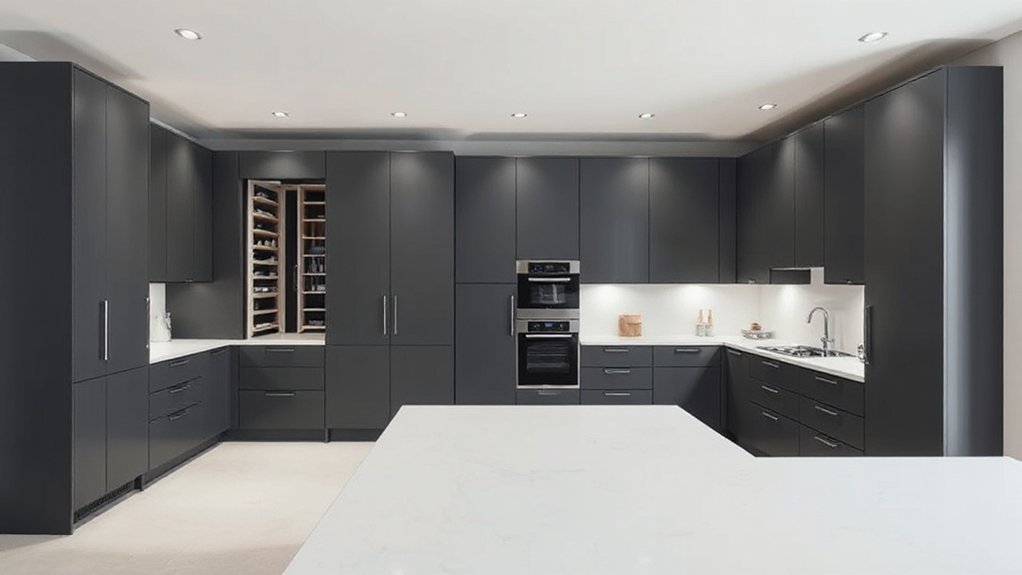
Modular cabinet systems let you tailor storage with flexible fit patterns that adapt as your needs change. You’ll appreciate adjustable configurations and interchangeable modules that reframe your workspace without a full redo.
Flexible shelf configurations guarantee you always have the right pullout, height, and reach for every task.
Modular Fit Patterns
Flexible, modular cabinet systems let you tailor a kitchen to your space and needs without redesigning the layout. Modular Fit Patterns optimize flow by aligning cabinet heights, widths, and depths to critical work zones. You’ll choose repeatable modules that interlock, enabling rapid reconfigurations as priorities change.
Patterns emphasize clean lines, minimizing visual clutter while maximizing storage reach. Consider how decorative accents and color schemes can appear across modules, creating cohesion without sacrificing flexibility.
- Seamless runs that read as single planes
- Reversible panels for future reorientation
- Equalized cabinet heights to simplify operations
- Hidden pull mechanisms for uninterrupted surfaces
- Strategic alcoves that house apps, tools, or appliances
These patterns deliver efficient load paths, predictable ergonomics, and a timeless, adaptable aesthetic.
Flexible Shelf Configurations
Shelf configurations within modular cabinet systems adapt on demand, letting you reallocate space as your storage needs evolve. You choose where to place shelves, swap panels, and tailor the layout without tools or downtime.
Adjustable brackets lock in positions, supporting heavy loads while maintaining a clean, minimalist line. When you need taller spaces for appliances or shorter gaps for dishware, you adjust quickly, preserving uniform aesthetics.
Shelf spacing becomes deliberate: closets, pantries, and work zones align to your workflow, reducing clutter and optimizing accessibility. Modular components maintain integrity through consistent tolerances, so updates remain seamless over time.
This approach yields flexible living without sacrificing structure, ensuring durable, scalable storage that grows with your kitchen’s demands.
Hidden Storage by Zone: Utensils and Tools
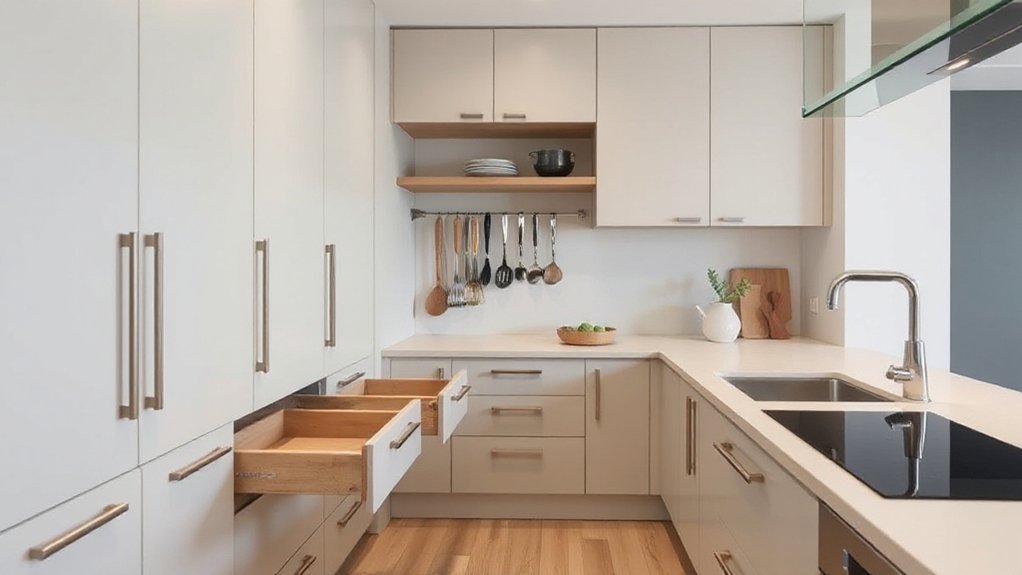
Hidden storage by zone keeps utensils and tools within arm’s reach while preserving counter space. You design zones that fit your workflow, ensuring every utensil has a defined home. Use hidden compartments integrated into cabinetry for knives, measuring spoons, and rarely used gadgets, so surfaces stay uncluttered.
Zone specific storage prioritizes accessibility, reducing search time and distractions. Align utensils to task—prep, cooking, serving—and maintain consistent depth to keep items stable. Your system should be scalable, adaptable, and easy to maintain.
- Recessed pull-out slot near the prep zone for knives and spoons
- Magnetic strip and slim caddy beside the stove
- Hidden drawer with dividers for measuring tools
- Under-cabinet pocket for peelers and graters
- Hidden compartments for specialty gadgets and lids
Drawer Organizers and Pull-Outs for Everyday Efficiency
Efficient drawer organizers and well-designed pull-outs keep everyday tools within reach and surfaces uncluttered. You’ll arrange utensils, lids, and small gadgets with precision, avoiding cross-traffic and wasted moments.
Innovative drawer inserts maximize capacity by shaping each compartment to suit its contents, reducing rummaging and misplacement. Choose shallow dividers for cutlery, deeper modules for measuring spoons, and labeled sections for lids and wraps to speed access.
Optimized pull out shelves glide smoothly, expose every item, and prevent overstacking. Install height-adjustable trays to accommodate growing needs without refilling.
In a minimalist kitchen, consistency matters: match finishes, align rails, and test closures. Regularly reassess: rotate rarely used items toward the back and keep a minimal core set within easy reach for daily tasks.
Lighting and Materials to Make the Space Feel Larger
Good lighting and carefully chosen materials can make a small kitchen feel expansive. You’ll balance brightness with clean lines, using ambient lighting to soften shadows and create depth. Select light, reflective surfaces to bounce light across counters and walls, enhancing perceived space.
Opt for matte cabinet fronts with a glossy backsplash to coil light without glare, maintaining calm minimalism. Keep countertops streamlined, choosing durable, pale materials that reflect rather than absorb. Color should stay neutral, with occasional cool accents to sharpen contours.
Guarantee your lighting plan layers: ambient, task, and accent, so the room reads larger at every angle.
- Soft, evenly distributed ceiling light for total coverage
- Under-cabinet LEDs to illuminate work zones
- High-gloss backsplash that reflects ambient glow
- Pale quartz or solid-surface countertops
- Glass or mirror accents to amplify depth
Frequently Asked Questions
How Can I Maximize Storage Without Increasing Countertop Clutter?
Yes, you can maximize storage without adding counter clutter: choose wall-mounted organizers, pull-out shelves, and magnetic rails; opt for tall cabinets with adjustable dividers, color schemes that reflect light, and lighting solutions that boost visibility without bulk.
What Budget-Friendly Hidden Storage Ideas Work in Small Kitchens?
Hidden cabinet ideas and fold away shelves deliver budget-friendly storage in small kitchens. You’ll maximize space, reclaim counters, and stay organized—hidden cabinet for discreet stash, fold away shelves for flexible, quick-access solutions, and ongoing practicality.
Which Materials Prevent Fingerprints While Looking Minimalist?
Fingerprint resistant finishes and low maintenance materials are ideal for a minimalist look; choose champagne stainless, powder-coated metals, or solid surfaces. You’ll minimize fingerprints, simplify upkeep, and maintain clean lines with durable, timeless textures.
How Can I Maintain Workflow Efficiency With Smart Storage?
You’ll open peak efficiency by prioritizing Smart organization and Efficient accessibility, streamlining tasks so nothing hunts for a tool. You keep workflows smooth: labels, zones, and pull-out shelves bring exactly what you need, exactly when you need it.
Are There Sustainable Options for Minimalist Kitchen Storage?
Yes, you can. Opt for eco friendly materials and renewable solutions, choosing FSC-certified wood, recycled metal, and compostable organizing components to minimize landfill impact while maintaining a sleek, functional minimalist kitchen design that lasts.
Conclusion
In a minimalist kitchen, smart storage isn’t an afterthought—it’s the backbone. You’ll reveal calm where chaos hides, yet every corner serves a purpose. Conceal appliances, yet keep access, because hidden isn’t silence, it’s strategy. Picture drawers that glide open to reveal essentials, islands that cradle clutter out of sight, and modular kits that adapt as life shifts. The secret: light, color, and materials that expand space. Stay sharp, stay patient—the moment you resist, the clutter returns.
About the Author


1 thought on “Minimalist Kitchen Designs With Smart Storage Solutions”