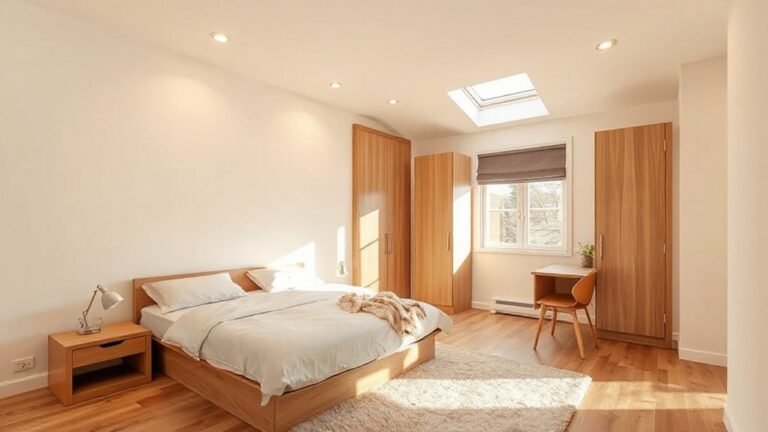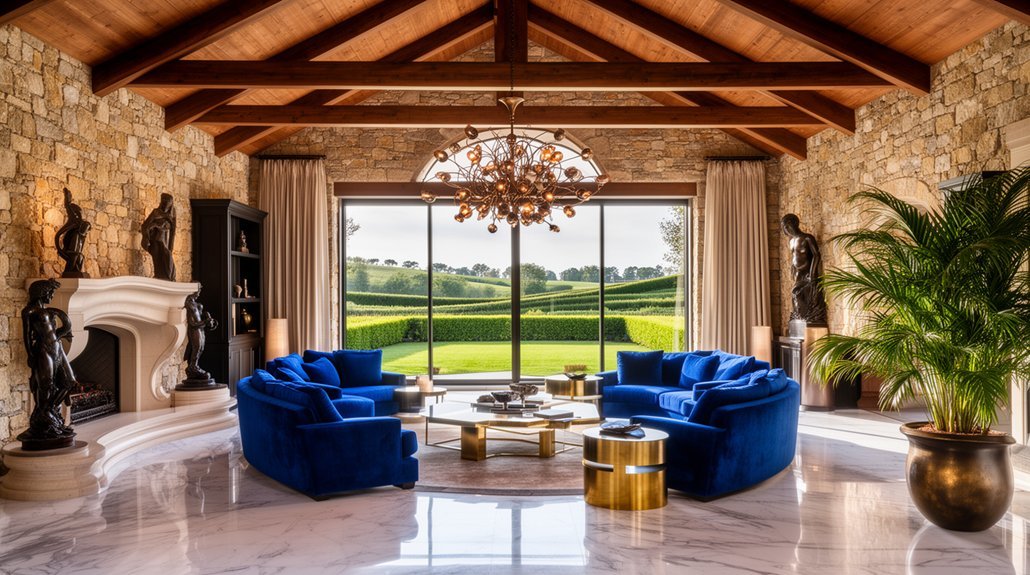
You’ll define luxury in large country homes by prioritizing provenance, durable finishes, and precise detailing that age gracefully. Craft grand entryways with alive light, and design panoramic living spaces that maintain sightlines while inviting warmth. Choose materials—wood, stone, and metal—that age beautifully, and choreograph indoor–outdoor flow for year‑round living. Plan for acoustics, maintenance, and phased budgets to sustain value. If you continue, you’ll uncover deeper strategies and case‑study insights.
What Defines Luxury in Large Country Homes
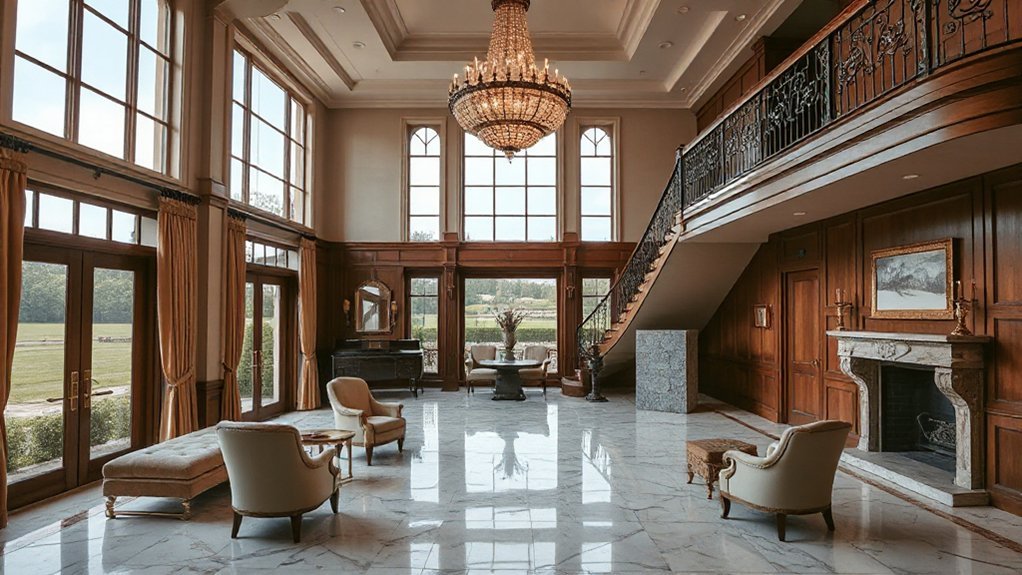
Material selection hinges on provenance, finish stability, and aging behavior, with veneers and metals paired to resist wear while maintaining restraint. Spatial planning prioritizes flow, sightlines, and room-to-exterior relationships, creating a coherent hierarchy that supports daily use and hospitality.
Vintage charm informs detailing without nostalgia driving the program, balancing antique cues with modern reliability. Garden integration becomes a logical extension of interior space, through controlled views, outdoor rooms, and sustainable landscape ties.
Precision, restraint, and measurable outcomes define true luxury in these homes.
Crafting Grand Entryways That Welcome With Light
A grand entryway should greet visitors with light that feels intentional and alive. You design doorway geometry, aperture placement, and glazing with purpose, so illumination arrives as a guiding cue, not a mere afterthought.
Prioritize daylight shaping through transoms, sidelights, and high clerestory panels to create a sense of arrival that evolves with the sun.
Integrate lighting controls that respond to occupancy and time, guaranteeing warmth during gatherings and crisp clarity at approach.
Materials embody Rustic charm without clutter, balancing texture, tone, and reflectivity to enhance luminosity.
Consider vintage-inspired fixtures to fuse heritage with modern efficiency, delivering vintage elegance while maintaining technical resilience.
Finally, ensure light preserves architectural hierarchies—foyers, staircases, and vistas—without overpowering subtle interior details.
Selecting Materials That Age Gracefully
- Vintage textiles
- Artistic ceramics
- Patina-aware finishes
Timeless Wood, Stone, and Metal Combinations
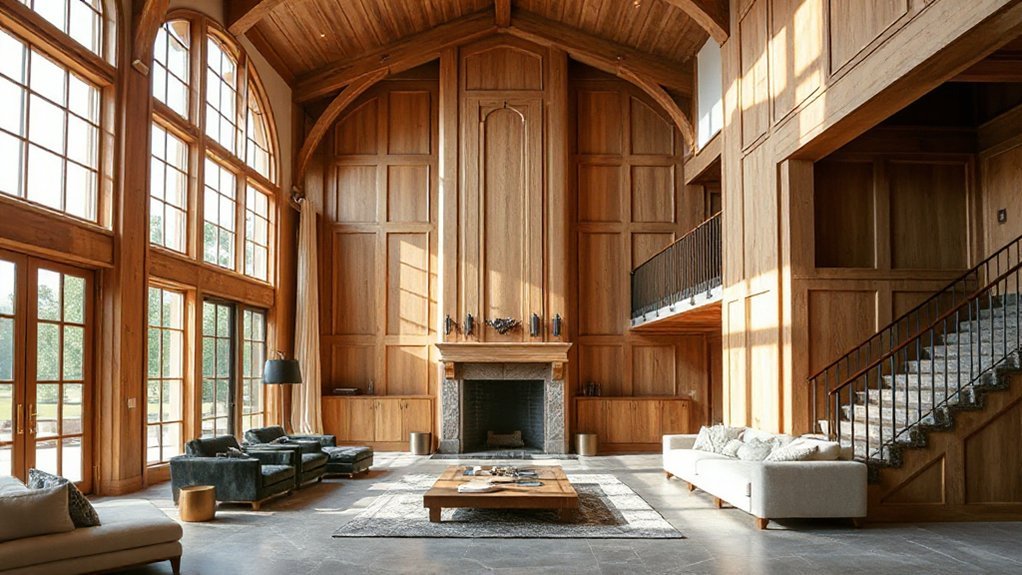
Timeless combinations of wood, stone, and metal anchor interiors in large country houses by balancing warmth, texture, and restraint.
You select timber with a tight grain for furniture and paneling to convey formal elegance, while stone offers grounded mass and tactile longevity. Metal accents—brushed bronze, antique brass, or oxidized steel—provide structural contrast and subtle sheen without overstatement.
Prioritize material longevity by pairing durable timbers with oiled finishes and stone that resists wear. Avoid excessive polish; instead, let natural patina evolve.
In planning layouts, coordinate joinery, grain direction, and finish depth to preserve visual coherence across rooms. The result is timeless elegance achieved through disciplined material orchestration, where warmth remains approachable and sophistication stays enduring, not fleeting.
Panoramic Living Rooms: Elevate Scale and Comfort
Panoramic living rooms harness expansive sightlines to amplify scale while maintaining intimate comfort. You shape space through large-format glazing and precise proportion, ensuring every chair aligns with the view. Your design prioritizes balance: panoramic views become a visual anchor, while luxurious furnishings uphold tactile richness.
Materials with low glare and warm undertones support long-term coziness without sacrificing clarity. Lighting is layered and controllable, preserving daylight drama while avoiding eye fatigue. Acoustic treatment maintains quiet focus, so conversations feel intimate despite the magnitude.
Finishes emphasize durability and refinement, reinforcing a timeless aesthetic. Seek furniture with streamlined profiles that don’t obstruct sightlines, and employ rugs to ground zones without crowding the panorama. Your room becomes a disciplined dialogue between outside grandeur and interior retreat.
- Expansive glazing as a focal element
- Strategic furniture scale and placement
- Controlled ambience for comfort and clarity
Spatial Zoning for Warmth in Open Plans
Open-plan spaces demand deliberate spatial zoning that cultivates warmth without sacrificing openness. You design with purpose, aligning furniture scales and materials to cue intimate zones while preserving flow.
Use varied ceiling treatment, floor finishes, and lighting to delineate functions without walls, guiding movement and atmosphere. Place cozy nooks along sightlines to offer reprieve without interrupting openness, ensuring sight, scent, and sound create inviting microclimates.
Fireplace integration should anchor gathering zones, leveraging heat output and visual focus to draw occupants together. Consider radiative and convective balance: distribute warm surfaces near high-traffic edges and seating clusters.
A calibrated rhythm of tucked seating, low screens, and soft textures prevents cold corners. Document pathways and zone extents to sustain readability, accessibility, and understated luxury throughout the plan.
Library Sanctuaries: Shelving, Seating, and Silence
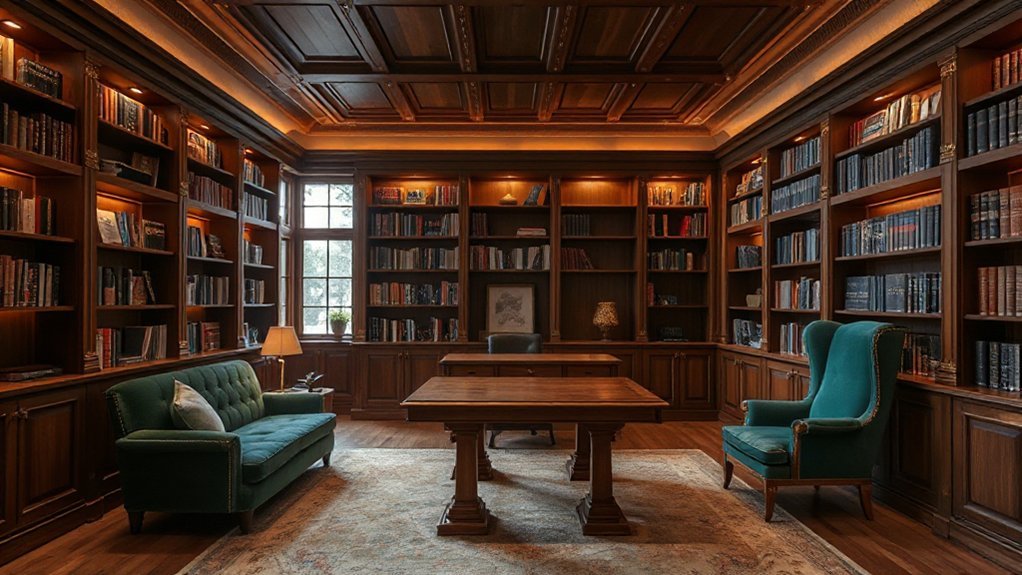
Shelving should achieve both aesthetic balance and functional reach, harmonizing display with accessibility for frequent use.
Seating must provide serenity and acoustic comfort, supporting quiet study and reflective reading without visual clutter.
Silence is engineered through layout, material choices, and subtle acoustics, guiding occupants toward focused contemplation while preserving refined luxury.
Shelving Aesthetic Balance
When designing library sanctuaries, shelving should achieve both function and serenity; the arrangement must support quick retrieval, protect valuable volumes, and contribute to a breathable, balanced ambience.
You curate a shelving system that emphasizes precise alignment, metric spacing, and material continuity, delivering shelving aesthetic that reads as calm and controlled.
Balance harmony emerges from proportional columning, consistent gap tolerances, and subtle color coordination with surrounding millwork.
You prioritize planar neutrality with varied depths to orchestrate focal lines without visual clutter, ensuring shelves recede when not in use.
- Aligns with architectural rhythm to enhance cohesion
- Uses material, tone, and spacing to reinforce balance harmony
- Allows modular flexibility for collection growth and seasonal displays
Seating for Serenity
Position seating to cultivate intimate dialogue while preserving clear circulation, aligning chairs to focal shelves or a muted fireplace. Choose materials that resist acoustic reverberation—double-faced wool, leather-topped cushions, and soft weaves—reducing ambient noise without isolation.
Integrate intimate lighting with dimmable warm LEDs and discreet task lamps to sustain study focus. Connect the space to exterior ideas by framing garden pathways from windows, and place discrete sculpture plinths for occasional contemplation of outdoor sculptures, inviting quiet pause within disciplined surroundings.
Hallway Proportions, Proximity, and Pace
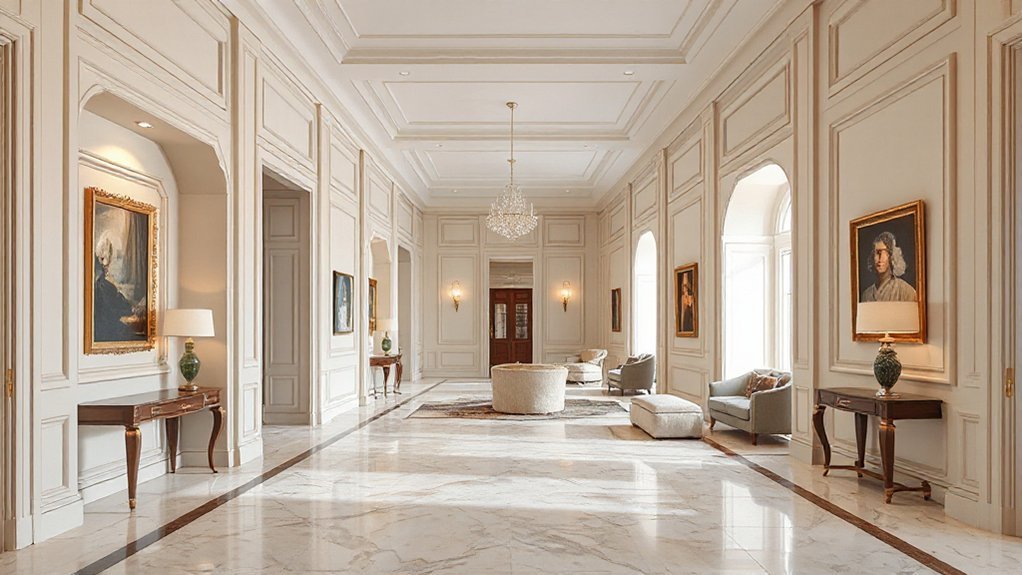
In elegant large-country-house hallways, proportions govern flow: they must balance width, ceiling height, and aperture rhythm so that movement feels effortless rather than truncating or elongated. You calibrate corridor breadth to accommodate furniture sightlines, ensure doorways align with sightlines, and respect ceiling proportions to avoid visual bottlenecks.
Proximity guides occupancy; too-close axes impede retreat, too-wide spaces feel empty and muted. Pace is set by rhythm—consistent intervals, material transitions, and lighting cues that anticipate arrival at destinations like formal paths or garden pathways.
You optimize acoustics to prevent harsh echoes while preserving quiet grandeur. Align these decisions with circulation diagrams, not whimsy.
- Prioritize sightline continuity and door alignment
- Integrate soft lighting and material rhythm for pace
- Reference garden pathways in exterior-to-interior transitions
Dining Rooms That Feel Intimate Yet Grand
Creating dining rooms that feel intimate yet grand starts with disciplined space planning and refined material logic. You sculpt proportion through sightlines, aisle widths, and furniture footprints, ensuring conversational proximity without crowding.
Ground the room in a restrained palette and tactile surfaces; treat walls, floors, and ceilings as a cohesive trio. Choose a substantial dining table with a formal silhouette to anchor the space, then offset its gravity with light, leggy seating and generous clearance for movement.
Vintage chandeliers provide an era-anchored focal point without heaviness, while carefully chosen textiles in upholstery and drapery add warmth and texture. Accent with metallic trims and subtle patterning to heighten sophistication, not noise.
Prioritize acoustics and ventilation to sustain quiet, intentional gatherings. Avoid clutter, preserve clarity, embrace restrained ornament.
Kitchens for Entertaining at Scale
- Wine cellars as a design anchor and service connector
- Zoned islands with integrated tech for beverage service
- Hidden storage and media considerations for evenings
Private Quarters: Resort-Style Comfort at Home
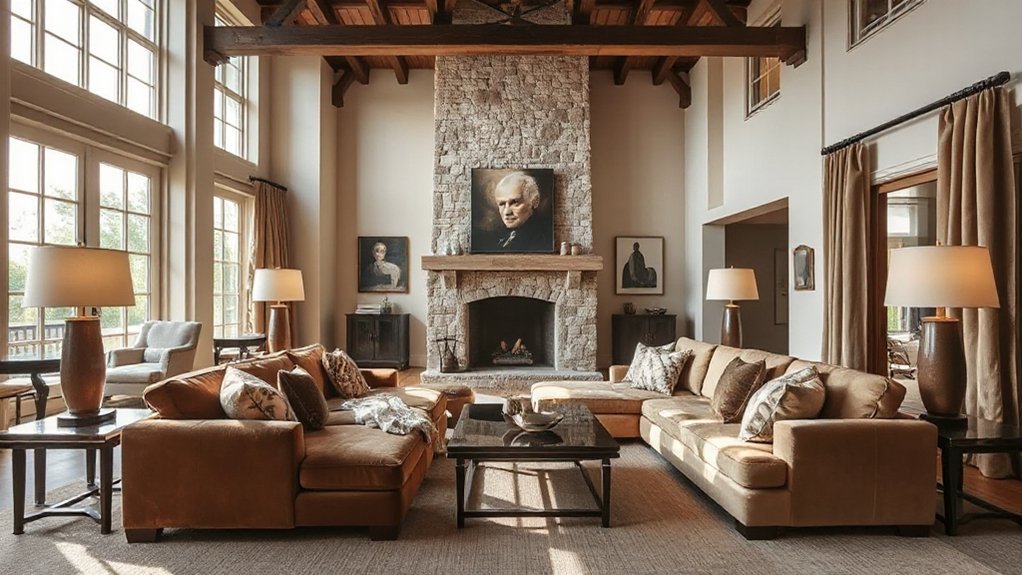
You design private retreat zones that balance function and quiet luxury, guiding how Private Retreat Design shapes spaces for focused respite and scalable comfort.
Consider Spa-Inspired Bathing as the core framework for routine rituals, ensuring materials, acoustics, and airflow harmonize to support daily renewal.
Finally, optimize a Quiet Zone Layout that separates circulation from rest, establishing clear thresholds that preserve sensory rest and seamless access to amenities.
Private Retreat Design
Could a private retreat at home redefine daily rest and focus? You curate a sanctuary that blends controlled lighting, sound isolation, and tactile finishes to sharpen concentration and restore energy. Design emphasizes intimate zones: a quiet study, a restorative bedroom, and a contemplative lounge that fuse function with luxury.
You incorporate climate control, air purity, and custom storage to minimize distraction, while material choices—solid timber, stone, and velvets—signal permanence and calm. The landscape surrounding these quarters extends inward with garden pathways and subtle sightlines to outdoor sculptures, creating visual anchors without distraction.
Precision detailing ensures durability and ease of maintenance, sustaining resort-grade comfort long term.
- Thoughtful spatial zoning that enhances privacy and flow
- Material performance and acoustics tuned for serenity
- Landscape cues—garden pathways, outdoor sculptures—linking exterior and interior
Spa-Inspired Bathing
Begin with a dedicated bathing sanctuary: a damp location with moisture-resistant surfaces, a recessed bench, and a frameless glass enclosure that preserves sightlines. Employ a rainfall or laminar-flow showerhead, a freestanding tub, and a digital thermostat for precise, repeatable sessions.
Incorporate accessible storage, integrated aromatics, and sound-dampening panels to sustain a tranquil atmosphere. The layout should support modular routines, enabling bathing rituals without interruptions.
Maintain high-performance ventilation, humidity control, and maintenance access to guarantee long-term reliability and a consistently restorative experience.
Quiet Zone Layout
In a private-quarters layout designed for resort-style comfort, the Quiet Zone prioritizes acoustic privacy, controlled visual access, and tactile calm. You curate spaces where sound travels minimally between suites, using defined sound attenuation strategies and concealed doorways.
Implementing soundproofing zones within bedroom wings and spa corridors creates measurable quiet zones, while acoustic treatments on walls and ceilings suppress reflections and external intrusions. You align furniture plans to reduce contact noise and optimize door seals, ensuring a coherent sensory field that supports rest and recuperation.
The result is a disciplined balance of privacy, atmosphere, and function, enabling smooth progressions from routine to retreat without compromising performance or style.
- Soundproofing zones
- Acoustic treatments
- Visual-access zoning
Acoustic Comfort in Vast Rooms
Implement soundproofing techniques at transfer points—doors, windows, and service openings—to minimize exterior intrusion while preserving interior energy. Apply acoustic treatments that target problem frequencies, using a combination of absorbers, diffusers, and resilient panels to shape reflections across multiple surfaces.
Use ceiling geometry and wall panels to control flutter echoes, ensuring speech remains intelligible without amplification. Monitor performance with simple measurements, iterating layouts and finishes to sustain comfort as room functions evolve.
Lighting Design for Texture and Mood
- ambient shadows as depth accent
- color layering for tonal richness
- discrete zoning to maintain clarity
Bespoke Furnishings and Custom Details
You select bespoke materials from a curated palette to establish a cohesive, high-contrast aesthetic across rooms.
You define custom details—trim, hardware, and stitching—to elevate scale, texture, and tactile quality.
You align these elements with structural realities and performance needs, ensuring each detail contributes to lasting refinement.
Bespoke Materials Palette
A bespoke materials palette anchors every element of a luxury country house, ensuring tactile contrast, visual unity, and long-term performance. You select durable substrates, refined textures, and restrained colorways to establish a coherent, enduring atmosphere. Prioritize materials that fuse performance with luxury, and specify precise finishes that age with grace.
You balance weight, scale, and light reflectivity to support architectural storytelling, while maintaining practical maintenance regimes. Custom fabrications and artisanal finishes appear as deliberate accents, enhancing depth without clutter. You design for provenance, sustainability, and quiet luxury, avoiding trend-driven distractions.
Your palette underpins all furnishings, cabinetry, and architectural detailing, guiding future updates with minimal disruption.
- Custom fabrications
- Artisanal finishes
- Material longevity and upkeep
Custom Details Crafting
Artisan craftsmanship guides selections—hand-carved molding, inlaid woods, and bespoke metalwork—ensuring durability and refined texture. Decorative accents are deliberate focal points, not afterthoughts, calibrated to catch light and echo architectural lines.
You specify joinery that honors long-term stability, choosing traditional methods where appropriate and modern adaptations where necessary. Surfaces receive controlled patination, patina development, or protective finishes to sustain elegance under use.
You validate proportion with virtual and physical models, then translate sketches into prototypes for critical inspection. The result is cohesive lineage between concept, manufacture, and the lived experience of luxury spaces.
Cohesive Color Palettes for Large Homes
Cohesive color palettes anchor the look of large country homes by coordinating wall tones, textiles, and architectural details into a unified narrative. You establish a controlled framework that supports hierarchy, proportion, and material honesty.
Prioritize color harmony across spaces, balancing warm and cool cues so progression feels deliberate rather than incidental. Use a restrained palette as your backbone, then layer palette contrast with texture, pattern, and occasional bold accents to maintain interest without fragmentation.
Implement swatches, mood boards, and lighting studies to validate choices before committing.
- Align primary neutrals with strategic accent moments to reinforce the architecture
- Test surface interactions under varied daylight and artificial lighting
- Map color relationships to furniture scales and fabric weights for cohesion
Art and Antiques: Curating Without Clutter
You curate with restraint, selecting pieces that serve the room’s architecture and light rather than merely filling space.
Display with purpose, grouping works by narrative or provenance and avoiding repetition or clutter.
Protect and preserve by choosing appropriate display options and conservation practices that respect age, material, and condition.
Curate With Restraint
Curating without clutter hinges on disciplined selection and strategic placement. You balance history and space, selecting pieces that speak with restraint, not volume. Each object earns its place through relevance, scale, and provenance, avoiding gratuitous repetition.
You create focal points by pairing antique with contemporary lines, ensuring texture and patina read as a curated dialogue rather than a crowded display. The aim is understated elegance, where minimalist clutter is avoided by precision in grouping, spacing, and lighting.
You monitor reflections, shadows, and access—every item should support the room’s function and flow. Maintain a concise gallery rhythm, letting negative space reinforce value.
Your discipline elevates luxury through thoughtful restraint, not accumulation.
- Thoughtful selection over abundance
- Proportional grouping with intentional spacing
- Subtle lighting to reveal patina and texture
Display With Purpose
With restraint, display becomes deliberate choreography: art and antiques should read as a curated conversation rather than as a crowded gallery. You balance focal pieces with negative space, letting each item justify its placement through provenance, material quality, and visual weight.
Prioritize a concise narrative: a single sculpture paired with a textile fragment, a painting oriented to natural light, or a cabinet that reveals its contents as a moment of discovery. When introducing objects, reference dimensions, period, and maker with precision, avoiding repetitive descriptors.
Emphasize sustainability by noting sustainable sourcing practices and the story behind each acquisition, rather than merely displaying credentials. Integrate vintage textiles as quiet accents—framed fragments or woven borders—so they enrich, not overwhelm.
Curating this way maintains clarity, authority, and timeless restraint.
Protect And Preserve
Protecting artwork and antiques is a disciplined discipline of handling, display, and environment. You optimize preservation by controlled humidity, stable temperatures, and minimal light exposure, ensuring each piece breathes without fading.
You curate with intent, pairing objects to tell stories while avoiding clutter. You integrate discreet security and regular condition checks, documenting changes to maintain provenance and value.
You design display with proportional shelves, UV-filtered glass, and non-abrasive mounts, so surfaces endure decades. You weave in garden pathways and landscape lighting to frame interiors without distraction, guiding attention toward focal pieces.
You practice rotation tactics, seasonal re-hangs, and sheer storage discipline to prevent overexposure. Your approach balances reverence with practicality, delivering a refined, lived-in collection that remains legible, intact, and quietly commanding.
Indoor-Outdoor Flow for Year-Round Living
A seamless indoor-outdoor flow is essential for year-round living in a large country house, where climate, views, and spatial scale demand intentional connections between interiors and exterior living spaces. You design progressions that feel effortless yet controlled, aligning thermal buffers with architectural apertures.
Seasonal comfort is achieved through operable fenestration, insulated flooring, and radiant systems that respond to sun position and wind patterns. Material continuity across thresholds minimizes perceived division, while shading strategies preserve sightlines without compromising access.
Indoor gardens blur boundaries, bringing greenery inside without compromising enclosure, and outdoor kitchens extend culinary operations into sheltered zones for all seasons. Consider integrated drainage, weatherproof finishes, and sound attenuation to sustain serenity.
Your plan equals habitability, efficiency, and refined, enduring appeal.
Maintenance and Longevity Beyond Aesthetics
You consider durability over time and select finishes that endure, reducing the need for frequent restoration.
Prioritize low-maintenance materials that resist wear while maintaining elegant texture and tone.
This sets the baseline for maintenance planning, ensuring longevity aligns with sophisticated design and practical performance.
Durability Over Time
- Proactive inspection cadence and documented maintenance
- Material performance over lifecycle with traceable specifications
- Integrated acoustics and ergonomic criteria in evolving spaces
Low-Maintenance Materials
In interiors, opt for sealed stone, high-performance composites, and engineered wood with robust finishes that resist scratches and fading.
For exteriors, choose corrosion-resistant metals, porcelain pavers, and low-porosity cladding that withstand climate while reducing sealing needs.
You’ll appreciate uniform aging, predictable maintenance cycles, and reduced downtime for repairs.
Pair materials with integrated systems that simplify care, such as sealed joints, self-cleaning textures, and efficient drainage.
Consider garden lighting and landscape features as part of a cohesive strategy, ensuring lighting durability and concealment.
This approach preserves ambience, value, and tactile quality across the estate.
Budgeting Luxury Without Compromise
Smart budgeting for luxury without compromise starts with a clear benchmark: define what truly drives value in a large-country-house project and allocate resources accordingly. You balance enduring quality with cost discipline, prioritizing systems, materials, and timeless aesthetics over fleeting trends.
By pairing disciplined procurement with strategic design decisions, you preserve aspirational scale while avoiding waste, delays, and over-specification. Emphasize durable finishes, efficient systems, and phased implementation to maximize impact without excess.
Sustainable sourcing and vintage accents can elevate perception of luxury without inflating budgets, provided you verify lifecycle costs and supplier reliability.
Align the brief with measurable performance targets, then monitor variances and adjust promptly to protect value over the project’s lifetime.
- Define value drivers and set stage-gates for decision-making
- Prioritize high-impact areas and phased deliveries
- Vet suppliers for reliability and lifecycle costs
Case Studies: Real Transformations in Large Country Homes
Across large country houses, real-world transformations illustrate how strategic choices in budgeting, materials, and systems yield visible impact without sacrificing longevity. In these case studies, you’ll see how careful zoning preserves structure while enabling modern comfort, with budgets aligned to phased upgrades and durable finishes.
Material selections bias longevity and provenance, favoring hardwoods, lime plaster, and thermally broken glazing that resist wear while aging gracefully. Systems modernization—HVAC efficiency, smart controls, and moisture management—ensures performance without disruptive downtime.
Historical influences inform spatial rhythm and detailing, while cultural symbolism guides foyer sculpture, library tones, and dining room ornamentation, creating coherent narratives. Each project demonstrates disciplined procurement, rigorous contractor oversight, and post-occupancy evaluation to sustain value.
These transformations prove refined engineering and design can coexist with tradition.
Frequently Asked Questions
How to Balance Grandeur With Daily Usability?
You balance grandeur with daily usability by prioritizing function first, then layering artistic focal points and textural contrasts. Use durable materials for routine use, integrate clever storage, and curate refined silhouettes to maintain an upscale, practical environment.
What Lighting Layers Best Define Luxury Spaces?
“Light makes the room breathe.” You define luxury with layered ambient illumination and well-placed statement fixtures, shaping depth and focus; you balance task, accent, and decorative lighting to enhance texture, color, and materials with disciplined precision.
Which Ceiling Heights Maximize Proportion and Airiness?
Ceiling heights around 10 to 12 feet maximize proportion and airiness; you create spatial harmony by balancing vertical scale with fixtures, textures, and openings, ensuring Ceiling proportions remain elegant while enhancing light, movement, and perceptual clarity throughout the space.
How to Integrate Heirlooms Without Clutter?
You integrate heirlooms by deliberate display and protected lighting, prioritizing antique display coordinates and minimalism to avoid clutter, while you safeguard heirloom preservation with archival mounts and controlled humidity, creating refined, technically sound cohesion within your space.
What Sustainable Practices Sustain Luxury Over Decades?
You sustain luxury over decades by choosing Eco friendly materials and integrating Renewable energy systems, ensuring durability and timeless appeal. You routinely audit lifecycle impacts, favor repairable components, and design for modular upgrades to maintain performance, efficiency, and refined elegance.
Conclusion
You’ll recognize luxury here isn’t showy excess but disciplined craft, where scale amplifies comfort and light guides perception. You select enduring materials, masterful joinery, and timeless metal, stone, and timber palettes that age with poise. You’ll craft panoramic spaces that breathe, and indoor-outdoor flow that seasons every moment. Maintain rigor in upkeep and budget, yet never compromise on lineage or performance. Fundamentally, you design for lasting grandeur—while embracing the unexpected, even a well-placed anachronism to intrigue.
About the Author