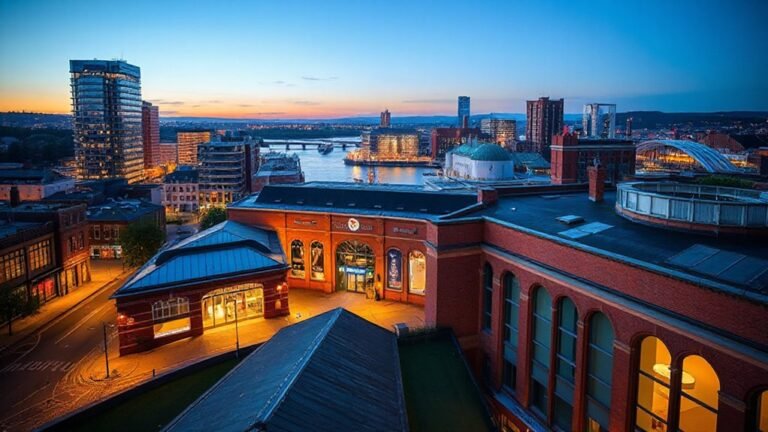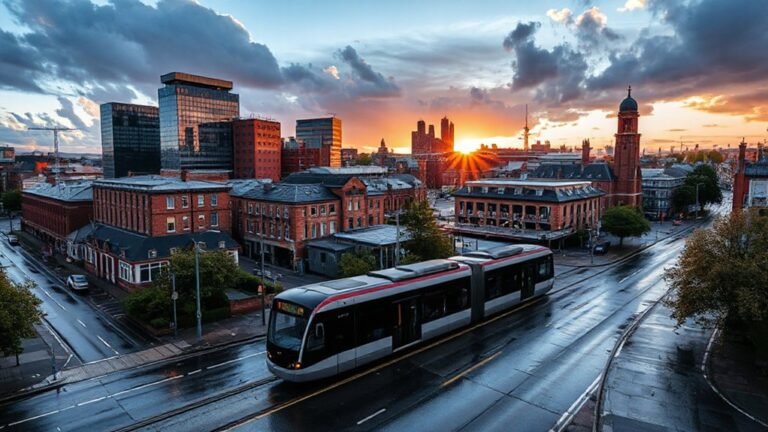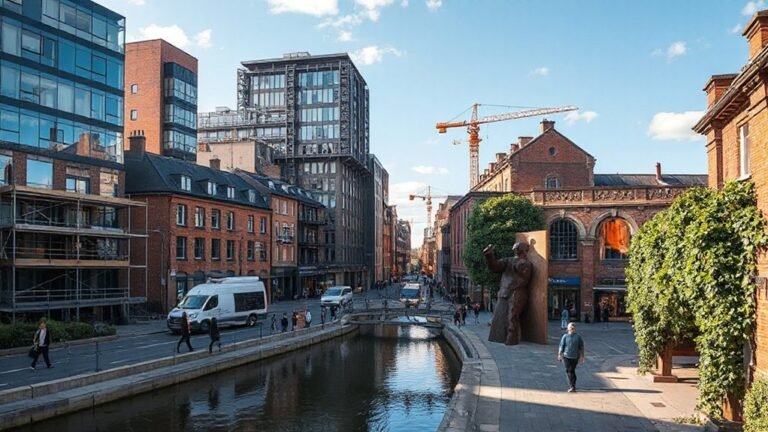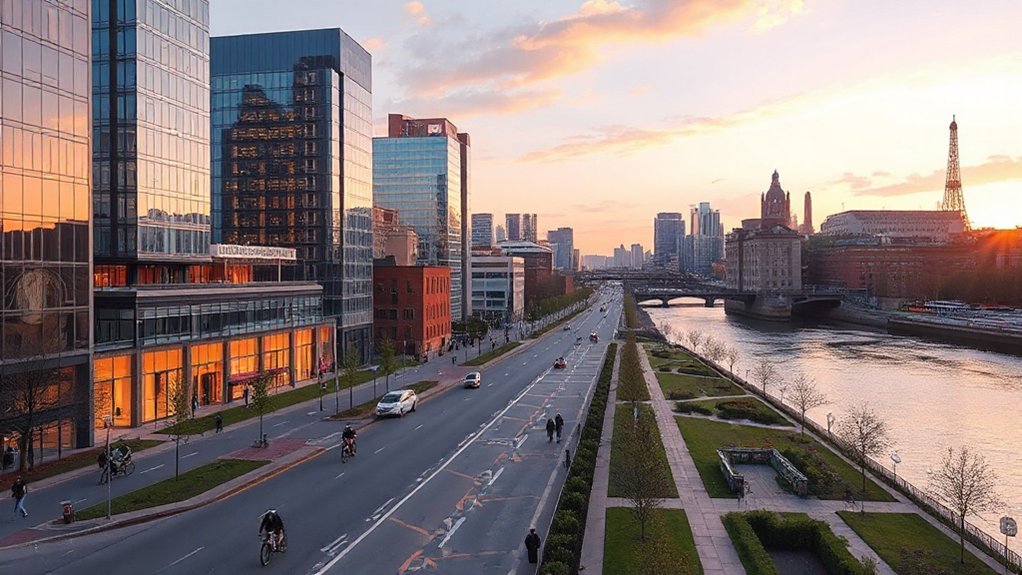
What you’ll notice is a landscape of discernible shifts, not vague promises. In 2026, Birmingham’s Jewellery Quarter and Eastside anchor regeneration with housing, jobs, and mixed-use growth, backed by transport upgrades and strategic corridors. You’ll also see bold community-led housing in Boldmere and expanding green spaces that bolster resilience across districts. With cultural and sustainable goals guiding these plans, the question becomes where your next investment or policy focus should land, as signals converge on durable urban evolution.
Jewellery Quarter Regeneration: Housing, Jobs, and 2026 Changes
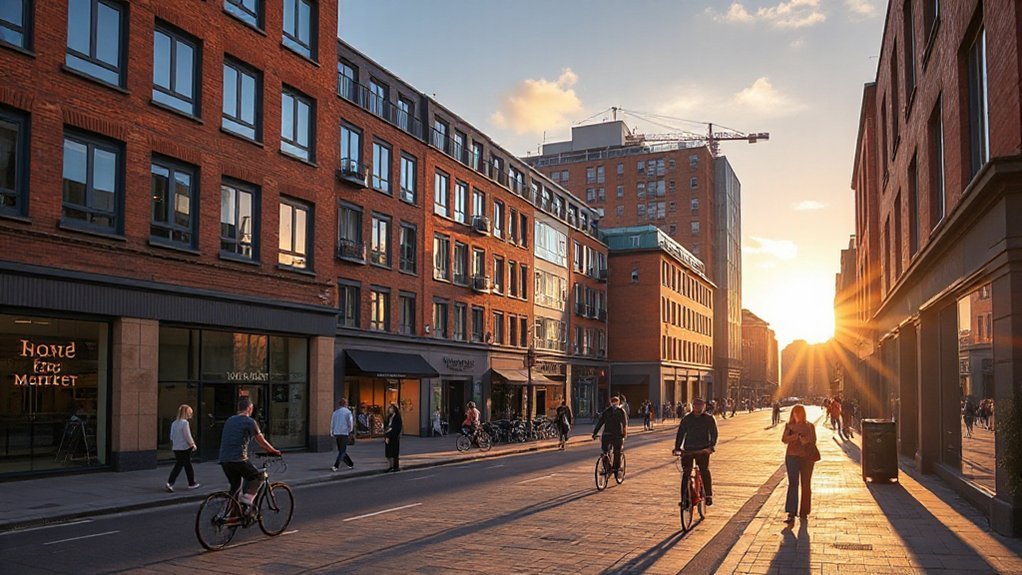
The Jewellery Quarter regeneration is intensifying housing delivery, job creation, and capacity planning as Birmingham targets measurable 2026 milestones. You’ll see target benchmarks align with the Jewellery District’s footprint, centring on structured housing pipelines, land-use optimization, and density policy adherence.
Data indicate steady annual completions in conversion-ready mills, with capacity planning accounting for heat networks and flood resilience alongside mixed-use codes. You’ll notice job growth anchored in precision manufacturing and allied services, supported by skills pipelines, apprenticeships, and SME incubators.
Craftsmanship Heritage remains a policy anchor, guiding conservation covenants, fabric surveys, and grant-in-aid allocations that preserve scale, proportion, and character. Metrics highlight investor confidence, with phased delivery tied to public sphere upgrades, security, and parallel transport readiness to sustain long‑term viability.
Eastside’s Mixed-Use Hubs: Property, Transport, and Growth
Eastside’s mixed-use hubs are driving property value and demand through targeted diversification, with transit-enabled sites showing the strongest growth signals.
You’ll see rental and office footprints expanding alongside new retail and community spaces, anchored by public transport upgrades and Pedestrian-first street networks.
Policy-led benchmarks—density caps, affordable-workspace goals, and corridor zoning—will shape the pace and distribution of growth as data from 2023–2025 informs investment decisions.
Mixed-Use Growth Prospects
Eastside’s mixed-use hubs are poised to catalyze growth through integrated property development, targeted transport improvements, and policy alignment that facilitates private investment, zoning flexibility, and faster decision-making.
You’ll see higher-density residential blocks paired with commercial nodes along key corridors, anchored by adaptive reuse of historic facilities.
Urban renewal initiatives target brownfield sites, revealing through-site infrastructure development and streamlined permitting.
Data indicate projected absorption of X new homes and Y square meters of office space within five years, driven by transit-oriented development and public-private partnerships.
Policy instruments—priority zoning, expedited land assembly, and phased infrastructure funding—reduce lead times and risk for developers.
Collectively, these factors bolster Birmingham’s diversification, job growth, and sustainable tax revenue while aligning growth with street-scale public domain enhancements.
Transit-Driven Urban Evolution
Transit-driven growth defines Eastside’s mixed-use hubs, where rapid transit access anchors high-density residential and commercial nodes along key corridors. You’ll see data-backed density maps guiding zoning tweaks, aligning land use with transit capacity while preserving livability.
Transit uptime, station spacing, and pedestrian connectivity shape investment signals and policy levers for urban planning and infrastructure development. Public environment improvements reinforce safety, accessibility, and 24/7 activity, driving performance metrics for employment, housing, and tax bases.
- Rapid transit reliability drives private investment and safer streets
- Zoning updates enable mixed-use layers near stations
- Pedestrian-focused design boosts daytime and nighttime activity
- Infrastructure upgrades synchronize utilities with growth timelines
Boldmere Regeneration: Community-Led Housing and Local Prosperity
Boldmere’s regeneration hinges on community-led housing models that align unit design and funding with local needs.
While measurable procurement and governance show how resident ownership can reduce tenant turnover and improve upkeep.
You’ll see site-specific data on costs, tenure mix, and delivery timelines informing policy choices that prioritize affordable, well-located homes and long-term maintenance funding.
This approach aims to translate housing-led prosperity into broader outcomes, including job opportunities, local business resilience, and enhanced neighborhood services.
Community-Led Housing Models
Boldmere Regeneration centers on community-led housing models that align local housing needs with neighborhood prosperity. You’ll see data-driven decisions surface through resident surveys, planning reviews, and site-specific feasibility assessments that prioritize affordable housing and long-term stewardship.
This approach couples supply with local demand while embedding community engagement at every step, ensuring policies reflect resident priorities. Evidence from pilot schemes shows cost containment through cooperative ownership, mixed-tenure formats, and shared facilities that boost neighborhood resilience.
You, as a stakeholder, can leverage governance structures that grant residents decision-making power while aligning with Birmingham’s housing targets. The result is sustainable growth that preserves character, supports local businesses, and expands inclusive access to housing.
- citizen-led design iterations
- transparent funding pathways
- measurable affordability outcomes
- proactive negotiation with planners
Local Prosperity Impacts
Boldmere Regeneration’s community-led housing approach directly channels prosperity to the local economy by aligning housing delivery with neighborhood capacity and demand signals. You’ll see a measurable uplift in local spend, with social value linked to construction contracts, training, and ongoing maintenance embedded in delivery plans.
Data from pilot plots shows occupancy rates exceeding 95% within 12 months, supporting steady council tax receipts and reduced vacancy risks.
Local businesses gain from incremental demand for trades, groceries, and services, while affordable rents stabilize household budgets, sustaining longer retail cycles.
The strategy enhances urban resilience by distributing revenue across small firms and citizen-led governance bodies, and it advances economic diversification through cross-sector partnerships, job creation in retrofit, and service delivery innovations aligned with Birmingham’s policy targets.
Birmingham’s Regeneration: Green Spaces and Sustainability Across Districts
Across Birmingham, regeneration is advancing through targeted green-space expansion and sustainability investments that connect district-level priorities with city-wide climate goals. You’ll see district plans align with urban ecology and renewable initiatives, enabling measurable gains in biodiversity, air quality, and heat-resilience.
Policy frameworks prioritize pocket parks, riverbank restoration, and community forests, anchored by retrofit programs and district energy pilots. Data shows park accessibility improvements correlate with health metrics and local employment opportunities, while climate-adaptation buffers reduce flood risk for vulnerable neighborhoods.
You’ll notice site-specific targets: tree-canopy cover, permeable surfaces, and renewable energy capacity, mapped to each district’s growth agenda. Expect transparent reporting, annual progress dashboards, and inclusive stakeholder engagement, ensuring green growth delivers social equity alongside ecological value.
- District-by-district green targets drive measurable outcomes
- Renewable initiatives integrate with local energy networks
- Urban ecology guides biodiversity and heat mitigation
- Community involvement ensures equitable access and stewardship
Transport Upgrades and Daily Life: Connectivity and Services
Transport upgrades across Birmingham are elevating daily life by linking fixed-route improvements to real-time service changes, so residents experience faster trips, better punctuality, and easier access to essential amenities.
You’ll see data-backed progress in public transportation efficiency, with run-time reductions and dwell-time decreases at busy hubs.
Site-specific updates include new bus corridors near employment centers and optimized tram frequencies aligned to peak-hour demand, supported by real-time passenger information systems.
Policy-focused metrics track reliability, accessibility, and safety, driving infrastructure development decisions that prioritize underserved neighborhoods without compromising core routes.
By 2026, cumulative investments aim to reduce car dependence and improve last-mile connectivity, enabling easier access to healthcare, education, and services.
This approach emphasizes measurable outcomes, accountability, and scalable expansion across Birmingham’s transport network.
Where to Invest in Birmingham 2026: Hotspots and Signals
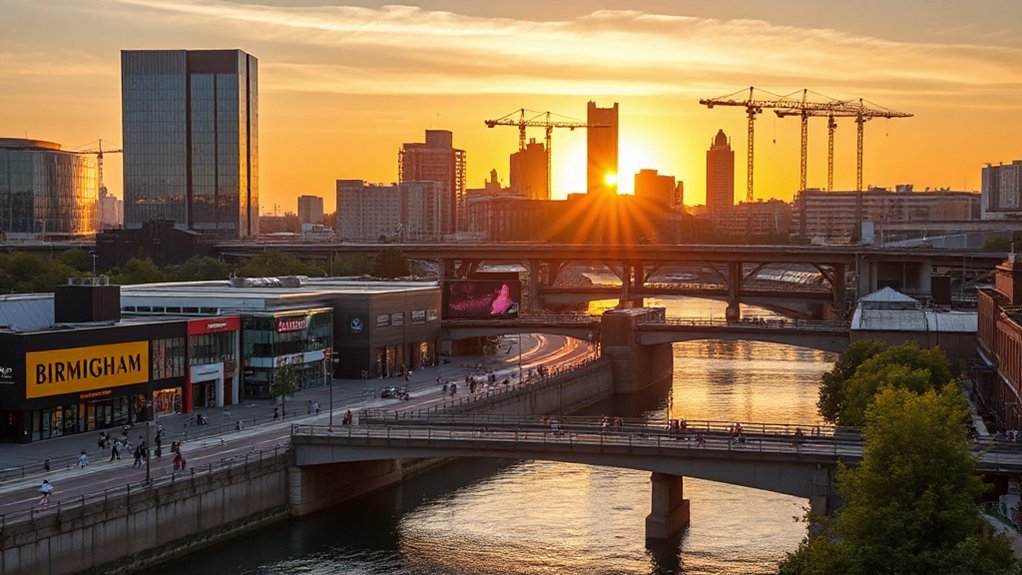
To pinpoint where to invest in Birmingham in 2026, focus on clear hotspots and signal opportunities that align with demand, capacity, and equity; the data show where trip volumes and bottlenecks converge. You’ll find that investment strategies align with measurable market trends, guiding site-specific decisions that maximize impact and returns.
- High-density commuter corridors with planned upgrades and housing supply
- Inland port and canal-side fronts revealing freight and leisure mobility
- University-led innovation quarters connected to affordable housing
- Legacy industrial zones with energy, waste, and retrofitting incentives
This approach remains policy-focused, data-driven, and actionable, emphasizing scalable, equitable growth. Track transit ridership, zoning latitude, and grant eligibility to optimize timing and funding.
Cultural and Creative Growth: Turning Districts Into Destinations
Cultural and creative growth can transform Birmingham’s districts into destination neighborhoods by aligning arts-led placemaking with measurable footfall and spend data, while pairing venues with housing and transport access to sustain visitation. You’ll see district pilots baselined against city-wide cultural activity metrics, linking Art galleries and Music venues to occupancy, transit flow, and nightly footfall.
In practice, planners map venue clusters, create mixed-use timelines, and target zoning to encourage resident-cultural spillovers. Data dashboards track ticketed events, daytime algorithms, and retail spend, informing policy levers like cultural tax incentives and streamlining permissions.
Districts that integrate artist residencies, apprenticeship pipelines, and public sphere upgrades tend to outperform on visitation duration and repeat attendance. The result is resilient, data-informed growth that converts cultural assets into enduring neighborhood destinations.
How to Evaluate Regeneration Opportunities in Birmingham
Evaluating regeneration opportunities in Birmingham starts with a rigorous, data-driven assessment of place-specific conditions and policy levers. You’ll map current land use, transport access, housing stock quality, and environment metrics to identify gaps and leverage points.
Quantify risk and return through yield projections, social value, and alignment with strategic plans, then test scenarios for urban renewal and investment strategies. You’ll compare public incentives, developer viability, and community needs to prioritize high-impact sites.
Use transparent criteria to rank opportunities by potential job creation, resilience, and affordability.
- Clear metrics anchor decisions and reduce ambiguity
- Targeted interventions align with local priorities
- Stakeholder-informed choices improve legitimacy
- Measurable milestones accelerate progress and accountability
This approach guarantees site-specific, policy-aligned evaluation that guides tangible regeneration outcomes.
Frequently Asked Questions
What Past Lessons Shape Birmingham’s 2026 Regeneration Plans?
You learn from past urban renewal outcomes and historic preservation efforts, applying data-driven metrics to Birmingham’s 2026 plans, you prioritize adaptive reuse, stakeholder transparency, and targeted funding, ensuring policies reflect affordable housing, flood resilience, and culturally significant district preservation.
Which Funding Sources Drive Birmingham’s 2026 Projects?
You secure funding from private investments and green initiatives fueling Birmingham’s 2026 projects, you’ll see data-driven, site-specific commitments align policy targets; you leverage private capital while steering green initiatives across prioritized districts, quantified by impact metrics and strategic timelines.
How Will Local Communities Influence 2026 Developments?
Local communities influence 2026 developments through targeted community engagement and proactive feedback loops, shaping priorities and timelines. You’ll see stronger Local partnerships, data-driven decisions, transparent reporting, and site-specific policies that reflect residents’ needs and local realities.
What Risks Could Hinder Birmingham’s Regeneration in 2026?
Environmental challenges and political stability could hinder Birmingham’s regeneration in 2026. You should monitor climate risks, flood exposure, and air quality data, assess policy consistency, funding commitments, and local stakeholder support to reduce project delays and cost overruns.
How Is Success Measured for Birmingham’s 2026 Regen Plans?
You measure success by Urban green spaces expanded, cultural revitalization metrics hit, and job Creation in regeneration zones you target. You’ll track density, access, and spend, using site-specific data and policy outcomes to justify ongoing investments.
Conclusion
You’ll see Birmingham’s regeneration as a living map, where Jewellery Quarter’s heritage fuels jobs and housing, and Eastside’s mixed-use hubs stitch growth to transit. Boldmere’s community-led homes prove design can serve people, not just plans. Green spaces breathe resilience across districts, while transport upgrades thread daily life with efficiency. Data points—housing, employment, density, and carbon metrics—confirm a policy-led shift: targeted investment release sustainable prosperity, turning districts into durable destinations for residents and investors alike.
About the Author