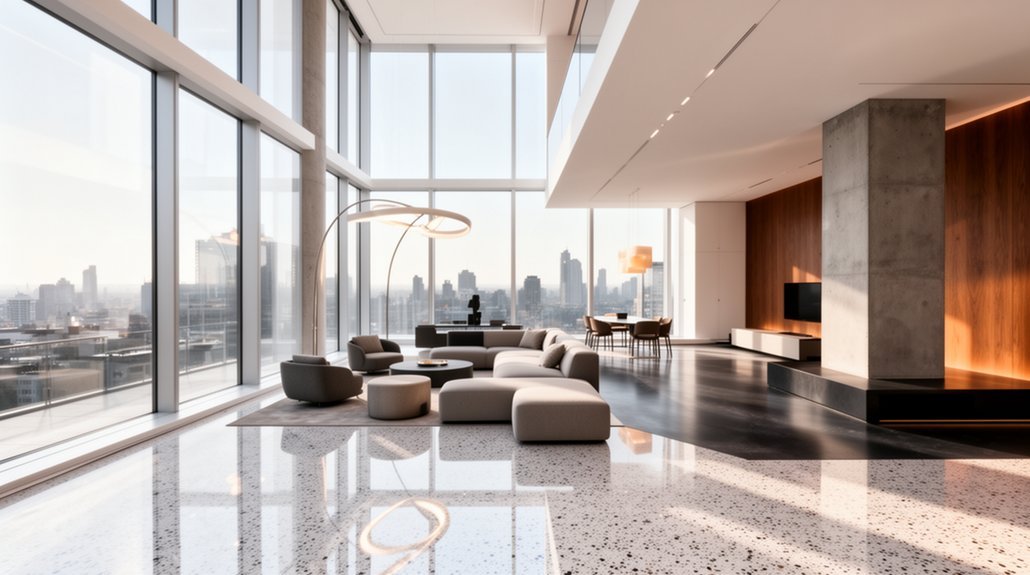
You can elevate an open‑plan city apartment with a cohesive, ultra‑modern approach that defines zones through furniture, lighting, and materials—never walls. Prioritize daylight with light‑reflective neutrals, consistent undertones, and reflective finishes, while using rugs and low‑profile storage to signal function. Arrange furniture for sightlines, balance, and flow; integrate modular seating and floating cabinetry for flexible layouts. Layered lighting—LEDs, dimmers, and color control—creates depth and ambiance. If you keep exploring, you’ll uncover practical, future‑proof strategies.
Defining Ultra-Modern for Open-Plan City Homes: Core Principles
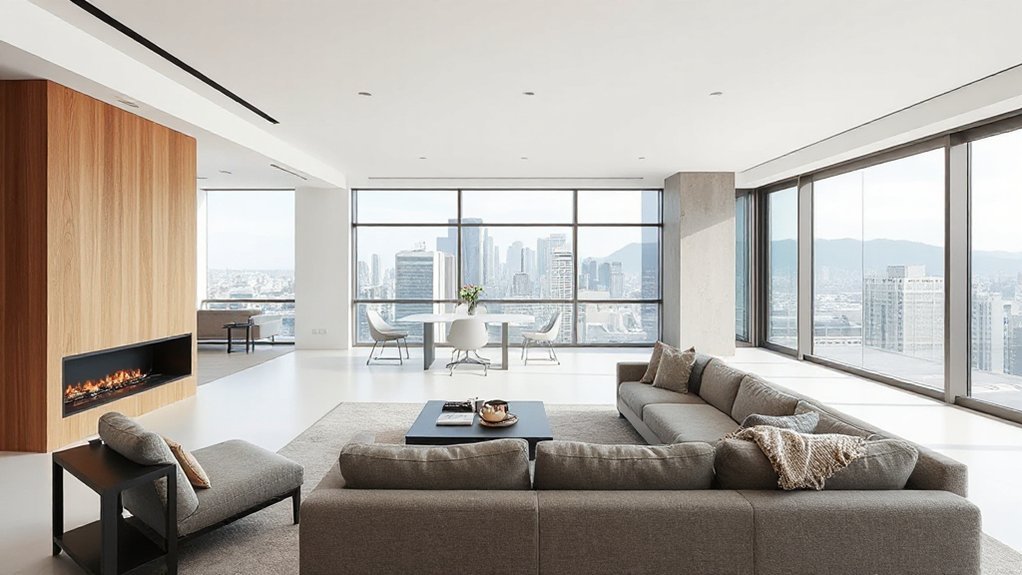
Ultra-modern open-plan city homes hinge on clear delineation of function while preserving spacious, uninterrupted sightlines. You define zones by purpose, not walls, using proportional furniture scales, lighting patches, and material progressions that minimize visual clutter.
Core principles center on precise workflow, responsive storage, and regulated acoustics to maintain calm amid activity. You prioritize modular systems that adapt to evolving needs, ensuring each area supports its role without encroaching on others.
Integrate Smart technology to automate lighting, climate, and shade control, enabling seamless environmental adjustments that feel instantaneous and intuitive.
Industrial accents provide texture and credibility without heaviness, employing restrained metal frames, concrete finishes, and exposed structure as deliberate design statements.
Maintain consistency in detailing, align seams, and document tolerances to sustain fidelity across finishes and installations.
Zoning Without Walls: Create Flow With Furniture Arrangements
You optimize flow by arranging furniture to create distinct zones without enclosing walls, guiding movement through sight lines and proportional scale.
Use visual boundaries like rugs, shelving, and furniture clusters to mark function while preserving openness. This approach emphasizes flow-optimized layouts and clear, wall-free zoning through strategic placements.
Flow-Optimized Furniture Layout
To create flow without walls, arrange furniture to define zones while preserving sightlines and easy circulation. In this movement-optimized layout, you guide movement with thoughtful placement, not barriers. Prioritize furniture placement that supports clear traffic flow between living, dining, and work zones, while keeping open sightlines to the whole apartment.
- Position seating to create inviting sightlines toward focal points, reinforcing function without fragmentation.
- Use area rugs and low-profile consoles to anchor zones, subtly signaling shifts and guiding movement.
- Place storage and desks along perimeter walls or in corner nooks to maintain airiness and uninterrupted circulation.
This approach minimizes clutter, elevates usability, and sustains a cohesive, modern rhythm throughout your open-plan space.
Visual Boundaries Without Walls
Use scale and rhythm to signal separate functions—pair longer sofas with a single console, or place a low bookshelf to interrupt flow without blocking light. Incorporate privacy screens or decorative dividers only where soft separation is needed, preserving continuity.
Choose materials and colors that repeat across zones to maintain cohesion. Evaluate distances, traffic paths, and acoustic considerations, refining placements until progression feels natural, intentional, and uncluttered.
Color Palettes That Maximize Light and Space
Light-reflective neutrals keep spaces airy and lines clean, boosting perceived height and brightness. Pair them with brightness-amplifying accents to create focal points without overpowering the open plan.
Use contrast sparingly and let material textures—glass, metal, and matte finishes—enhance depth without reducing light.
Light Reflective Neutrals
A light-reflective neutral palette uses pale, unsaturated tones to bounce natural light around compact city spaces, making walls, ceilings, and floors act as a single luminous surface. You optimize brightness by selecting a neutrals palette that minimizes saturation while maximizing contrast with subtle textures.
Emphasize reflective surfaces to extend daylight, reduce artificial lighting, and create perceived depth. This approach supports clean sightlines and flexible layout logic without visual clutter.
- Maintain consistent undertones across walls, ceilings, and cabinetry to guarantee seamless diffusion.
- Introduce matte textures + minimal sheen to balance glare and warmth.
- Use strategically placed mirrors and glass to double daylight without overcrowding.
Desired outcomes: enhanced spaciousness, improved energy efficiency, and refined, timeless aesthetics.
Brightness Amplifying Accents
To amplify brightness without sacrificing cohesion, you’ll lean on color palettes that pair airy neutrals with selective chroma. You implement brightness amplifying accents by limiting saturated hues to targeted focal points, preserving space perception.
Use high-contrast, cool whites and pale beiges as base, then introduce a single chroma color in accessories, artwork, or upholstery to draw the eye without overwhelming the room.
Material reflectivity matters: glossy surfaces and light woods amplify reflected light, while matte textures reduce glare.
Schedule artificial lighting to complement color decisions, layering ambient, task, and accent lighting for depth without hotspots.
Consider window treatments that maximize light during the day, shielding glare when needed, and maintain cohesion with frame finishes and fabric tones.
This approach sustains perceived openness while delivering visual precision.
Texture Layering: Warming Sleek Surfaces With Materials
Texture layering turns sleek, hard surfaces into inviting, livable spaces by adding tactile warmth. You enhance perceived depth by pairing materials with distinct textures, achieving textural contrast and material harmony across zones. Choose complementary fibers, finishes, and grains to preserve light and scale in open-plan layouts.
- Start with a base of matte stone or concrete, then introduce warm textiles for contrast.
- Layer woods and metals in varying weaves and cross‑textures to create rhythm without crowding sight lines.
- Finish edges with soft, cushioned details to balance hardness while preserving sleek lines.
Applied techniques deliver functional warmth: controlled sheen, deliberate grain direction, and restrained color. The result is a cohesive, high‑tech aesthetic that remains comfortable and navigable.
Floating Cabinetry for Hidden Storage and Clean Lines
Floating cabinetry creates hidden storage and exposes clean sight lines by mounting units just above floor level. You implement this approach to maintain an uninterrupted floor plane while concealing hardware and contents. Choose integrated pulls or touch‑to‑open mechanisms to preserve the streamlined look.
Depth is critical: shallow profiles reduce visual weight yet offer practical capacity for daily essentials. In open plans, align cabinetry with architectural cues—baseboards, soffits, and ceiling lines—to reinforce cohesion.
Materials should resist fingerprints and moisture, with thermal‑mirror finishes or matte laminates favored for durability. Mounting height matters: position upper units to keep sightlines clear while allowing easy access.
Label storage zones internally to improve usability, and consider soft‑close hardware for quiet operation. Floating cabinetry supports a minimalist aesthetic while maximizing practical storage. hidden storage
Modular Seating That Scales as Your Space Changes
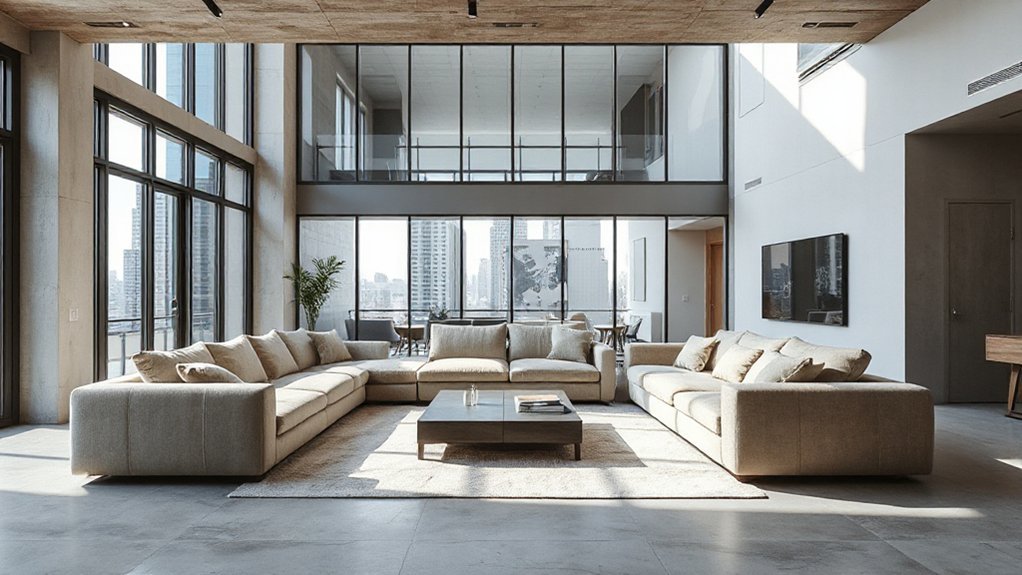
Modular seating adapts to changing footprints by combining modular units, connectors, and smart sizing. You’ll achieve flexible arrangements that reconfigure in minutes, preserving sightlines and flow. This approach supports adaptable layouts without abandoning comfort or style.
- Flexible configurations allow you to expand or reduce seating density as needs shift.
- Integrated connectors enable seamless linkages between zones for work, dining, or lounging.
- Stocked modules with hidden mechanisms simplify resizing, keeping everything tidy and stable.
With modular furniture, you maintain control over room proportions, balance, and focal points. You’ll also optimize acoustics and traffic patterns, maximizing usable area. The result is an environment that evolves with you, not against you, while preserving a cohesive aesthetic.
This system thrives in open plans, delivering disciplined, scalable comfort.
Ceiling Lighting to Set the Mood and Enhance Perception
You’ll use mood-setting ceiling lighting to shape atmosphere and cue how you move through the space. Precise fixture placement enhances perception by guiding depth, focal points, and flow without creating glare.
Layered light temperatures add dimensionality, depth, and a sense of scale that adapts from day to night.
Mood-Setting Ceiling Lighting
Ceiling lighting sets the mood and shapes how you perceive a space, so choose fixtures that deliver adjustable brightness and color temperature to match activities from relaxing evenings to focused work. You’ll cultivate atmosphere with controls that switch between ambient glow and higher-contrast task light, preserving color accuracy.
- Calibrated tunability: set warm hues for lounging, cooler tones for reading or drafting, maintaining color contrast for objects and furnishings.
- Layered luminance: combine recessed, pendant, and cove sources to sculpt depth and texture without glare.
- Dynamic scenes: program presets for scenes like “intimate,” “focus,” and “entertain,” ensuring seamless progression.
This approach prioritizes efficiency, comfort, and visual clarity, aligning with open-plan layouts and modern finishes.
Perception-Enhancing Fixture Placement
To shape perception in open-plan spaces, place ceiling fixtures to control how light sculpts walls, furniture, and zones. You’ll use directed artificial lighting to carve visual boundaries without heavy clutter, preserving an airy flow.
Position luminaires to emphasize architectural features and reduce glare, which sharpens depth cues and perceived room size. Mount adjustable spotlights along work zones to define tasks while keeping seating areas softly illuminated with diffuse downlight for cohesion.
Integrate decorative accents with discreet trims and integrated valences to maintain clean lines while enriching texture. Favor dimmable controls to quickly shift mood from bright day-work to intimate evenings, ensuring consistent color rendering across fixtures.
Prioritize uniform ceiling brightness to avoid perceptual cliffs, and balance fixture density with wall reflectance for a cohesive, legible planar perception.
Layered Light Temperature Effects
Layered color temperature in ceiling lighting shapes perception by pairing cool, task-focused light with warmer, diffuse ambient glow. You create depth and pacing in open spaces by layering light temperatures, not just brightness. This approach leverages layered light to guide attention, improve contrast, and influence mood.
In practice, balance cool, high-CRI task fixtures with subtle warm ambient sources to avoid jarring shifts. Temperature effects emerge as you sculpt zones for work, socializing, and retreat, keeping ceilings visually disengaged yet emotionally resonant. Be precise with lumen output, Kelvin ranges, and dimming profiles to maintain consistency across zones.
- Calibrate task and ambient temps to prevent color distortion.
- Use controls that smoothly shift across activity periods.
- Test perceptual outcomes in real-time to fine-tune layering.
Materials and Finishes That Read as Light and Reflective
When you choose materials and finishes that read as light and reflective, you create a sense of airiness that enhances openness in small urban spaces. You should prioritize high-light reflectance and uniformity to minimize visual noise.
Material textures matter: opt for smooth, low-contrast surfaces that bounce daylight without creating glare. Finish options include pale, cool-toned porcelains, glass, mirrors, and polished stones that mirror surroundings rather than compete with them.
Keep edges crisp and seams minimal to sustain seamless planes. Use light, neutral palettes with consistent undertones across floors, walls, and cabinetry to reinforce cohesion.
Avoid heavy textures or saturated hues that absorb light. Select finishes with durable, easy-to-clean properties to preserve reflectivity under daily use.
Real-World Zoning Case Studies in Small Urban Pads
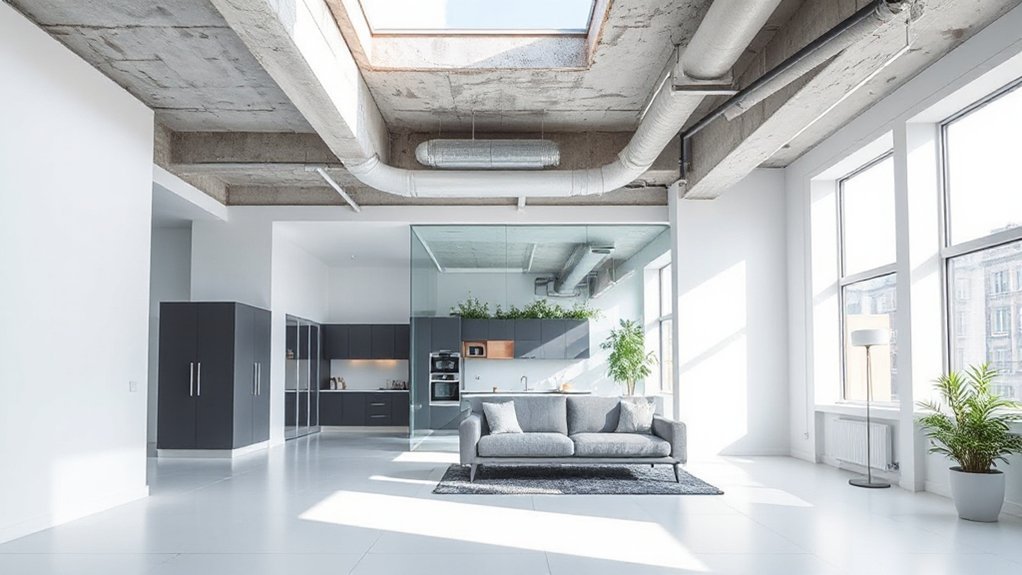
- Case A demonstrates adaptive reuse, preserving fabric while adding compliant units.
- Case B shows height modifiers and setback adjustments that protect daylight access.
- Case C integrates performance standards, guiding materials and mechanicals for efficiency.
You’ll note how transit accessibility, parking policy, and public sphere requirements drive layouts and unit mix, all while maintaining character.
The result is predictable, enforceable, and legible zoning outcomes that support open-plan interiors without walls of density.
Historical influences and sustainable materials emerge as recurring levers in policy design, shaping future pads.
Budget-Friendly Upgrades That Deliver a Modern Punch
Small upgrades can redefine an open-plan city apartment without a full renovation. You’ll focus on high-impact, low-cost moves that sharpen form and function.
Begin with lighting: layered layers of LED, dimmers, and color temperature control create depth without walls.
Choose a neutral base and add texture with architectural details like trim, molding, or slim shelving profiles to imply structure.
For visual interest, incorporate artistic wall murals strategically as focal points, not wallpaper-wide coverage.
Introduce vintage decor selectively—one statement piece, like a mid-century chair or industrial lamp, anchors the space without clutter.
Flooring upgrades can be simulated with area rugs that define zones.
Finally, optimize acoustics with soft furnishings and compact panels, preserving openness while reducing noise.
These updates deliver a modern punch without disrupting flows.
Maintenance, Durability, and Future-Proofing Your Open Plan
To keep an open-plan city home reliable over time, you’ll prioritize maintenance that preserves layout flexibility, durability, and future-proofing. You’ll implement robust cleaning routines and targeted material maintenance to minimize wear, sag, and structural shifts.
- Schedule routine inspections and timely component replacements to sustain load paths and flexibility.
- Choose durable finishes and modular systems that resist scuffs, moisture, and temperature swings.
- Plan future-ready layouts with adaptable zones, concealed services, and accessible upgrades to extend lifespan.
Trustworthy maintenance boosts resale value and reduces downtime. Use cleaning routines to prevent residue buildup and preserve aesthetics, and apply material maintenance to extend surface life.
Maintain documentation for warranties and service histories to guide upgrades and repairs, ensuring your open plan remains functional, efficient, and adaptable as needs evolve.
Frequently Asked Questions
How to Balance Acoustics in Open-Plan Spaces?
You balance acoustics by layering sound absorption materials and defining zones, using privacy solutions like privacy screens and acoustic panels; strategically place furniture to interrupt reflections, maintain flow, and guarantee speech intelligibility across open-plan spaces.
What Lighting Setups Maximize Perceived Height?
You’ll boost perceived ceiling height by 20% with layered ambient lighting and wall grazing, distributing light upward and outward. Use ambient lighting to reflect off light-colored ceilings; emphasize ceiling height with indirect, cool-toned fixtures.
Can Plants Improve the Open-Plan Without Clutter?
Yes, indoor greenery can enhance openness without clutter. You optimize plant placement by choosing slim, vertical specimens, using floating shelves and perimeters, and grouping via sightlines to maintain airy flow while leveraging natural light.
How to Choose Furniture That Fits Multiple Zones?
You’ll harmonize zones by thoughtful Furniture placement and flexible pieces, then adjust Color coordination to unify palettes. Start with scalable seating, align sightlines, and use rugs to cue each area; you’ll charm flow without crowding.
What Are Budget-Friendly Smart Storage Ideas?
Budget-friendly storage starts with modular furniture and hidden compartments. You’ll maximize space, keep clutter out of sight, and adapt layouts quickly, using modular furniture to reconfigure zones and hidden compartments for secure, low-cost organization.
Conclusion
You are the captain steering a glass-quiet ship through an urban harbor. Your open plan is the sea; zoning is the wind, not walls. Align light, texture, and floating storage like sails and rigging—sleek yet practical. When storms of clutter arise, deploy reflective surfaces and smart materials to refract chaos into calm. Maintain course with durability and future-proof choices. Your ultra-modern home becomes a well-charted voyage—clear, efficient, and endlessly adaptable to the city’s shifting tides.
About the Author