The Hybrid Office And How UK Businesses Are Redesigning Their Workplaces
The office has not disappeared. But it has changed, is changing, and will continue to change in response to the most fundamental shift in working patterns that most businesses have experienced in a generation. The hybrid working model — in which employees split their time between the office and home or other remote locations — has moved from emergency pandemic accommodation to settled working practice for the majority of UK knowledge workers, and the physical offices that house them are being redesigned, refurbished, and rethought to reflect this new reality.
The central design challenge of the hybrid office is straightforward to articulate and complex to solve: if only 40% to 60% of the workforce is in the office on any given day, what should the office be for? The answer that UK businesses and their workplace designers are arriving at, through a combination of research, experimentation, and the evidence of what actually draws people into the office when attendance is not mandated, is that the hybrid office should be optimised for what it does uniquely well — collaboration, social connection, mentoring, culture-building, and the serendipitous encounters that are genuinely difficult to replicate digitally — rather than trying to replicate the focused individual work environment that employees now do more effectively at home.
This reorientation of office purpose is producing a wave of workplace redesign activity across the UK that is one of the most significant drivers of office occupier behaviour in the post-pandemic property market. Understanding what UK businesses are doing to redesign their workplaces — and why — is directly relevant to landlords, developers, and investors assessing the future of the office sector.
From Workstations to Destinations
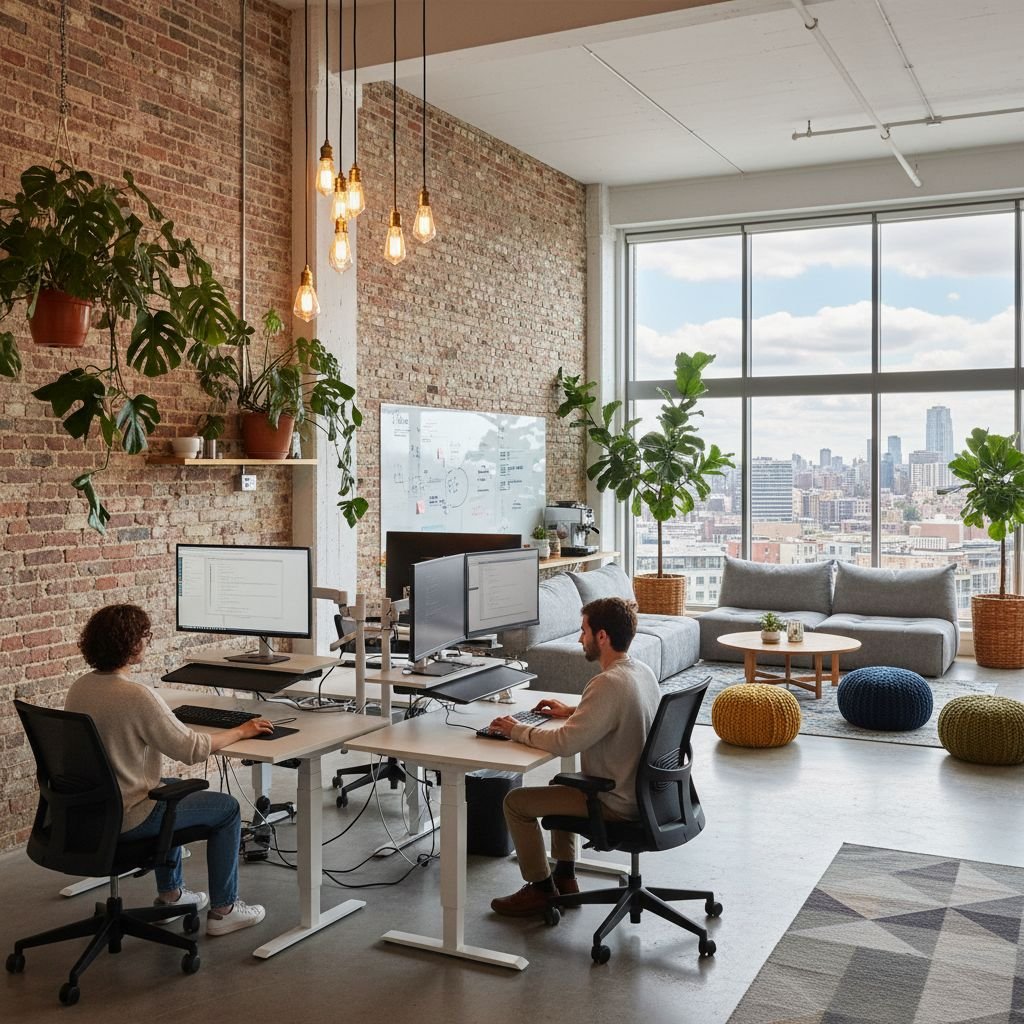
The dominant model of pre-pandemic office design — rows of assigned workstations, meeting rooms booked through a calendar system, and a breakout space with a coffee machine — was optimised for a workforce that came to the office every day to do focused individual work at a fixed desk. This model is being dismantled and replaced by what workplace designers call activity-based working — an approach in which the office provides a range of different environments suited to different types of work, and employees choose the environment that best serves what they are trying to do at any given time.
In a well-designed hybrid office, the space allocation has shifted dramatically. The proportion of the floor plate allocated to individual focused work has reduced — often from 70% to 80% of the total to 30% to 50% — while the proportion allocated to collaboration, social, and community spaces has increased correspondingly. Collaboration zones — open areas with writable surfaces, moveable furniture, and technology infrastructure for hybrid meetings — have expanded. Social spaces — café-style areas, lounges, and informal meeting points — have been created or enlarged. Quiet focus areas — library-style zones with high-quality acoustic treatment and a culture of minimal distraction — have been introduced as a counterpoint to the more social spaces, recognising that not all focused work is best done at home.
The technology infrastructure of the hybrid office has become a critical design element rather than a background utility. Meeting rooms designed for hybrid meetings — where some attendees are in the room and others are joining remotely — require audio-visual technology that gives remote participants a genuinely equivalent experience to being present. The Owl Labs Meeting Owl, Microsoft Teams Rooms, and equivalently sophisticated conferencing infrastructure have moved from nice-to-have to essential in any meeting space used for hybrid collaboration. Offices that fail to invest in this infrastructure find that hybrid meetings are frustrating, that remote participants are marginalised, and that employees choose not to come in precisely because the in-person experience is no better than the remote one.
The Amenity Arms Race
One of the most striking features of the post-pandemic office redesign conversation is the emphasis on amenity — the range of facilities, services, and experiences available to employees in the office building — as a driver of office attendance. If employees have a genuine choice about whether to come to the office or work from home, the quality of the office experience needs to be sufficiently better than the home experience to make the journey worthwhile. This has driven significant investment in office amenity that goes well beyond what was considered necessary or appropriate in the pre-pandemic era.
High-quality food and beverage provision — café-style operations, barista coffee, and in some cases restaurant-quality lunch options — has become a standard feature of the best-in-class UK office. Employee wellbeing facilities — gyms, yoga studios, meditation rooms, and outdoor terraces — are increasingly common in premium office developments and refurbishments. Concierge services, dry cleaning, and other lifestyle amenities that reduce the friction of the working day are available in some of the most competitive office environments.
The viability of providing this level of amenity depends on density and dwell time — facilities that are used by a sufficient number of employees for sufficient hours to justify their cost and staffing. This creates a paradox for businesses that have reduced their total office headcount as a proportion of pre-pandemic levels: the employees who do come in need better amenity to justify the journey, but the reduced occupancy makes the economics of high-quality amenity provision more challenging. The solution that many businesses are arriving at is shared amenity — building-wide or campus-wide facilities shared across multiple tenants — which spreads the cost and creates the density of users needed to make high-quality provision viable.
Neighbourhood and District Offices
One of the most significant post-pandemic workplace trends for UK businesses is the development of neighbourhood office networks — smaller offices located close to where employees live, supplementing the main headquarters office and reducing the commute burden of the hybrid working week. Rather than requiring employees to commute to a single city-centre office on the days they work away from home, a neighbourhood office network provides professional workspace within a shorter journey of the employee’s home.
This trend has driven demand for smaller, well-specified office spaces in suburban locations and secondary town centres that was not previously a significant feature of the UK office market. Flexible workspace operators including IWG, Industrious, and Spaces have expanded their suburban networks in response to this demand, and some large employers have established their own satellite office networks. The property market implications — increased demand for suburban flexible workspace, reduced demand for large single-site headquarters in some cases — are still working through the market.
Conclusion
The hybrid office redesign is not a temporary response to the pandemic but a permanent reconfiguration of what offices are for and how they are designed. UK businesses are investing significantly in creating workplace environments that justify the journey by offering collaboration, social connection, and amenity that home working cannot replicate. Landlords and developers who understand this shift and provide spaces that support it — flexible, well-specified, technology-enabled, and amenity-rich — are consistently outperforming those who have not adapted. The flight to quality that characterises post-pandemic office demand is, at its core, a flight to offices that are genuinely worth coming to.
FAQs
What is activity-based working?
Activity-based working is an office design approach that provides a range of different environments suited to different types of work — collaboration zones, quiet focus areas, social spaces, and informal meeting areas — rather than assigned individual workstations. Employees choose the environment that best serves their current task rather than sitting at the same desk every day. It is the dominant design philosophy for hybrid office redesigns in the UK.
How much office space do businesses need for hybrid working?
Most businesses implementing hybrid working have reduced their total office space by 20% to 40% compared to pre-pandemic, reflecting the reduced peak occupancy when employees split their time between office and home. However, the space that remains is typically higher quality and more intensively used than the space that preceded it, with the savings from reduced total area reinvested in better specification, more collaborative space, and higher-quality amenity.
What technology does a hybrid office need?
The minimum technology requirement for a functional hybrid office is meeting room audio-visual infrastructure that gives remote participants a genuinely equivalent experience to being present — high-quality cameras, microphones, and displays. Beyond this, desk booking systems, occupancy monitoring, and digital wayfinding all improve the management of shared spaces. The investment in hybrid meeting technology is consistently cited by employees as the factor that most determines whether coming to the office is a positive or frustrating experience.
About the Author