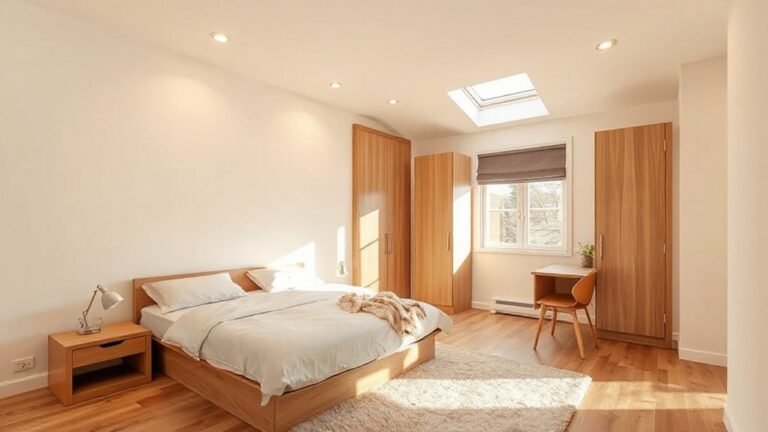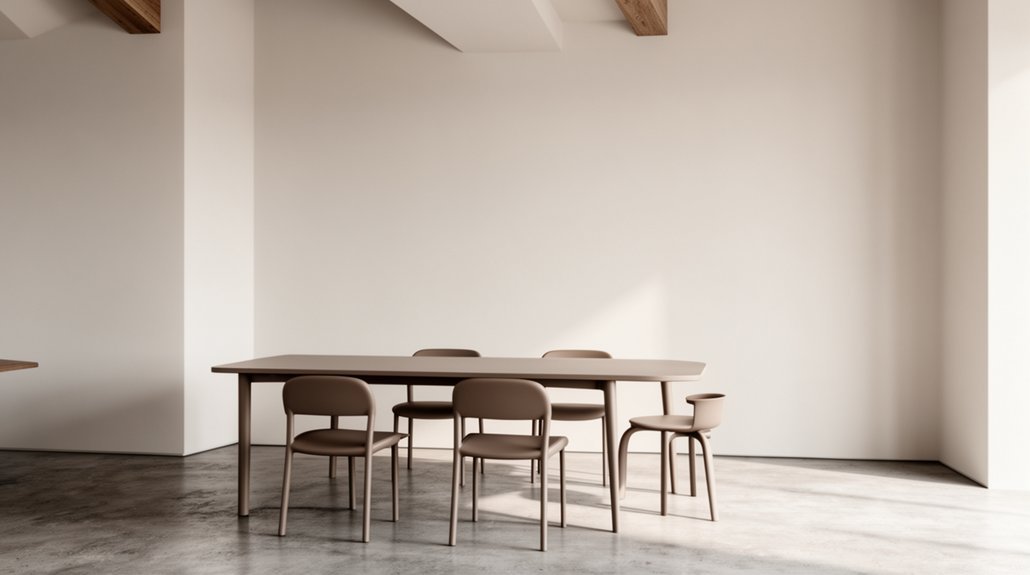
You want a minimalist dining room with clean lines and calm proportions. Prioritize restrained palettes, continuous low-profile forms, and cantilevered silhouettes to preserve sightlines. Pair matte timber tabletops with durable, low-sheen stone and subtle metal trims, using wall-mounted cabinets and floating shelves for concealed storage. Limit texture and color variety; let art and textiles respond to light without overpowering the space. Guarantee hidden channels, soft-close hardware, and adjustable task lighting for precision and ease as you scale the concept further. If you keep exploring, more details await.
Define Your Minimalist Dining Room: The Core Principles
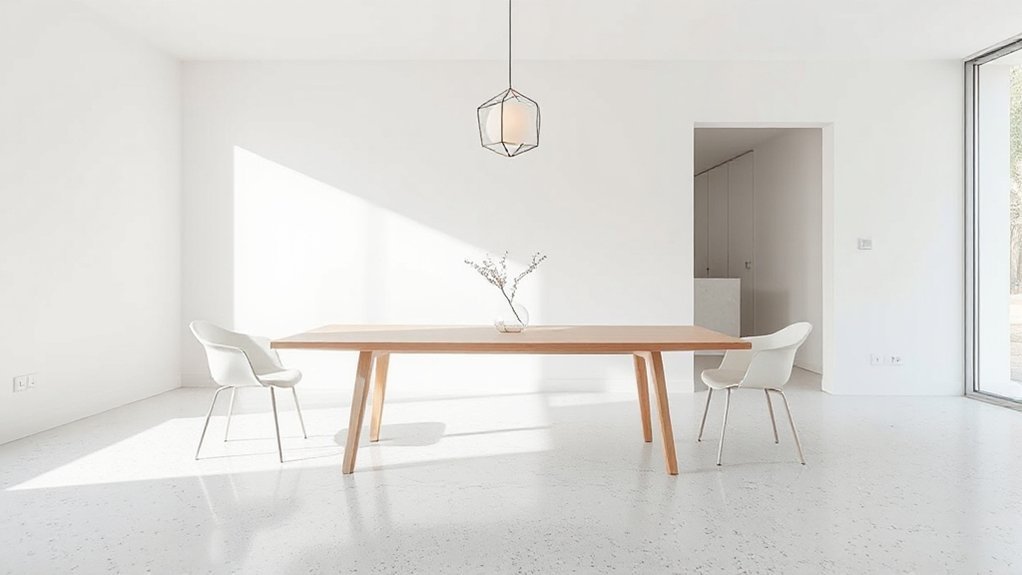
Minimalist dining rooms distill function to essentials: the space should support dining without distractions, so choose a restrained palette, clean lines, and purposeful placements.
You define your minimalist dining room by isolating core functions, prioritizing clear circulation, ample negative space, and predictable sightlines.
Focus on how materials read under natural and artificial light, matching texture to purpose rather than ornament.
You cultivate artistic expression through restrained contrasts, subtle tonal shifts, and deliberate geometry, not by decoration complexity.
Cultural influences enter via provenance-aware materials, familiar silhouettes, and historically informed spacing that respect place and ritual.
You test constraints with measurement: seat depth, leg clearance, and table height align with ergonomic standards.
This disciplined approach yields a coherent system where form serves function and evolving taste remains legible.
Choose Furniture With Clean, Continuous Lines
Choosing furniture with clean, continuous lines guarantees a cohesive, perceptible flow in a minimalist dining room. You should prioritize pieces that emphasize uninterrupted silhouettes, resisting extraneous ornamentation. Look for surfaces with uninterrupted horizontals and verticals, where junctions read as seamless progressions rather than abrupt breaks.
Favor low-profile legs and cantilevered forms that keep sightlines clear, enhancing perceived space. Material progressions must be minimal, with consistent edge treatment and uniform finishes to prevent visual fragmentation.
When incorporating Vintage accents, select items that replicate a streamlined, cohesive language rather than contrasting styles; sparingly integrate them to avoid breaking the line. Consider Artistic murals as focal complements that align with your geometry, ensuring their motifs reinforce the continuous theme without introducing competing rhythms.
Consistency in scale and proportion maintains perceptual calm and clarity throughout the room.
Material Combinations for a Calm, Cohesive Look
You’ll start by selecting material pairing techniques that create a cohesive baseline while letting accent tones stand out without clashing. Balance tone and texture to maintain visual calm, using restrained contrasts and predictable repetition across surfaces.
Consider longevity and maintenance from the outset, choosing durable finishes and practical care routines to guarantee the arrangement remains crisp over time.
Material Pairing Techniques
Begin with a matte timber tabletop as the anchor, pairing it with low-sheen stone or porcelain for durability and light reflection balance. Subtle metal trims or hardware act as quiet punctuations, while textile-backed chairs add tactile depth without overpowering lines.
Consider Cultural influences to inform proportionality and color restraint, ensuring motifs remain restrained. Artistic embellishments should be deliberate, selecting one or two restrained pieces to avoid clutter.
Maintain consistent grain orientation and a limited palette, allowing negative space to articulate structure and precision.
Tone and Texture Balance
Texture and tone must synchronize to create calm cohesion: start with a deliberate hierarchy of surfaces, pairing matte finishes with subtle sheen to guide light and perception without distraction. You balance texture by aligning material families—wood, fabric, stone—in a controlled progression, ensuring contrast remains tactile rather than noisy.
You select finishes that reflect a single temperature of light, avoiding chromatic clashes while preserving dimensional depth. In practice, limit decorative foregrounds to purposeful textures, letting Seasonal decor and artistic accents punctuate rather than overpower the composition.
You favor low-contrast neutrals for major planes and reserve pattern for restrained focal points, such as a central rug or seating cushions. This disciplined approach yields a serene, cohesive atmosphere that supports clean lines and effortless visual flow.
Longevity and Maintenance
Use matte finishes on high-traffic zones to reduce glare and fingerprints, and implement protective seals where moisture exposure occurs. Consider edge details that discourage chipping and plan for seamless junctions between materials to preserve a restrained rhythm.
Seasonal decor can be swapped without altering structural cohesion, preserving the core palette while allowing subtle updates. Balance is achieved by integrating artistic accents—sculptural forms, linear patterns, and restrained textures—that reinforce the calm atmosphere.
Guarantee maintenance routines target cleaning, re-sealing, and occasional refinishing to sustain the cohesive look.
Color Schemes That Support Simplicity and Focus
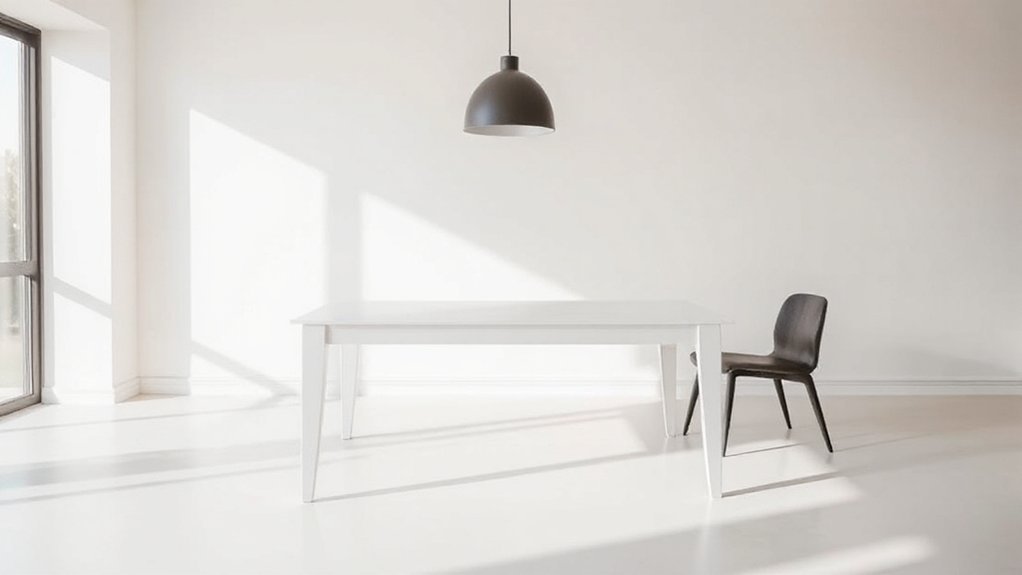
Color schemes that emphasize simplicity and focus rely on restrained palettes, balanced contrasts, and intentional saturation. You select a dominant neutral and pair it with one or two accents that don’t compete for attention, preserving visual calm. Use color psychology to guide mood: cooler neutrals for serenity, warmer tones for approachability, and subdued blacks for grounding.
Maintain consistency across walls, cabinetry, and tabletops, so focal points remain undistracted. Choose paint finishes intentionally—matte or satin on walls to minimize glare, and a semigloss or lightly lacquered surface on trim for definition without reflection. Limit high-contrast pairings to small areas, and keep lighting in harmony with the palette to preserve perceived depth.
Document swatches and test under dining room lighting to verify perceived simplicity and focus.
Hidden Storage Ideas for Clutter-Free Surfaces
Hidden storage can drastically reduce surface clutter without sacrificing style. You implement clever integrations that maintain clean lines while preserving accessibility. Hidden compartments appear as slim channels behind baseboards, chair rails, or within pedestal legs, giving you pull-out access without visual interruptions.
Concealed drawers tuck beneath countertops or inside extendable leaves, using soft-close mechanisms to protect surfaces from rattle and wear. You optimize layout by zoning functions: a central work zone stays uninterrupted, while storage aligns with periphery in flush-front panels.
Materials favor matte finishes and uniform grain to minimize reflectivity and distraction. You test capacity with real-world items—silverware, placemats, chargers—and adjust gap tolerances for smooth operation.
The result: clutter-free surfaces that retain dining-room tactility and precise, minimalist integrity.
Lighting That Delivers Subtle, Functional Glow
You’ll balance soft ambient illumination with targeted task lighting to mold the dining experience precisely.
Prioritize functional task lighting for plating and serving zones, while maintaining subtle dimmer control to shift mood without creating glare.
This approach keeps the space efficient, adaptable, and visually harmonious, aligning Soft Ambient Illumination, Functional Task Lighting, and Subtle Dimmer Control into one cohesive glow.
Soft Ambient Illumination
The aim is consistent luminance across the dining plane, with soft falloff toward walls to prevent visual fatigue. You balance correlated color temperature to complement established materials, ensuring the space reads with neutral accuracy during both meal prep and quiet dining.
Implement dimming controls to modulate intensity without perceptible color shift. Integrate fixtures that echo clean lines, using understated housings and matte finishes.
Consider incorporating artisanal ceramics and vibrant textiles as surface accents whose textures respond to ambient light, enhancing depth without overpowering minimal form. This approach preserves clarity, reduces hotspots, and supports subtle, functional glow.
Functional Task Lighting
How can you guarantee precise visibility for tasks without compromising the room’s aesthetic? Functional task lighting delivers targeted radiance to dining surfaces while preserving clean lines.
Place adjustable fixtures close to the work plane to minimize glare and shadows, using cool-white tones for accuracy without harsh contrast. Corridor or under-shelf lighting can emphasize the table edge, supporting readability at dinner and during cleanup.
Choose luminaires with minimal profiles, matte finishes, and dimmable controls to maintain a restrained silhouette. Integrate decorative accents and subtle architectural details to avoid visual competition with the primary dining form.
Assure the color rendering index remains high to reveal true material tones, supporting artistic focal points and ensuring that every plate, glass, and utensil reads clearly.
Subtle Dimmer Control
Implementing gradual spring throttled steps prevents abrupt shifts that disrupt focus, maintaining consistent eye comfort from plate to wall. In minimalist rooms, subtle dimming minimizes glare on glossy finishes and enhances material texture without competing with architectural lines.
Pair dimmer-controlled fixtures with intention, ensuring the glow remains background—deliberate, not dominant. When used with mood lighting, this technique delivers precise control over atmosphere, enabling functional clarity and refined, calm luminosity throughout the dining sequence.
Layout Strategies for Open, Flexible Dining Areas
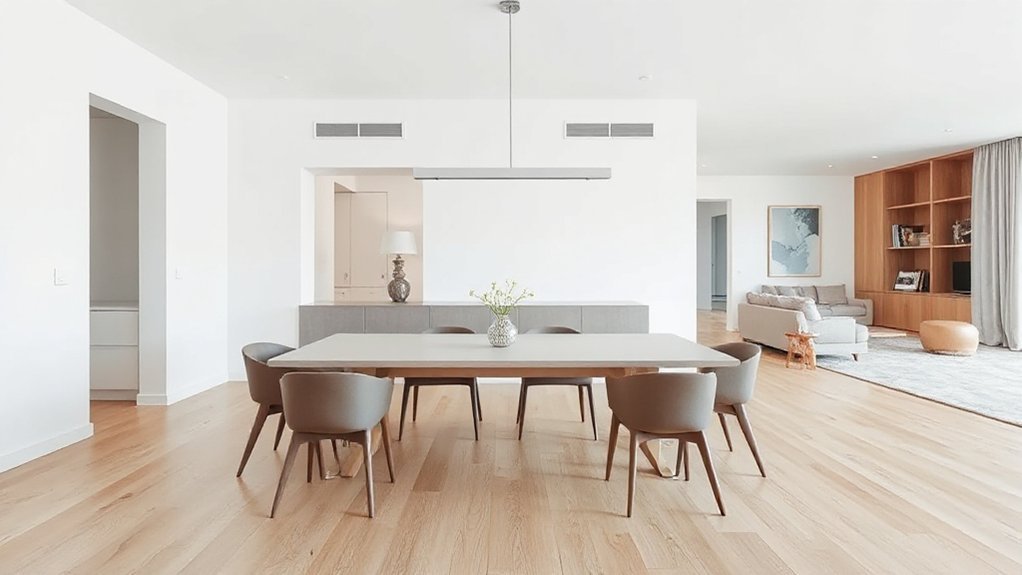
Open, flexible dining layouts demand clear zoning and adaptable furniture to sustain flow without visual clutter. You implement modular seating that can reconfigure for gatherings, ensuring sightlines remain uninterrupted and circulation paths stay clear.
Position the table to align with primary traffic directions, avoiding obstruction near entryways and service zones. Use a neutral palette as a unifying backbone, then apply focused contrasts through materials and finishes.
Incorporate Rustic accents and Vintage elements as deliberate accents rather than dominant features, so they read as refinements rather than focal points.
Store beneath-desk items in concealed drawers or slim cabinets to preserve minimalism. Layer lighting with dimmable, directional sources to adapt ambiance without introducing bulk.
Finally, test layouts at various scales, ensuring flexibility without sacrificing proportion or ergonomic reach.
Textures and Accessories Without Visual Noise
To achieve textures and accessories without visual noise, prioritize restraint and purposeful selection that enhances readability and flow. You’ll balance tactile interest with clean lines, selecting materials that read as a cohesive whole. Favor low-contrast textures and limit dimensional variety to avoid clutter, while ensuring tactility remains engaging.
Integrate vintage accents sparingly, using them as focal points rather than pattern fillers, so they read as intentional punctuation within a restrained palette. Eclectic decor should be restrained, blending disparate elements through common undertones such as color, scale, or material.
Maintain visual hierarchy by aligning accessories to surface edges and avoiding excessive layering. This disciplined approach preserves airiness, supports easy navigation, and reinforces a minimalist base without sacrificing character.
- Choose a single vintage accent as a deliberate focal point
- Group accessories by material or tone to reduce noise
- Limit eclectic decor to one cohesive vignette per zone
Integrating Technology Without Disrupting the Aesthetic
Integrating technology into a dining room concept should enhance function without interrupting the room’s calm, cohesive reading of space. You implement devices that disappear behind clean lines, preserving minimalist geometry while delivering control, ambiance, and acoustics.
Prioritize concealed wiring, recessed outlets, and surface-mounted controls that blend with materials like glass, wood, or matte metals. Opt for wireless ecosystems with centralized hubs to minimize clutter and reduce visible hardware.
Calibrate luminance, air, and sound so tech adjustments remain seamless during dining moments.
Honor cultural influences and historical references when selecting interfaces and finishes, ensuring devices respect traditional motifs yet stay contemporary.
Test layouts for sightlines, accessibility, and ease of maintenance, confirming that technology supports, not dominates, the room’s intentional restraint.
Small-Space Solutions: Maximizing Space With Less
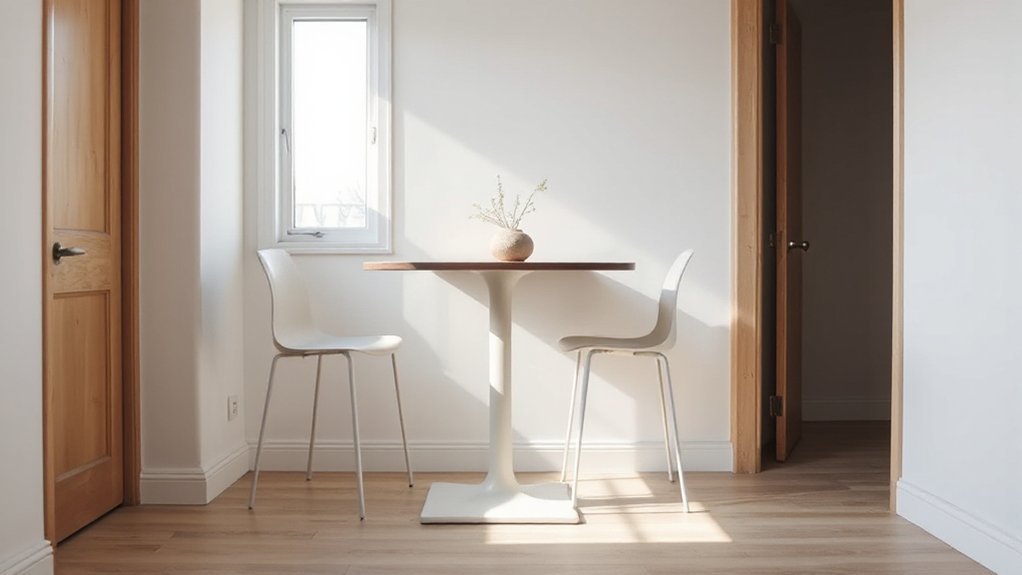
Maximize every inch with smart storage solutions that keep essentials at hand without cluttering sight lines. You’ll leverage multi-functional furniture that folds, tucks, or expands to adapt to changing meals and layouts.
Prioritize vertical space—shelves, hooks, and tall cabinetry—to multiply capacity while preserving floor area.
Smart Storage Oriented
Smart storage orientation for small spaces leverages vertical, modular, and multi-functional solutions to maximize utility without expanding footprint. You’ll implement tightly integrated storage that blends with clean lines, prioritizing accessibility and durability.
Precision choice of materials reduces bulk while preserving strength, and the design emphasizes eco friendly materials. You’ll organize daily items in tiered shelves, pullout trays, and overhead sleeves that minimize clutter without sacrificing workflow.
Artful details deliver a restrained aesthetic, so every feature serves a purpose. Confirm finishes resist wear and stains, maintaining a subtle, enduring look. You’ll test accessibility from dining height to rotate items efficiently, keeping essential tools within reach.
- Utilize vertical stacking and concealed compartments
- Integrate pullout organizers with soft-close mechanisms
- Apply artistic accents through restrained hardware and finishes
Multi-Functional Furniture
Prioritize mechanical simplicity, predictable operation, and durable joints to sustain frequent reconfiguration. When evaluating design, assess footprint alignment with traffic flow, ensuring clear sightlines and reach.
Favor modular systems that allow you to reorient functions to match evolving dining routines, from intimate meals to temporary work surfaces. Consider finishes and joinery that resist wear while maintaining clean lines.
Conceptually, multi-function designs foreground artistic expression through sculptural silhouettes and tactility, yet remain restrained to preserve calm aesthetics. Cultural influences can inform material choices and detailing, embedding local character without compromising versatility.
Vertical Space Maximization
Vertical space isn’t an afterthought in small rooms; it’s a primary axis for efficiency. You leverage height to free floor area without sacrificing function, applying precise placement and proportional balance to maintain clean lines. Begin with ceiling-to-floor layers: integrated storage, suspended surfaces, and visual anchors that guide the eye upward.
Use lines and materials that echo the room’s minimalist tone, ensuring every element serves a purpose. When adding decor, favor upward-focused textures and subdued contrast to avoid clutter. Incorporate artistic murals and decorative accents as focal points above eye level, not random fillers.
Plan for stability, accessibility, and light interaction, selecting hardware and brackets that blend with the aesthetic while maintaining serviceability.
- Utilize vertical storage alcoves and wall-mounted cabinets
- Install floating shelves paired with task lighting
- Integrate art and murals to draw the gaze upward
Maintenance Habits to Keep the Line Quiet and Elegant
Maintenance habits keep the dining room line quiet and elegant by minimizing noise, wear, and visual clutter. You implement disciplined cleaning routines, selecting tools that preserve finishes and reduce abrasion. Schedule periodic inspections of joints, hardware, and glides, addressing looseness before it becomes audible or visible.
Use soft cloths, nonabrasive cleaners, and appropriate protective waxes on wood, metal, and glass to sustain pristine surfaces. Establish a calibration cadence for lighting and accessories to prevent drift from the minimalist baseline.
Garden integration should remain subtle: choose planters that complement line weight and reposition infrequently to avoid rearrangement noise. Artistic accents stay deliberate and restrained, limited in number, aligned with sightlines.
Document maintenance log entries to track patterns, ensuring consistency with the desired quiet, elegant aesthetic. Continuous feedback informs timely adjustments.
Frequently Asked Questions
How to Choose a Single Statement Piece Without Clutter?
To choose a single piece, prioritize a focal point selection that draws the eye first, then complement with statement lighting to enhance it; avoid competing textures, and guarantee scale, balance, and function align with your dining area.
Can Color Influence Perceived Space in a Minimalist Dining Room?
Color psychology can influence spatial perception in a minimalist dining room; you’ll perceive larger, airier spaces with cool neutrals, while warm accents add coziness. You optimize mood and perceived openness by balancing color temperature and contrast.
What Are Subtle Ways to Hide Cords and Outlets?
Prioritize concealed wiring behind furniture and along baseboards; use cord channels and recessed outlets. You’ll still access power via discreet outlet covers, maintaining clean lines. You conceal clutter with thoughtful routing, ensuring safety and precise, uninterrupted aesthetics.
Which Materials Withstand Daily Dining Wear Gracefully?
You’ll prioritize tableware durability and surface finishes, selecting ceramic or tempered glass with strong resistance to scratches and staining, while coatings like vitrified glaze or matte polyurethane enhance longevity under daily dining wear.
How Often Should Minimalism Visuals Be Refreshed?
Aesthetic consistency governs refresh cadence; refresh every 1–2 years as visuals drift. You maintain visual balance by updating accents sparingly, ensuring you don’t disrupt the room’s calm. You’ll preserve clarity, cohesion, and purposeful simplicity with measured updates.
Conclusion
In embracing minimalist dining room concepts, you’ll sustain calm through disciplined choices and deliberate restraint. Prioritize clean lines, cohesive materials, and discreet storage to keep surfaces clear and focus intact. Maintain balance between form and function by testing each piece for silhouette and utility. If clutter creeps in, prune with purpose and reconfigure storage. Nail the rhythm: simplicity guides function, function reinforces simplicity—and your space finally feels quiet, purposeful, and, like they say, a well-oiled machine.
About the Author