
London’s SW1 and E14 each show distinct risk-adjusted profiles: SW1 enjoys average rents about 20–35% higher than city averages with lower vacancy, while E14 is driven by regeneration-led growth and infrastructure upgrades that hint at future yield upside. You’ll want to weigh stability versus growth potential as you assess entry costs, lease durations, and capital outlay. Curious how these metrics shift over the next five years and what that means for your strategy? Let’s compare the data.
Why SW1 vs E14? A Quick Investment Decision Framework

Choosing between SW1 and E14 hinges on a clear, data-driven framework: assess demand drivers, price dynamics, rental yields, and risk factors.
You compare historical trends to spot momentum, volatility, and resilience, then map cultural influences that shape buyer and renter sentiment.
You’ll quantify demand by transaction volume, days-on-market, and occupancy rates, and normalize price dynamics through annualized appreciation and spread analyses.
Rental yields factor in gross vs net income, maintenance costs, and vacancy risk, enabling a risk-adjusted view.
Metrics-first decisioning reduces bias: weight growth, liquidity, and regulatory exposure, then stress-test scenarios for interest-rate shifts.
In short, use objective signals, not anecdotes, to decide which postcode aligns with your risk tolerance and capital-holding horizon.
What Drives Demand in SW1 and E14 Compared
You’ll see demand in SW1 driven by prime amenities, connectivity, and high-income pockets, with metrics like walkability scores and price growth signaling resilience.
In E14, demographic shifts and rental churn point to a different risk profile, so you’ll want to track tenancy rates, age distribution, and rental yields.
Across both areas, market trends—pricing momentum, supply constraints, and policy effects—set the baseline for investment decisions.
Demand Drivers For SW1
What drives demand in SW1, and how does it compare to E14, of course hinges on a mix of accessibility, amenities, and growth prospects. You’ll see SW1’s appeal rooted in premier transport links, luxury apartments, and institutional employment footprints, creating robust rental velocity and price resilience.
In contrast, E14 leans on regeneration momentum, modern developments, and tech-adjacent offices, with solid but diversified demand.
- Transportation hubs: tube/rail access in SW1 powers repeat tenancy and quick commutes.
- Amenity density: luxury apartments near high-end dining and cultural venues support premium rents.
- Growth signals: government/municipal investment in SW1 versus mixed-use schemes in E14 influence risk-adjusted returns.
Demographic Influence On E14
Demographic profiles shape demand in E14 as much as in SW1, with age distribution, household formation, and income concentration driving rental velocity and price resilience.
You’ll see Demographic shifts shaping tenant cohorts, from students to professionals, altering turnover rates and peak rental seasons. In E14, larger late‑stage millennial and Gen Z groups interact with mature renters, creating a mixed demand curve that strengthens resilience during economic swings.
Cultural influences, including locality preferences and community amenities, steer rent premiums and vacancy risk. You measure performance by metrics like occupancy duration, rent per unit, and turnover costs, then stress‑test against unemployment shocks.
Consider migration inflows, school catchment performance, and commuting accessibility to quantify risk-adjusted returns. Overall, demographic intelligence guides pricing, lease structuring, and portfolio diversification.
Market Trends In Both Areas
Market demand in SW1 and E14 is shaped by a blend of income growth, supply dynamics, and commuter access, with each area showing distinct but overlapping momentum. You’ll notice higher demand sensitivity to job growth, with SW1 benefiting from finance and public admin clusters, and E14 tied to tech and logistics spillovers.
Luxury amenities and cultural attractions act as premium pull factors, while new-build completions cap supply pressures in prime pockets. Here’s what drives momentum:
- Income growth trajectories and mortgage affordability
- Sub-market supply gaps, new units, and lease-up speed
- Commuter access improvements, station upgrades, and transit reliability
Metrics to watch: price per square foot, rental yields, vacancy rates, and time-on-market shifts. Stay attuned to risk: macro cycles, policy changes, and shifting demand preferences.
Infrastructure Timelines: What’s Happening Next and When
Infrastructure timelines are set, with key projects mapping to tighter delivery windows and clearer milestones over the next 12–24 months. You’ll see verified schedules for Crossrail-like upgrades, rail station refurbishments, and bus-priority corridors reflected in quarterly dashboards.
The most impactful items: urban connectivity improvements that reduce commute times by 8–12 minutes on peak routes, plus new signaling that promises reliability gains of 15–20%.
Luxury amenities near transport nodes are expected to anchor development, driving pedestrian footfall and consumer spend.
Risk-adjusted milestones show a 70% probability of on-time delivery for core network upgrades, with a 25-point spread for ancillary works.
You should monitor procurement risk, contractor capacity, and funding certainty as visible indicators of projected delivery confidence.
Yields, Occupancy, and Stability: Postcode-by-Postcode Snapshot
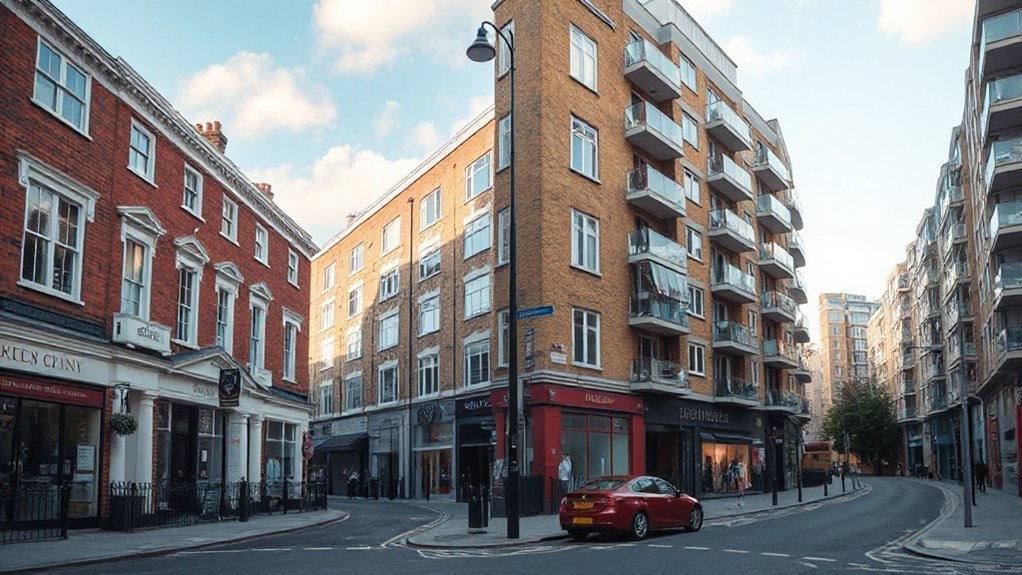
Across London’s SW1 and E14 postcodes, yields, occupancy, and stability are mapped to granular metrics to illuminate risk-adjusted performance, not just headline numbers. You’ll see how occupancy tracks seasonal shifts, rent collection resilience, and leasing velocity, revealing true cashflow reliability beyond simple averages.
- Yields: compare gross vs net, factoring maintenance and void costs to expose net income reality.
- Occupancy: monitor turnover, tenancy duration, and renewal probability to gauge demand depth.
- Stability: assess rent delta volatility, regulatory impacts, and macro shocks on long‑term viability.
Cultural landmarks and Local amenities matter because they anchor demand, influencing tenant quality and retention. This postcode-by-postcode snapshot helps you calibrate risk, optimize rent bands, and foresee resilience under stress scenarios.
Price Trajectories and Regeneration: Where Value Is Shifting
You’ll want to track price trajectory shifts alongside regeneration signals to gauge where value is shifting.
Metric-focused insights—such as recent price per square foot changes, regeneration funding timing, and occupancy growth—help quantify risk and upside by postcode.
Price Trajectory Shifts
Price trajectories across SW1 and E14 are shifting as regeneration hits different catalysts and market fundamentals. You’ll see signals in annualized rent growth, price per square foot, and sale-to-list spreads that reflect evolving demand.
Historical appreciation remains a reference point, but trajectories diverge by micro-location, investor profile, and macro cycles. Market volatility persists, so you should weight risk-adjusted returns and hold-period expectations into your models.
- Compare 5-year CAGR, noting deceleration or acceleration relative to long-run norms.
- Track quarterly price-per-square-foot changes alongside leasing momentum and vacancy shifts.
- Monitor yield compression versus rising construction costs and planning approvals.
Stay disciplined: calibrate exit risk, stress-test scenarios, and align bets with regeneration pacing rather than headline hype.
Regeneration-Driven Value Upswing
Regeneration is reshaping value trajectories in SW1 and E14, with observable inflection points in rent growth, vacancy compression, and new supply pipelines.
You should see a tightening occupancy backdrop in high-amenity zones, paired with selective yields improving where regeneration accelerates and transport hubs upgrade.
Price signals evidence a shift toward regeneration-led valuation — not just location, but pipeline leverage, planning clarity, and mixed-use intensity.
Luxury apartments remain a premium anchor, yet the strongest value upticks align with projects that guarantee commuting convenience and time-value savings for residents.
Risk-adjusted criteria point to disciplined demand forecasting, with macro headwinds partly offset by enhanced lifecycle costs and asset stewardship.
In SW1, E14, regeneration-driven bets require precise timing, transparent disclosures, and rigorous performance tracking.
Neighborhood Renewal Impacts
Neighborhood renewal shifts price trajectories as regeneration accelerates, with clearer signals in rent growth, vacancy rates, and new supply. You’ll see how price momentum tracks proximity to completed projects, and how risk adjusts as density rises.
1) Rent growth tightens around anchored assets, while speculative moves subside where supply outpaces demand.
2) Vacancy rates compress near new amenities, then stabilize as dwellings mature in the mix.
3) Local amenities and community cohesion become correlates of value, dampening downside during macro slowdowns.
This pattern reveals where value is shifting: higher-quality renewal areas tend to sustain longer-run gains, but cyclical shocks matter.
Monitor turnover, occupancy, and price dispersion to gauge risk. Prioritize districts with strong transit access, cohesive neighborhoods, and ongoing investment in services to maximize resilience and upside.
Risks You Must Consider Before Investing
Investing in SW1 or E14 carries meaningful risk signals that you should quantify before committing capital. You’ll want a metrics-first assessment: price volatility, rental yields, and capital expenditure trends across the last five years.
Compare median price per square meter, turnover velocity, and time-on-market to gauge liquidity risk.
Consider macro factors like interest-rate sensitivity, planning policy shifts, and tax changes that directly affect cash flow.
Luxury amenities can inflate upfront costs, yet may not translate to proportional rent growth in downturns.
Historical significance often supports long-term value but can suppress short-term flexibility due to preservation constraints.
In your due‑diligence, stress-test scenarios for vacancy, rent compression, and refinancing terms to avoid overreliance on peak-cycle assumptions.
Which Postcode Fits Your Goals: Shortlists for Yield, Growth, and Long-Term Hold

To choose the right postcode for your goals, start with clear, metric-driven shortlists: yield-focused candidates with higher rental returns, growth-oriented areas showing upside in price per square meter, and long-term holds with resilience to cycles.
You’ll compare annual gross yields, price-per-sqft trends, and vacancy rates across SW1 and E14 to quantify risk-adjusted upside.
Focus on segments like luxury apartments and historic landmarks to gauge demand quality and liquidity.
Use concise screens to avoid overexposure to any one cycle, and weight rents, capex needs, and tenant mix.
Prioritize stability in income streams, capital preservation, and potential for capital recycling.
- Yield-oriented shortlist
- Growth-oriented shortlist
- Long-term-hold shortlist
How to Start: Practical Steps to Buy in SW1 or E14 Today
Ready to buy in SW1 or E14? Here’s a pragmatic, data-driven checklist you can act on today.
Define your budget, then map loan-to-value ratios, interest rates, and monthly service charges across target streets.
Run cap-rate and gross yield projections using recent transactions for luxury apartments and family-sized units to benchmark.
Verify planning constraints near historic landmarks, and confirm leasehold vs freehold status to size your risk.
Build a shortlist of reputable agents with recent closings in SW1 and E14; request comparable market analyses and client references.
Conduct due diligence on vendor disclosures, vacant possession timing, and required refurb costs.
Lock-in contingency buffers for FX, conveyancing, and stamp duty, then schedule viewings within a two-week window to preserve momentum.
Document decisions, update your investment thesis, and proceed with confidence.
Frequently Asked Questions
How Do Tax Changes Affect SW1 Vs E14 Investments?
Tax changes favor luxury apartments and commercial properties with clearer depreciation and stamp duty adjustments; you’ll see higher capex write-offs and nuanced reliefs, so you should model cash-on-cash returns, vacancy risk, and regulatory costs for SW1 vs E14 investments.
Which Tenant Mix Drives Stability in Each Postcode?
Tenant diversity drives stability in both postcodes; mix apartments, family units, and amenities to balance risk. You’ll see Rental stability rise with diversified tenant profiles, quantifiable occupancy rates, and low churn—data-backed indicators guiding your risk-aware investment decisions.
What Are the Typical Cap Rates by Property Type?
You’ll see cap rates vary by property type, with office and retail typically priced lower and residential higher, reflecting market volatility and Rental yields risk. You measure via cap rate spreads, noting markets’ volatility and steadier Rental yields.
How Do Political Risk and Planning Policy Impact Returns?
Political stability and planning restrictions shape returns: you’ll see steadier cash flows with lower risk in stable environments, yet tighter rules can curb upside. You realize risk-adjusted yields depend on policy clarity, permitting timelines, and local market fundamentals.
What Are Hidden Costs When Buying in Central Vs Outer London?
Hidden costs when buying in central vs outer London include stamp duty, service charges, and refurbishment, you’ll want to account for maintenance, management fees, and financing risks; luxury apartments near historical landmarks can raise upfront costs but drive premium yields.
Conclusion
You’ll see SW1 offer steadier yields and lower risk, while E14 leans into growth with regeneration-driven upside. Use metrics: rent coverage, vacancy rates, and cap rates to compare now versus 5–10 years out. Track regeneration milestones, transport upgrades, and occupancy shifts as leading indicators. The decision is a balance sheet, not a buzz. If you crave predictability, start with SW1; if you chase value uplift, tilt toward E14—yet monitor downside scenarios like buyer risk and debt costs.
About the Author