
Tourism drives Edinburgh’s property demand so fiercely you’d think every street is booked solid year-round. You’ll see occupancy cycles spike with festivals, and rental yields follow the crowds, especially in historic cores and near transport links. You’re facing a tightening balance: longer stays in historic districts clash with short-term lets that capitalize on event congestion. If you want a practical edge, you’ll need to weigh policy, timing, and capital with care as the city evolves.
How Tourism Fuels Edinburgh’s Rental Demand

Tourism drives a steady uptick in Edinburgh’s short- and mid-term rental demand, with visitor numbers shaping occupancy and pricing patterns across neighborhoods. You’ll see demand correlations emerge between peak travel windows and neighborhood occupancy rates, translating into higher average daily rents during festival seasons.
Cultural heritage underpins stay duration, with guests extending visits to immerse in historic districts. Meanwhile, local festivals concentrate bookings around specific dates, tightening supply and boosting premium pricing.
Data across quarters show occupancy resiliency when cultural assets are promoted through targeted listings, calendar synchronization, and dynamic pricing. Looking ahead, continued diversification of visitor segments and coordinated event calendars will sustain occupancy floors even during shoulder periods.
You can expect incremental revenue gains by aligning marketing messages with heritage-led experiences and festival timelines.
What Opens the Door to Short-Term Lets in Edinburgh
Edinburgh’s short-term let market tightens when regulatory clarity, platform efficiencies, and data-driven pricing align, creating accessible openings for compliant operators. You gain opportunities by aligning with permitting processes, registration timelines, and standardized safety checks.
Then leveraging reliable listing portals that prioritize verified properties. Historical architecture becomes a selling point when you emphasize authentic spaces that meet safety and quality standards, attracting travelers seeking unique stays.
Data-backed pricing helps you stay competitive without undervaluing your asset, while occupancy forecasts guide marketing cycles around peak demand. Cultural festivals drive arrivals during defined windows, so you tailor listings and amenities to event crowds.
Visitors Flow and Edinburgh’s Housing Pressure
You’ll see how visitors pressure on housing intersects with sustained tourism flows, shaping occupancy, rents, and new supply needs.
Our data-driven view points to tightening housing markets during peak seasons, with spillovers into affordability and investment signals for the sector.
Looking ahead, you’ll want to track flow patterns, policy responses, and collaboration opportunities between hospitality, housing, and planning to balance demand and housing pressure.
Visitors Pressure on Housing
What impact does visitor flow have on Edinburgh’s housing pressure, and how can data-driven insights guide policy and investment? You’ll see how seasonal peaks tighten rents, alter vacancy rates, and shift housing use toward short-term lets.
By tracking occupancy, pricing, and turnover, you can forecast bottlenecks and target interventions before strain worsens. Cultural preservation and local traditions matter in planning—protecting authentic neighborhoods while enabling sustainable tourism.
Data-informed actions can balance demand with supply, preserving character without stifling growth.
- Align housing development with peak visitor periods
- Incentivize long-term leases over transient stays
- Invest in mixed-use projects near transport hubs
- Monitor visitor-driven rent dispersion to protect affordability
Tourism Flows and Demand
Tourist flows directly shape Edinburgh’s housing demand, with seasonal surges tightening occupancy, pushing rents higher, and narrowing vacancy windows.
You track arrivals by origin, duration, and purpose, spotting how cultural festivals redefine peak weeks and spillover effects into shoulder seasons.
Data shows that short-stay demand outpaces supply in core districts, while longer leases compress elsewhere, elevating overall price momentum.
You project that cultural festivals will sustain elevated occupancy into late autumn, even as conferences and art fairs shift travel patterns.
Culinary tourism adds lengthier stays in hospitality hubs, elevating demand resilience during midweek lulls.
You model scenarios where airports and rail corridors funnel visitors into greenspace-adjacent neighborhoods, intensifying occupancy pressure near transit nodes.
The evidence supports proactive supply alignment, price signaling, and tenant protections to maintain market balance.
Homeowners Turning to Holiday-Style Rentals
You’re seeing a shift as homeowners weigh holiday-style rentals against traditional lets, driven by higher short-term yields and evolving demand patterns.
The short-term let market is expanding, with occupancy and rate data pointing to greater profitability when managed efficiently.
Expect property-management models to adapt—more professionalized upkeep, flexible pricing, and streamlined compliance to sustain growth.
Holiday-Style Rental Appeal
Across Edinburgh’s housing market, homeowners are increasingly turning to holiday-style rentals to capture higher nightly rates and more predictable cash flow, especially as traditional long-term rents tighten.
You’ll find demand driven by seasonal events and consistent visitor inflows, with occupancy tilting toward weekends and festival periods.
Data indicate higher revenue per available night versus standard leases, hinging on location, amenities, and responsive management.
Strategic advantages include shorter vacancy cycles and accelerated recovery after low seasons.
To illustrate, consider:
1) Proximity to Cultural festivals boosts occupancy
2) Access to Local cuisine experiences enhances reviews
3) Flexible nightly pricing captures peak demand
4) Compliance-supported channels reduce risk
Looking ahead, you should optimize listings around event calendars, curate culturally rich experiences, and monitor regulatory shifts to sustain gains.
Short-Term Let Market
In Edinburgh, many homeowners are anchoring earnings to holiday-style lets as traditional long-term rents tighten, using flexible nightly pricing and rapid turnover to boost occupancy during festivals and peak weekends.
The Short-Term Let Market shows steady year-on-year growth in occupancy rates, driven by demand from cultural festivals and inbound visitors seeking authentic stays near Historical architecture.
You’ll find pricing more responsive to demand swings, with dynamic calendars and minimum-stay rules optimizing revenue during high-traffic periods.
Tech-enabled listings, reviews, and local guest services increasingly influence ranking and booking likelihood, elevating the importance of operational efficiency.
Looking ahead, regulatory clarity and platform transparency could stabilize returns, while continued emphasis on guest experience around heritage districts should sustain resilience in a crowded short-term landscape.
Property Management Shifts
Property management is shifting as homeowners increasingly formalize holiday-style rentals to maximize revenue, supported by data-driven pricing, turnkey guest services, and streamlined operations.
You’re seeing more professional onboarding, consolidated maintenance, and clearer compliance practices as part of a proactive asset strategy.
In Edinburgh, this alignment is tied to rising demand signals and evolving tax rules, with property taxes and land valuation shaping profitability curves.
The move toward standardized experiences reduces vacancy risk and elevates average daily rates across seasons.
- Implement dynamic pricing engines linked to occupancy trends
- Centralize guest communications and housekeeping workflows
- Align insurance, permits, and tax reporting for compliance
- Monitor land valuation changes to reassess investment appetite
The Role of Serviced Apartments in Edinburgh

Could serviced apartments be the missing link between short-term stays and long-term residency in Edinburgh? You’ll see a growing overlap between temporary visits and stable occupancy as operators align offer to evolving demand.
Data shows higher repeat visitation and longer average stay when properties deliver predictable routines, flexible leases, and professional management.
In Edinburgh, serviced apartments combine hotel-like consistency with apartment living, boosting occupancy during shoulder seasons and stabilizing yields across districts.
Luxury amenities and targeted interior design elevate user experience while preserving cost efficiency for operators.
Market surveys reveal demand tightness in central corridors and scalable capacity in newer developments, suggesting a path to diversified revenue streams.
Forward momentum hinges on standardized branding, seamless booking tech, and rigorous asset-management playbooks.
Why Edinburgh Properties Attract Ongoing Investment
You’ll see steady demand drivers and resilient returns underpin ongoing investment in Edinburgh’s property market.
Investor confidence grows as data points show consistent rental demand, occupancy stability, and favorable supply-demand dynamics.
With a forward-looking view, sector fundamentals signal continued capital inflows as markets remain well-positioned for scalable, long-term growth.
Stable Demand Drivers
What underpins sustained demand for Edinburgh property, and why does it persist through market cycles? You’ll find stable drivers that anchor investment, from resilient demand fundamentals to long-horizon returns. You’ll also see how city-rights dynamics and visitor-driven momentum translate into steady rental performance and price resilience. Historical architecture and Cultural festivals act as repeated pull factors, reinforcing livability and appeal.
- Diversified tenant mix sustains occupancy
- Strong yield visibility amid macro uncertainty
- Ongoing tourism-supported occupancy and rental demand
- Persistent cross-border and institutional investor interest
Data-focused outlook: occupancy trends, rent growth, and vacancy compression converge to support steady capitalization rates. You’ll benefit from a mature market structure, transparent data flows, and informed underwriting that prioritizes growth, risk controls, and future-proofed supply alignment.
Investment Confidence Factors
Edinburgh’s investment appeal rests on a convergence of measurable catalysts that translate into confidence and durable capital allocation. You see steady return signals from diversified demand channels, with rental yields supported by occupier fundamentals and long-term population trends.
Confidence rises where data shows resilient occupancy during off-peak periods and predictable visitor inflows tied to events and academia. Investment decisions increasingly weigh governance transparency, planning consistency, and infrastructure pipelines that reduce risk.
Historical architecture adds value by enabling premium, differentiated conversions and boutique portfolios, while Cultural festivals sustain recurring demand for short-term and mid-term stays.
Forward-looking projections highlight macro-stability, favorable financing terms, and policy alignment encouraging private capital. Taken together, these factors drive ongoing capital allocation and sector resilience.
Rent vs. Purchase Trends in Edinburgh’s Market
Are rents and purchase costs diverging, or moving in tandem, in Edinburgh’s evolving housing landscape? You’ll notice a split between short-term rental yields and longer-term ownership appetite, with pricing curves converging in pockets of stabilized demand.
Data show rents rising on high-tourism corridors while entry costs for flats near historical architecture and green spaces remain tempered by mortgage rates. You, as a market observer, can track this through four key shifts:
1) Buyer incentives increasing in revitalized neighborhoods
2) Rent growth outperforming wage growth in prime cores
3) Lenders tightening debt service metrics for investors
4) New-build price resistance outside central hubs
The trajectory favors adaptive portfolios; expect consolidation around assets aligned with cultural appeal, sustainable sites, and enduring amenity access.
Regulations Shaping Edinburgh’s Supply and Costs
Regulatory shifts are reshaping Edinburgh’s housing supply and cost dynamics, with policy levers steering development timelines, financing hurdles, and tenant protections.
You’ll see urban planning rules tightening land-use reviews, setback requirements, and density targets, which compress approvals but aim for smarter growth.
Financing channels adapt to stricter covenant standards and higher required equity, affecting project feasibility and capex pacing.
Cultural preservation mandates increasingly influence design and reuse, pushing costs upward but preserving historic value that sustains tourism-driven demand.
Short-term rental regulation is tightening oversight, shifting supply toward longer-term housing stock and stabilizing rent trajectories.
Data indicate slower new builds in central zones, offset by targeted incentives for fringe areas with higher yield.
In this evolving regime, developers must model regulatory timelines alongside market demand forecasts.
How Short-Term Rules Affect Long-Term Availability

Short-term rules reshape long-term availability by steering where and how housing is built, traded, and reused. You’ll see tighter caps on short-let permits push developers toward stays that serve locals and long-term tenants, changing feasibility calculations. Data indicate rent gaps widen in areas near Cultural festivals and Heritage sites, where demand peaks seasonally but supply remains constrained.
You’ll want to monitor policy signals, enforcement intensity, and renewal timelines to forecast future vacancy rates and investment risk.
- Permit quotas influence project staging and financing
- Enforcement patterns shift redevelopment pace
- Conversion limits affect inventory depth
- Tourism cycles reshape price resilience near landmarks
This trajectory aligns with sustainability goals, urban resilience, and sector profitability.
Neighborhood Impacts: Case Studies Across Edinburgh
You’ll see how neighborhood tourism pressures shape occupancy, air quality, and resident experience across Edinburgh’s districts.
Early data indicate shifts in rental mix and pricing as visitor demand concentrates near core attractions, with spillovers into transit access and local services.
Looking ahead, we’ll compare case studies to identify which policy levers, development patterns, and market signals most effectively balance visitor benefits with affordability and quality of life.
Neighborhood Tourism Pressures
- Concentrated demand in heritage cores drives adaptive reuse and preservation investments.
- Seasonal occupancy peaks align with major events, impacting local services and parking.
- Short-stay activity outpaces long-term rentals, elevating price sensitivity for residents.
- Infrastructure upgrades tied to tourism growth influence zoning, transit, and public space planning.
Forecasts indicate sustained pressure unless diversification strategies balance supply, with outcomes tied to Cultural heritage preservation and Urban development integration.
You gain actionable insights for policy, planning, and private-sector investment.
Rental Market Shifts Across Areas
Across Edinburgh, rental market shifts vary by neighborhood, reflecting how demand from visitors and residents interacts with each area’s housing stock and amenities. You’ll notice concentrations of steady occupancy in historic cores, while outer districts report more volatility tied to seasonality and development pipelines.
Data show rising rents in areas near Cultural festivals and Cultural venues, contrasted with stabilizing prices where new purpose-built stock outpaces demand. Historical architecture drives premium segments, attracting both short stays and long lets, yet maintenance costs and planning constraints temper growth.
Supply signals diverge: investment is strongest where transport links and amenities align with employer clusters and student demand. Looking ahead, districts that blend authentic character with modern connectivity will outperform, while neighborhoods lacking diversification may underperform despite tourism inflows.
Balancing Affordable Housing With Rental Opportunities
Data indicates incremental gains when policy aligns housing density with liveability, urban renewal, and sustained rental turnover. A forward-looking view shows mixed-use development reinforcing both affordable units and market rentals, without sacrificing green spaces.
To illustrate, consider the following priorities:
1) Targeted inclusionary zoning that scales with tourism-driven demand
2) Flexible, small-format dwellings near transit hubs
3) Public-private partnerships to accelerate vacant-property conversions
4) Preservation of urban green spaces within new developments
This approach supports stable rents, healthier neighborhoods, and resilient growth.
Financing and Returns for Tourism-Driven Investments
Tourism-driven investments in Edinburgh require a clear view of financing structures, risk-adjusted returns, and liquidity timelines. You’ll weigh debt, equity, and grant options against predictable occupancy and ADR trends.
Historical architecture and adaptive reuse often release higher multiples, yet demand careful capex planning for preservation requirements and regulatory compliance. You’ll benchmark yield against comparable cities, incorporating rental income stability from short-term and long-term channels to gauge overall IRR.
Forecasts should model seasonal occupancy, festival-driven spikes, and macroeconomic tailwinds like tourism growth and exchange-rate movements. You’ll emphasize exit scenarios, debt-service coverage, and liquidity during cycle inflections.
Cultural festivals provide near-term revenue certainty, but you’ll stress-test diversification across property types to mitigate concentration risk and sustain resilient, data-driven returns.
Impacts on Local Infrastructure and Services
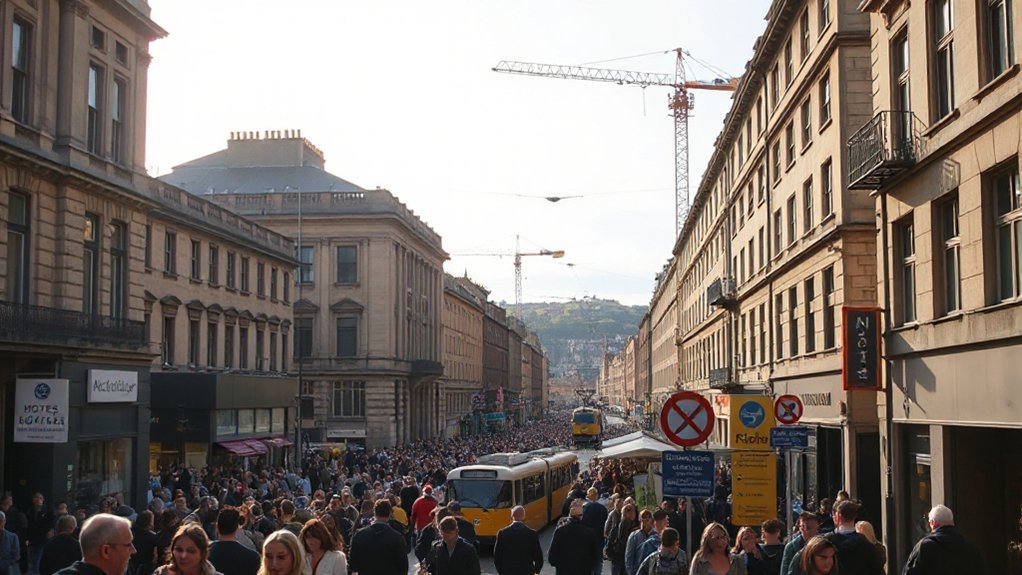
Policy-driven growth from Edinburgh’s tourism sector places measurable pressure on local infrastructure and services. You’ll need to quantify these effects across transport, utilities, housing, and public spaces to forecast capacity needs.
You’ll see demand shifts, load spikes, and funding gaps reflected in real-time indicators, guiding decisions on resilience and community sustainability. By tracking usage patterns, you’ll align investments with projected peaks, ensuring services keep pace with visitor activity while protecting livability for residents.
1) Transport capacity and congestion metrics
2) Utility load and outage risk indicators
3) Housing affordability and vacancy trends
4) Public space turnover and maintenance costs
This approach delivers a data-driven, forward-looking view that prioritizes infrastructure resilience and community sustainability for Edinburgh’s evolving profile.
Future Scenarios for Edinburgh’s Property Market
To project Edinburgh’s property landscape, we integrate scenario-based outputs from macroeconomic trends, tourism demand, and housing policy, then translate them into core market signals like prices, rents, and vacancy rates.
In future scenarios, you’ll see price trajectories anchored by tourism cycles and diversified demand, with rents responding to a spectrum of occupancy patterns. Vacancy rates will reflect shifts in short-stay normalization, regulatory frameworks, and urban redevelopment pace.
Cultural heritage acts as a stabilizer, preserving value in historic districts while guiding renewal activity. Urban development decisions, including transport access and mixed-use zoning, shape centralized versus peripheral demand.
Sensitivity analyses reveal downside risks from policy shifts and macro shocks, while upside paths hinge on targeted investment and visitor growth sustaining long-term market resilience.
A Practical Guide for Buyers and Investors in Edinburgh
If you’re looking to buy or invest in Edinburgh, start with a clear view of value drivers: price momentum, rental economics, and occupancy trends shaped by tourism, policy, and redevelopment. You’ll map opportunities on historical architecture and the city’s evolving cultural calendar, then align with data-backed forecasts.
Key steps:
1) Analyze yield vs. demand in neighborhoods near major attractions and universities.
2) Track vacancy rates and seasonal occupancy shifts tied to festivals and conferences.
3) Assess redevelopment plans, planning approvals, and heritage constraints impacting returns.
4) Compare short- vs. long-term leases to optimize cash flow and risk.
This approach emphasizes transparency, scalability, and sector intelligence, enabling you to capture upside from tourism demand while managing regulatory risk and market cycles.
Frequently Asked Questions
How Is Tourist Seasonality Measured for Edinburgh’s Rentals?
Tourist seasonality is measured via seasonality analysis of occupancy and ADR trends, comparing monthly averages against yearly baselines. You track rental fluctuation, forecasting demand shocks and adjusting pricing and availability accordingly to optimize performance in Edinburgh’s market.
What Taxes Affect Short-Term Rental Profitability Here?
You face a shifting ledger: property tax and rental income taxes cut into margins, but rising efficiency, compliance, and data insights offset them. You’ll optimize profitability by forecasting cash flow, adjusting pricing, and tightening expense controls.
Which Neighborhoods See the Strongest Demand Spikes?
You’ll notice strongest demand spikes in classic investment hotspots like Leith and Old Town, driven by steady Historical property trends and enhanced by university influx. Projections indicate continued, data-driven growth in these neighborhoods for future investment opportunities.
How Quickly Can Owners Switch From Long-Term to Short-Term Lets?
You can switch from long-term to short-term lets within weeks, depending on permitting and registrations. In property management terms, expect approvals, registrations, and compliance checks to shape timelines; rental regulations and data-backed demand will guide pacing.
What’s the Typical Occupancy Rate for Edinburgh Serviced Apartments?
You’ll typically see occupancy around 70–85% for Edinburgh serviced apartments. You’re prioritizing Luxury apartments while maneuvering Local regulations, so monitor demand trends, seasonality, and competitive pricing to optimize occupancy and revenue growth in a forward-looking, data-driven way.
Conclusion
Tourism and rentals already steer Edinburgh’s property pulse, and the trend isn’t reversing. Data shows peaks tied to festivals, with short-term and serviced stays soaking up demand in historic cores and transport hubs. If regulatory clarity sharpens and infrastructure scales, returns look robust for savvy investors. Yet the pace of policy shifts and market discipline will determine who capitalizes. As flows intensify, one question remains: who will navigate the evolving balance between heritage and housing, successfully?
About the Author