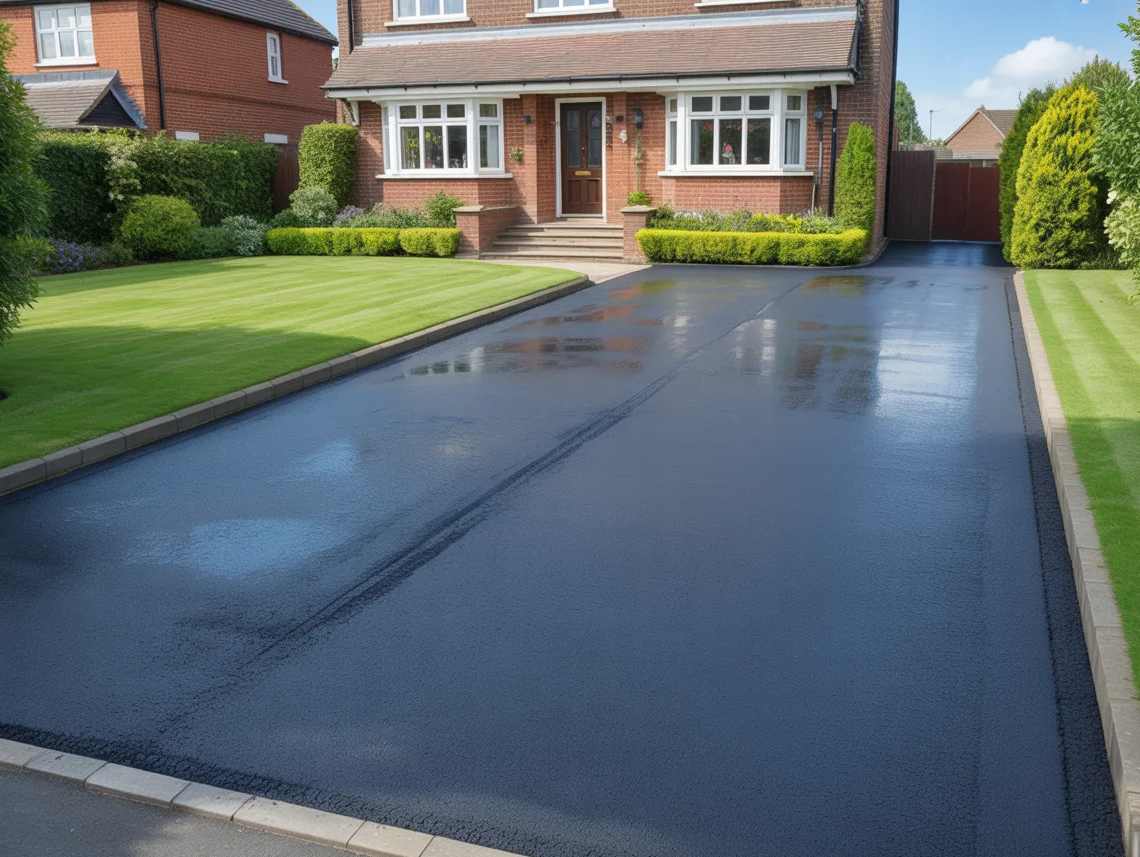
How Long Does Tar Take to Dry on a New Drive?
“Tar” driveways — more accurately called tarmac or asphalt driveways — do not dry the way paint or cement does. Tarmac is a bitumen-bound aggregate mix that is laid hot and compacted while molten, then cools and solidifies. There is no chemical curing reaction; the setting is simply a matter of the bitumen cooling from its application temperature (typically 140–160°C) to ambient temperature, during which it transitions from a workable liquid state to the firm, dense surface of a finished drive.
This fundamental difference from cement-based materials affects everything about the timelines involved.
How Long Before You Can Walk on It
Typically 24–48 hours in normal UK weather conditions (10–20°C).
A freshly laid tarmac driveway can usually be walked on cautiously after 24 hours, when the surface has cooled and solidified sufficiently to bear foot traffic without leaving impressions. At lower temperatures, cooling is faster and the surface firms up more quickly; in hot weather, cooling is slower and the bitumen remains softer for longer.
Some contractors will advise waiting the full 48 hours before any use, particularly in warm weather. This is conservative but sensible.
How Long Before You Can Drive on It
At minimum 48–72 hours; ideally 5–7 days.
This is the question that matters most practically, and the answer has more nuance than the walking timeline.
After 48–72 hours, a standard tarmac driveway is typically firm enough to take normal domestic vehicles (cars, small SUVs) without leaving permanent marks — but only if the weather has been mild to cool. In warm summer weather (above 20°C), the bitumen remains softer and more susceptible to deformation, and waiting 5–7 days is genuinely advisable.
The most vulnerable period for a new tarmac drive is the first 3–4 weeks, during which the bitumen is still completing its cooling and hardening process and the surface is at its most susceptible to:
- Point loads — sharp narrow loads such as vehicle jacks, motorcycle centre stands, and high heels concentrate stress on a small area. These can permanently mark a new tarmac surface for weeks after installation.
- Turning wheels — turning steering wheels while stationary (or near-stationary) on a freshly laid surface twists the tarmac and can cause surface scuffing and deformation that remains visible once the drive hardens.
- Heavy vehicles — vans, skip lorries, removal lorries, and delivery vehicles with high axle weights should not be driven onto a new tarmac driveway for at least 4 weeks.
How Temperature Affects Drying Time
Because tarmac setting is purely a cooling process, ambient temperature has a more direct effect on timeline than almost anything else:
Cold weather (below 10°C): The surface cools and firms up faster. In cool autumn or winter conditions, a tarmac drive may be firm enough for foot traffic within 12–18 hours and for vehicles within 48 hours. The risk shifts from slow hardening to poor initial compaction — tarmac laid in very cold conditions may not compact correctly during installation, which is a separate quality concern.
Mild weather (10–20°C): Standard conditions; the timelines above apply.
Hot weather (above 25°C): The bitumen remains soft for significantly longer. In a UK heatwave, a freshly laid tarmac drive may still be soft enough to take impressions from parked cars a week or more after installation. This is the period where the most complaints about new tarmac arise — cars parked on a hot summer day can sink into the surface and leave permanent tyre marks.
Direct sunlight adds to this: a south-facing driveway absorbing direct sun will remain softer longer than an equivalent north-facing drive in shade.
Practical Timeline Summary
| Weather conditions | Walk on | Normal cars | Heavy vehicles |
|---|---|---|---|
| Cold (below 10°C) | 12–24 hours | 48 hours | 4 weeks |
| Mild (10–20°C) | 24–48 hours | 48–72 hours | 4 weeks |
| Hot (above 25°C) | 48 hours | 5–7 days | 6+ weeks |
What Can Go Wrong in the First Few Weeks
Tyre marks and indentations: Parked cars on a hot surface, particularly on the front tyres where the steering is turned, leave circular marks. These are usually permanent once the surface fully hardens.
High heels and kickstands: Both concentrate weight on a small point. High heels can pierce a still-soft tarmac surface; motorcycle centre stands can leave circular impressions. Advise anyone visiting within the first month to park on the road or on a firm mat.
Wheelie bins: The small hard wheels of a wheelie bin dragged or spun on a soft tarmac surface can score the surface. Use a board or mat under the bin during the first few weeks.
Vehicle turning: Turning the wheels at low speed or stationary is more damaging to new tarmac than straightforward driving, because the friction twists and shears the surface rather than simply compressing it. Drive straight onto and off the driveway wherever possible for the first month.
Does Sealing Help?
Some tarmac contractors offer a sealant coat over the new surface, applied after the initial curing period. A bitumen or coal tar sealant protects the surface from UV degradation (which causes the characteristic greying and oxidation of older tarmac), from oil and fuel spills that dissolve bitumen, and from frost/freeze-thaw damage.
Sealing is not the same as hardening — it does not accelerate the curing process. A sealant should not be applied until the drive has fully cured (at least 3–4 weeks after installation, some contractors recommend waiting 6–12 months to allow any remaining volatiles to off-gas from the surface before sealing).
When Something Has Gone Wrong
If a new tarmac drive has significant depressions, loose aggregate, or crumbling edges within a few weeks of installation, this suggests either a problem with the mix specification, inadequate compaction during laying, or installation in unsuitable weather conditions (too cold for proper compaction, or over a substrate that was not properly prepared).
A reputable contractor will return to assess and remedy installation defects that appear within a reasonable period — typically the first 12 months. Get the installation warranty terms in writing before work begins, and document any problems with photographs as soon as they appear.
The Simple Rules for a New Tarmac Drive
- Wait 48 hours before driving on it in mild weather; 5–7 days in hot weather
- Avoid parking in the same spot every day for the first month — rotate positions to avoid concentrated load marks
- Keep heavy vehicles (vans, lorries) off the drive for at least 4 weeks
- Avoid turning steering wheels while stationary on the drive for the first month
- Keep high heels, motorcycle stands, and small-wheeled equipment off the surface for the first month
- Do not apply sealant until at least 3–4 weeks after installation; many contractors recommend 6–12 months
- Park on the road during hot spells in the first summer if the drive becomes noticeably soft in direct sun
So if you’re wanting to replace your driveway, there are plenty of different material options out there. As much as people love gravel, tarmac still looks imressive, when done properly.
About the Author