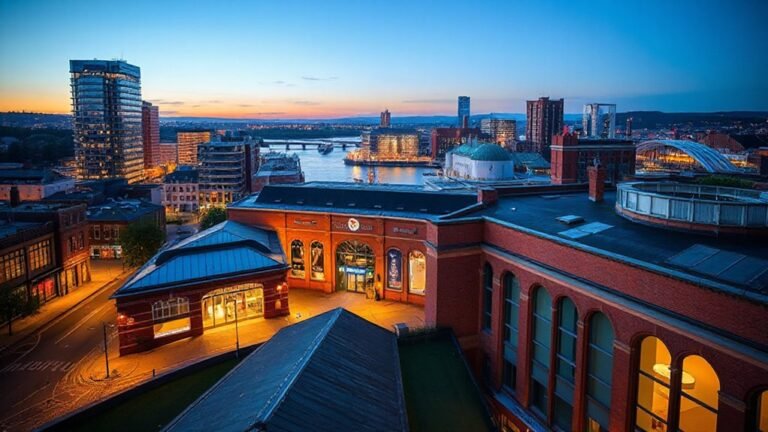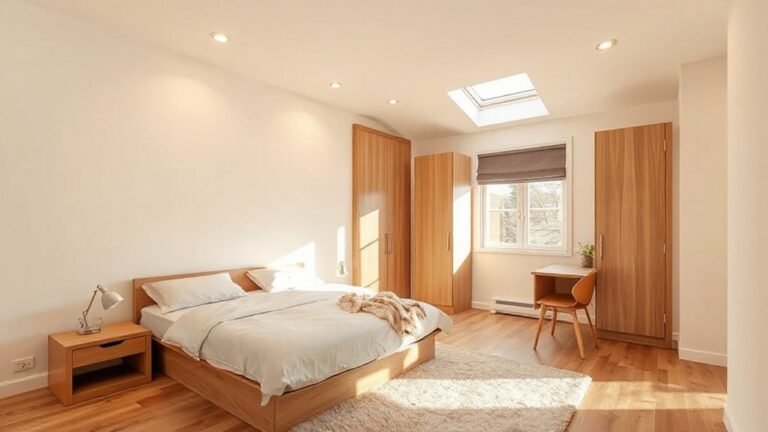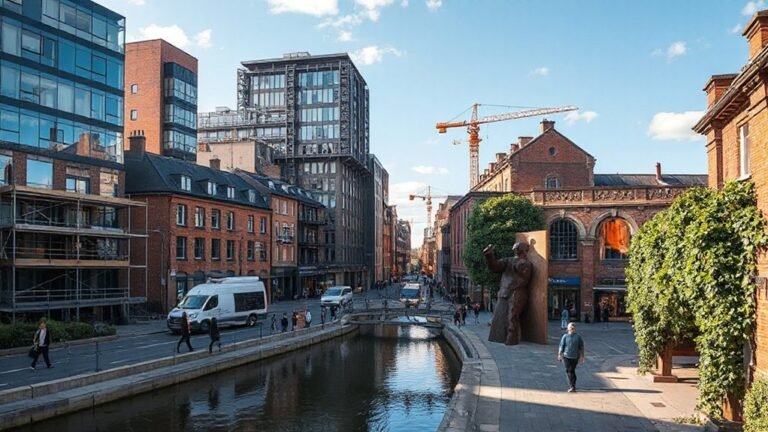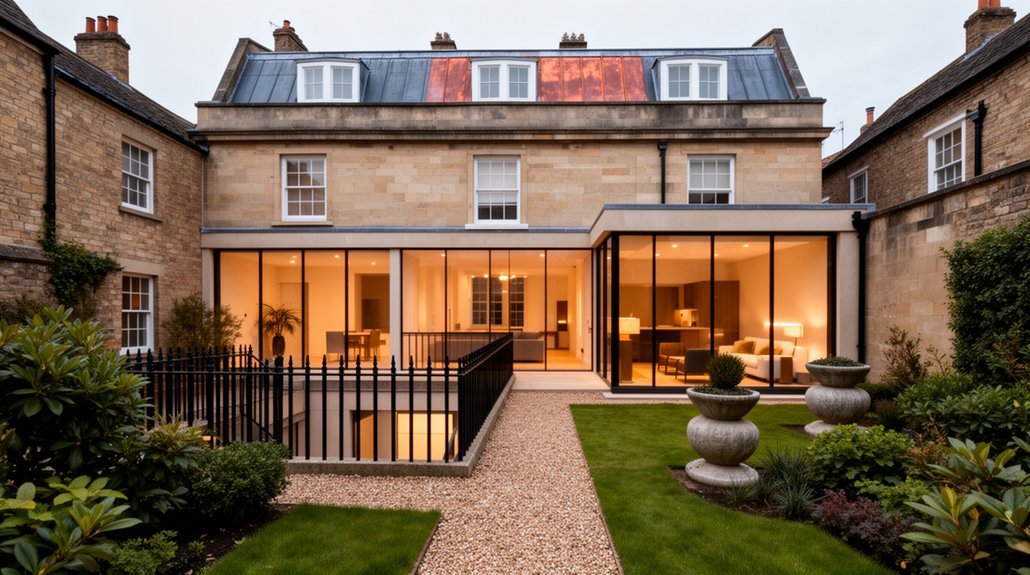
You’ll transform a Georgian townhouse in York into a light-filled, efficient home that respects history while delivering modern comfort, with a plan that stitches heritage details to contemporary living. Start by defining a York-ready renovation brief that prioritizes structural clarity, daylight, and purposeful room flow, while preserving sash windows, plasterwork, and stair detailing. Open the ground plan carefully, connect interiors to terraces, and layer lighting with sustainable materials. If you keep going, you’ll uncover practical steps and proven tactics.
Why a Georgian Townhouse Works for Modern Living in York
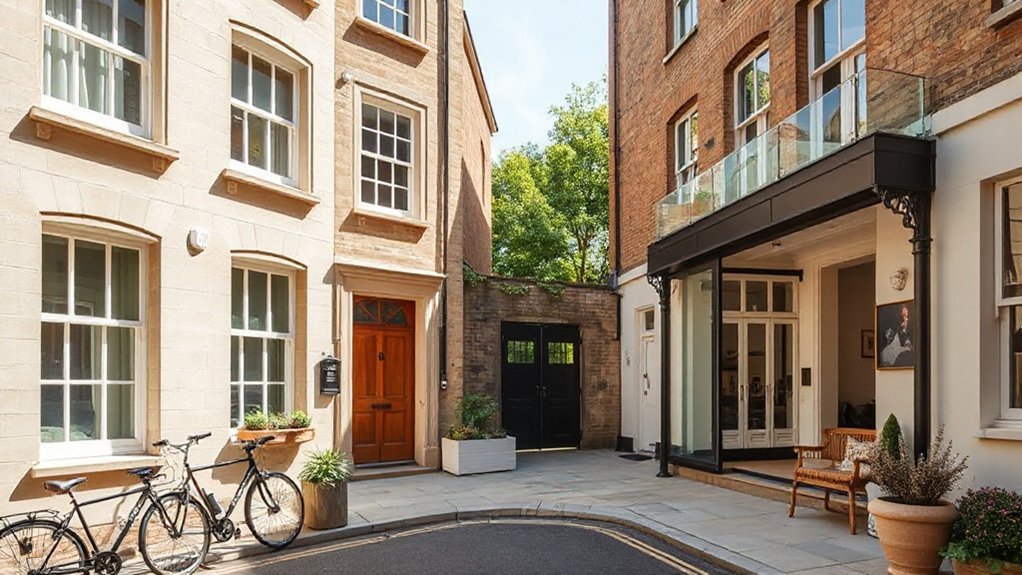
Georgian townhouses in York blend timeless craftsmanship with practical, modern living. You’ll appreciate how historical architecture informs thoughtful layouts, giving you character without sacrificing function.
The deliberate proportions, sash windows, and tall ceilings create bright, airy spaces that adapt to everyday life. You benefit from robust plasterwork and enduring brickwork that stand up to York’s weather while delivering quiet interiors.
In terms of urban planning, you gain efficient street presence and a compact footprint that suits contemporary mobility, walkability, and access to services. You can reconfigure rooms to suit evolving needs without erasing the building’s heritage.
Defining a York-Ready Renovation Brief
Start by outlining your Space Planning Essentials to guarantee every room earns its keep and flows with the Georgian rhythm of York.
Then set your York-Ready Criteria, tying function to fabric—natural light, storage, and access—so constraints become design opportunities.
Finally, define criteria-driven priorities to align budget, timeline, and modern life needs with site realities.
Space Planning Essentials
Defining a York-ready renovation brief begins with a clear spaces-for-function map: identify how you’ll want each room used, what flows between them, and where daylight and views matter most. You’ll translate that map into precise zones, prioritizing functional adjacency and circulation, so every movement feels natural and purposeful.
Consider ceiling height, doorway alignments, and structural constraints early to prevent later rework. Map storage, utility access, and service routes without sacrificing living quality.
Align furnishing accessories with each area’s role, ensuring scale, sightlines, and acoustics support tasks and relaxation alike.
For exterior landscaping, plan progressions from interior thresholds to outdoor spaces, optimizing access, light, and microclimates.
Finalize the brief with measurable benchmarks to guide design decisions and procurement.
York-Ready Criteria
To craft a York-ready renovation brief, begin by translating your space-for-function map into concrete criteria that guide decisions from scope to procurement. You’ll anchor the brief in Historical context while balancing Modern life needs, guaranteeing design choices reflect York’s architectural symbolism without nostalgia overload.
Define performance standards for structure, moisture, and ventilation, paired with accuracy in materials, finishes, and provenance. Establish timeframes, budgets, and decision gates to prevent scope creep, while prioritizing adaptable layouts, ventilation, and daylight.
Align contractor PM, trades, and approvals to ensure rigorous quality control. Finally, codify risk management and compliance checkpoints to protect heritage integrity.
- Historical context-driven criteria
- Architectural symbolism considerations
- Scope-to-procurement decision gates
- Adaptable, daylight-focused layouts
- Heritage-compliant risk and quality controls
Preserving Heritage: Which Georgian Details to Protect
Preserving heritage means choosing which Georgian details to protect based on both significance and practicality. You assess features that define the townhouse’s character—listed cornices, sash windows, and lime-rendered facades—against current living needs.
Preserve elements that convey authenticity, yet allow safe adaptations for modern life. Prioritize original joinery and staircases, where feasible, while restoring pargets and plasterwork to reveal craftsmanship.
Where tolerable, retain floor layouts and spatial rhythm that reflect Georgian proportion, resisting intrusive alterations that erase period language. When incorporating modern appliances, select discreet integrations that don’t compromise ornament or material integrity.
Emphasize energy efficiency through high-performance glazing and insulation that respects historic envelopes. Document decisions, justify alterations, and balance continuity with comfort to sustain the townhouse’s legacy for future generations.
Planning an Open Ground-Plan: From Drawing Room to Kitchen
Could an open ground-plan transform a Georgian townhouse from formal drawing-room separation into a fluid daily living space? Yes, with careful alignment of structure, circulation, and service cores, you create a cohesive zone that feels spacious yet respectful of historical preservation.
Start by removing non-load-bearing partitions to reveal a continuous flow, then insert a slim, raised threshold to delineate zones without interrupting sightlines. Plan for Modern amenities—concealed wiring, discreet storage, and efficient kitchen fixtures—so function matches form.
Maintain proportion by echoing original moldings and fireplace cues in millwork. Retrofit ventilation and heating to ensure comfort without bulky radiators. The result respects the past while embracing today’s rhythms.
- Clear sightlines between drawing room, dining, and kitchen
- Subtle, strategic zones rather than rigid walls
- Hidden wiring and appliance integrations
- Preserved architectural cues in new joinery
- Thoughtful lighting to enhance ambience
Historical preservation, Modern amenities
Maximizing Natural Light in Thick-Walled Townhouses
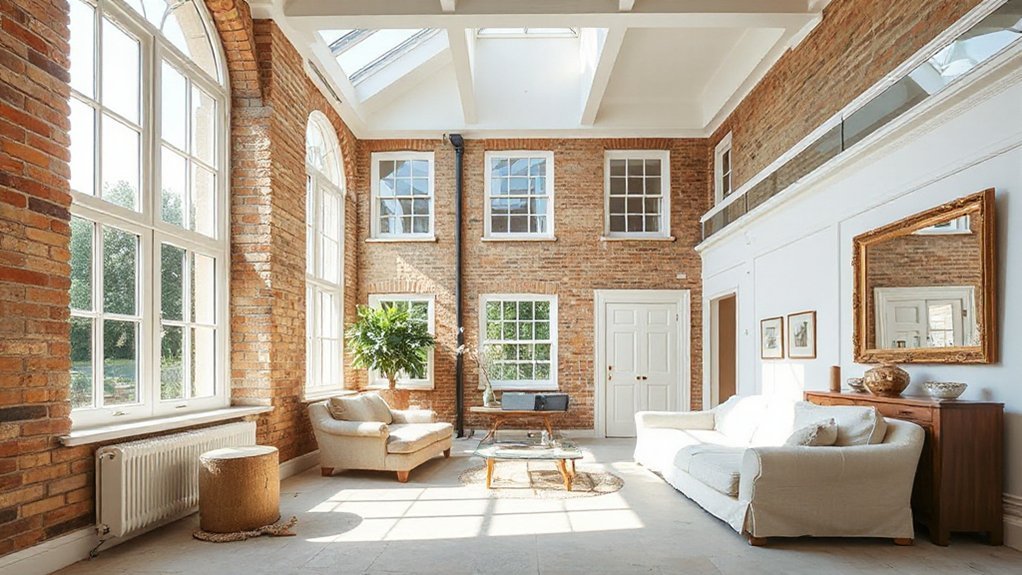
Thick walls demand clever strategies to bring daylight deeper into your rooms, starting with wall thickness considerations that influence light diffusion and window sizing.
We’ll examine wall thickness strategies, window placement techniques, and light-reflective surfaces to maximize glare-free illumination without compromising structure.
Together, these choices create brighter spaces that feel open while preserving the townhouse’s authentic character.
Wall Thickness Strategies
To maximize natural light in thick-walled Georgian townhouses, start by lightening the load at the core: remove or relocate interior loads that obscure window wells and reduce daylight reach. You’ll choose wall thickness strategies that respect historic fabric while delivering modern clarity, focusing on wall insulation and structural reinforcement. Precision planning minimizes disruption and preserves character.
- Assess header and lintel conditions for load transfer without enlarging exterior mass.
- Use minimally invasive cavity fills to improve insulation without widening walls.
- Implement steel or reinforced timber where arches require support.
- Preserve masonry integrity with targeted mortar repointing and vapor management.
- Retrofit with slim, high-performance panels behind plaster for added warmth.
These steps align performance with aesthetics, ensuring durable light permeates living spaces.
Window Placement Techniques
Are there tactics that let in daylight without compromising the building’s character? Yes. Window placement focuses on optimizing thin signal paths through thick walls, aligning openings with interior sightlines and thermal breaks.
You maximize daylight by prioritizing south-facing or well-illuminated elevations, using narrow transoms to bring light deeper into rooms without enlarging the masonry footprint. When you must modify, frame openings within traditional masonry details, preserving lintels, sills, and reveals to honor Historic preservation.
Use casement or slim-vee glazing to reduce glazing area while boosting perceived brightness. Consider a lightwell or internal courtyard strategy where feasible, carefully integrated with surrounding walls.
You coordinate with structural and fabric concerns, ensuring Traditional masonry remains legible while delivering consistent, glare-controlled daylight.
Light Reflective Surfaces
- High-reflectance paints and wallpapers
- Light-toned, low-gloss tiles for floors
- Aluminum or white-foil window trims
- Strategically placed mirrors
- Matte, reflective plaster for accents
Sustainable Materials That Suit York’s Traditions
Sustainable materials that honor York’s traditions combine modern performance with local craft. You’ll select options that endure, breathe, and age gracefully, aligning with historic sensibilities.
Prioritize locally sourced stone, brick, and lime-based mortars to maintain authentic textures and historic patina. Consider timber from certified local forests, seasoned to reduce movement while honoring traditional craftsmanship. Use reclaimed materials where feasible to minimize embodied energy without sacrificing integrity.
For insulation, choose breathable systems that work with timber-framed walls, preventing moisture buildup and preserving structure.
Finishes should be carbon-conscious and durable, such as lime plaster and limewash, enhancing depth and color without harsh coatings.
Emphasize sustainable architecture principles: longevity, repairability, and seamless integration with York’s built heritage.
Bold Accent Colors Without Compromising Charm
Bold accent colors can energize a Georgian backdrop without erasing its patina. Start with a bold hue as a focal point while keeping a subtle backdrop to preserve timeless charm.
Layer in accents that repeat a restrained palette, ensuring each color reinforces rather than competes with character.
Bold Hues, Subtle Backdrop
Color can set the mood without overwhelming a room, and this townhouse proves you can pair bold accents with a restrained backdrop. You’ll see how confident hues act as focal points while tones stay calm, ensuring balance and charm endure. Thoughtful color psychology guides choices, using high-contrast accents only where they reinforce function and flow.
Materials feel contemporary yet timeless, with durable surfaces reflecting material sustainability principles. The result is a refreshed interior that remains welcoming, not loud.
- Bold accents anchor spaces without overpowering adjacent neutrals
- Strategic repetition creates cohesion across rooms
- Textures soften harsh color edges for warmth
- High-contrast details highlight architectural features
- Finishes prioritize longevity and eco-friendly sourcing
Layered Accents, Timeless Charm
Layered accents create depth without shouting, letting bold colors play off softer neutrals for timeless appeal. You balance layers of texture, from brass hardware to woven textiles, so each hue supports the next rather than competing.
In this approach, Layered accents reinforce room rhythm, guiding the eye through architectural detail and furnishings without overwhelming the Georgian lineage. You select saturated tones as focal points—emerald cushions, slate rugs, and blush artwork—then ground them with pale walls and natural wood.
This contrast preserves timeless charm while acknowledging contemporary life. You’ll craft cohesion through repetition: repeat a color family in trim, décor, and fabrics to create a curated narrative.
The result is bold, refined, and enduring, delivering Layered accents that preserve timeless charm.
Smart Home Systems That Blend In
- Discreet sensors and hubs
- Hidden wiring strategies
- Low-profile lighting scenes
- Privacy and data controls
- Energy‑aware scheduling
Hidden Storage Ideas for Small Rooms
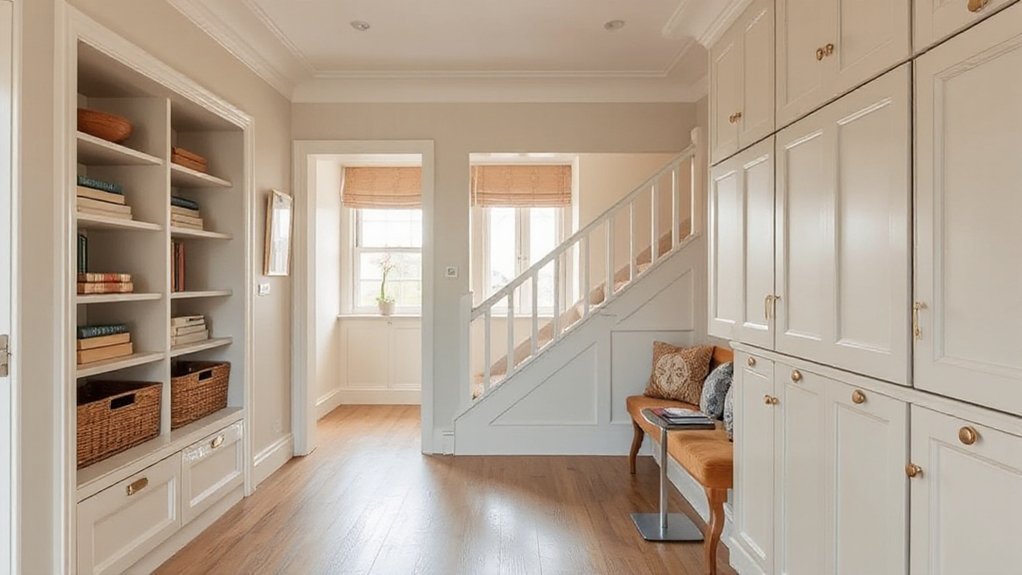
Hidden storage can transform a compact Georgian townhouse into a more livable space without sacrificing its character. You’ll uncover hidden compartments integrated into architectural detailing, such as window seats, alcoves, and baseboards, that keep clutter out of sight while remaining accessible.
Look for multi-use furniture that serves dual purposes—think ottomans with lift-off tops, coffee tables that conceal trays, or beds with built-in drawers and charging bays.
In narrow hallways, install wall niches with shallow shelving and magnetic strips for tools or keys, avoiding floor clutter.
Elevate closets with slim organizers, pull-out baskets, and adjustable rods to maximize every inch.
Choose furniture with soft-close mechanisms to reduce noise and preserve the calm of a refined townhouse aesthetic.
Prioritize clean lines and concealed hardware for a seamless look.
The Staircase as a Feature: Flow and Access
Your staircase should do more than connect floors; it shapes how you move through the house and read the space. Consider how its placement and detailing guide circulation, create sightlines, and anchor entrances to rooms.
Flow Through Staircase
The staircase acts as a connective spine, guiding movement between the townhouse’s levels while shaping spatial flow and daily routines. You’ll notice how the run length, sightlines, and landings create intuitive passages, encouraging efficient navigation without interruption to living zones.
Focus on material selection and detailing that convey permanence while remaining tactile and warm. The staircase design should balance safety with elegance, integrating seamlessly with York’s Georgian character and modern amenities.
Consider continuous handrails, generous headroom, and light channels that illuminate steps without glare. Proportions must support both ascent and descent, minimizing abrupt stops.
The result is a coherent corridor between floors, enhancing everyday tasks and social interactions.
- Design coherence with Georgian context
- Material selection for warmth and durability
- Sightlines and lighting for safety
- Handrail and headroom considerations
- Flow-enhancing proportions and rhythms
Access And Circulation
The staircase becomes a spine that choreographs habit, guiding occupants through everyday routines while framing moments of connection. In updating materials and detailing, you preserve tactile heritage—wrought iron, carved balustrades, and period plaster—so historical preservation remains visible in daily use.
You design landings and landings’ silhouettes to optimize throughput, ensuring accessibility for all ages and abilities without compromising form. This approach strengthens urban connectivity by linking inner rooms to shared exterior routes, embedding the home in York’s broader pedestrian network while respecting its Georgian vernacular.
Outdoor Connections for Year-Round Living
Outdoor connections make year‑round living feasible by seamlessly linking interior rooms to protected exterior spaces. You optimize passages with anchored viewpoints, weatherproof doors, and operable screens that invite light without compromising warmth. Use glazing that balances solar gain and insulation, ensuring comfortable thresholds between rooms.
Prioritize garden privacy and outdoor lighting to extend evenings while maintaining discreet boundaries.
- Align patios with living spaces for natural flow
- Install retractable awnings and durable screens
- Choose layered lighting: ambient, task, and accent
- Integrate planters to frame views and soften edges
- Elevate garden privacy with trellises and evergreen screens
These moves create versatile anchors throughout the year, supporting practical use and refined design without sacrificing comfort or energy efficiency.
Achieving Acoustic Comfort in a Dense Townhouse
In a dense townhouse, you’ll start with acoustic isolation tactics to minimize transfer between levels and rooms.
Pair these with quiet living design choices that prioritize softer surfaces, door seals, and resilient construction to sustain calm throughout daily life.
This approach sets a precise framework for achieving lasting acoustic comfort in a Georgian context.
Acoustic Isolation Tactics
Sound insulation is essential in a dense townhouse, where thin partitions and shared walls transmit footsteps, voices, and mechanical noise. You’ll implement targeted tactics that minimize transmission paths while preserving space and aesthetics.
Begin with robust door seals and frame inserts, then upgrade drywall assemblies with staggered or double studs and decoupled channels. Introduce resilient underlay under flooring and acoustic-rated ceilings to break flanking paths.
Treat noisy common walls with acoustic panels and mineral wool infill to damp reverberation and leakage. Seal gaps around outlets, cables, and HVAC penetrations, and utilize vibration isolators for mechanical equipment.
Regularly test room pairs to verify performance. Soundproofing techniques and acoustic treatment converge to deliver quiet, comfortable living zones.
- Door seals and frame inserts
- Decoupled drywall assemblies
- Resilient underlay and ceiling treatments
- Acoustic panels and mineral wool
- Extensive sealing and vibration isolation
Quiet Living Design
Quiet living in a dense townhouse starts with deliberate layout and materials choices that curb noise at the source. You’ll prioritize spatial zoning that separates communal from private zones, using corridor buffers and staggered room alignments to disrupt sound paths.
Specify high-mass materials and dense fiber underlay for floors, plus acoustic-rated partitions to contain impact and airborne noise. Select doors with sealing gaskets and frames tuned to tight clearances, and install operable acoustic vents to balance fresh air without muffling sound.
Integrate a garden retreat as a visual and acoustic softening edge, shading external noise while offering a restorative pause. Create a quiet sanctuary with layered textiles, soft furnishings, and controlled lighting to reduce reflexes and fatigue.
This combination sustains comfort, privacy, and focus throughout the townhouse.
Heating, Insulation, and Historic Efficiency Gains
Modern efficiency starts with a thorough, practical assessment of the townhouse’s fabric: historic masonry, timber framing, and existing services. You’ll balance retrofit with preservation, targeting historic preservation without compromising comfort.
Insulation strategies focus on minimizing heat loss while maintaining breathable walls and preserving character. You’ll upgrade heating to efficient, controllable systems that support modern amenities while respecting the building’s fabric.
Thermal bridging is mitigated through targeted detailing, without detracting from finishes. Air leakage is reduced with well-sealed enclosures and draft-proofing at junctions.
Energy monitoring guides ongoing improvements, linking performance to real-life use. Historical considerations frame each decision, ensuring reversible, non-invasive measures where possible.
Modern amenities align with comfort, durability, and long-term value.
- Assess fabric and services for preservation and efficiency
- Prioritize breathable insulation and minimal disruption
- Choose reversible, non-invasive upgrades
- Optimize heating with controllable, efficient systems
- Monitor performance to drive ongoing refinements
The Kitchen–Living Hub: Designing the Heart of the Home
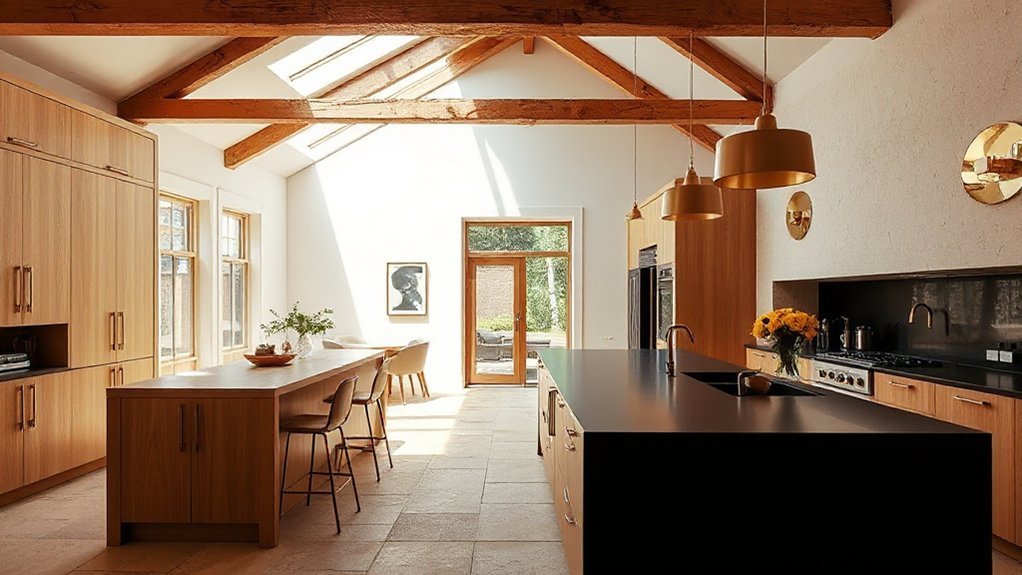
The Kitchen–Living Hub integrates cooking, dining, and day-to-day living into a single, flexible zone that supports contemporary life while preserving Georgian character.
You design with a dual aim: efficient workflows and visual continuity with historic facades, exterior details that define the street presence.
Plan a radiant, low-height island that anchors prep zones while inviting conversation, keeping sightlines open to the dining area.
Choose surfaces that resist wear yet stay refined, with timber accents echoing period mills while modern joinery remains invisible.
Integrated appliances hide behind paneling, minimizing chrome clutter.
Lighting is layered: task, ambient, and feature, tuned for morning routines and evening gatherings.
Ventilation is quiet yet effective.
Material choices respect scale, proportion, and the townhouse’s authentic cadence.
Upcycling Heritage Materials for New Life
Could heritage materials be given a new lease on life without losing their character? Yes. You transform originals into functional statements, preserving provenance while updating utility. You’ll respect grain, patina, and joinery, letting traditional craftsmanship lead the way.
Careful consolidation of fragments enhances resilience, prevents waste, and sustains authenticity. You’ll document provenance to inform future maintenance, while selecting durable finishes that reveal texture rather than mask it.
You’ll repurpose vintage furniture pieces as room anchors, creating dialogue between eras. You’ll balance contrast with restraint, avoiding hackneyed “retro” shortcuts.
You’ll source local, sustainable materials to complement the palette without overpowering it. You’ll test scale, ensuring every object serves a purpose and contributes to flow.
- Preserve patina, reuse joinery, and celebrate craftsmanship
- Refit vintage furniture with modern utility
- Repair, not replace, where possible
- Pair natural finishes with restrained color
- Document provenance and maintenance needs
Layered Lighting for Atmosphere and Function
Layered lighting shapes a Georgian townhouse’s atmosphere and function by balancing task, ambient, and accent layers. You’ll plan zones that support daily life, from a bright, glare-free kitchen workspace to a softly lit living area for evenings.
Choose warm, dimmable LEDs for general illumination and add task lighting at desks, counters, and reading nooks. Accent lighting highlights architectural details—mouldings, stair rails, and alcoves—creating depth without glare.
Integrate concealed cove lighting behind cornices to diffuse glow and reduce shadows. Consider daylight integration with light shelves and large, properly filtered windows to preserve color fidelity.
This approach becomes artistic expression, reinforcing cultural significance in the home’s narrative while ensuring energy efficiency and comfortable, adaptable spaces.
Courtyard and Garden Design for York-Style Curb Appeal
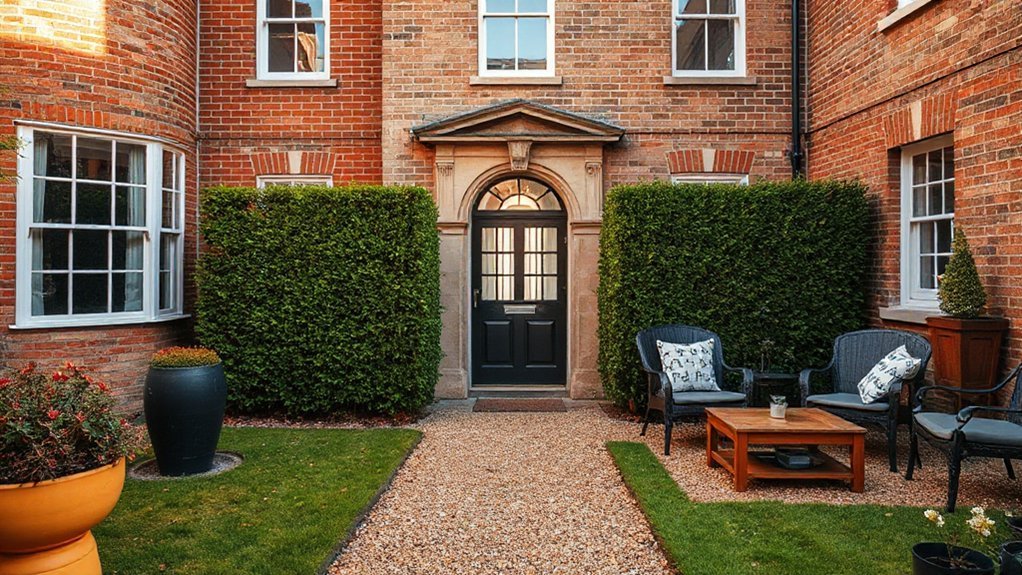
A thoughtfully designed courtyard and garden can extend York-style curb appeal from the doorstep outward, pairing architectural restraint with lush, climate-conscious planting. You’ll curate a compact, layered exterior that respects Historic architecture while enhancing daily life, using durable materials and a restrained color palette.
Consider a narrow herb strip, a paved path, and a vertical focal point to draw the eye. Plant choices prioritize drought tolerance and seasonal interest, complementing interior decor with cohesive textures and tones.
Integrate seating for cadence between indoors and out, and deploy lighting that accentuates architectural detail without glare. Maintain scale with proportionate shrubs and a cohesive rhythm across borders for timeless charm.
- Heritage-friendly materials and textures
- Low-water planting with seasonal color
- Quiet seating zones and sightlines
- Subtle, durable lighting for safety
- Cohesive, integrated hardscape and greenery
Budgeting for Heritage and Modern Needs
Balancing heritage and modern needs requires a disciplined budgeting approach that protects historic character while delivering everyday livability. You’ll map costs against priorities, separating must-haves from nice-to-haves, and build contingencies for unforeseen discoveries.
Begin with a baseline estimate that respects listed constraints and planning approvals, then layer in architectural details that preserve historical significance while enabling safe, efficient living. Allocate funds for structural stabilization, damp remediation, and compliant electrical and plumbing upgrades, but cap discretionary spending to avoid scope creep.
Prioritize retention of original features—fireplaces, plasterwork, sash windows—where feasible, budgeting for expert restoration rather than replacement.
Track value across long timelines, integrating energy upgrades and durable materials to minimize lifecycle costs. Document decisions, linked to approvals, to support transparent stewardship of your Georgian home.
A Step-by-Step Renovation Timeline for a York Georgian
Planning your renovation timeline for a York Georgian starts with a clear sequence: assess the existing fabric, secure approvals, and then map phases from demolition-safe steps through finish work. You’ll align Historical architecture considerations with practical milestones, ensuring each stage respects structural integrity and urban planning constraints.
Timing contingencies, contractor coordination, and material sourcing sit at the core of your plan, reducing risk and delay.
- Assess fabric and heritage constraints clearly
- Secure permissions and consult planning authorities
- Sequence demolition-safe steps before major interventions
- Phase structural, then mechanical, then finishes
- Verify compliance, documentation, and handover criteria
This approach preserves Georgian details while delivering modern comfort, tightening project control, and maintaining a respectful balance between tradition and contemporary living.
Case Studies: Restorations of Georgian Townhouses in York
York’s Georgian streets are a living archive of craft and proportion, and these case studies spotlight how restorations marry historical fidelity with contemporary living. You’ll see how Georgian architecture principles guide every choice, from timber detailing to sash window reinstatement.
In York, heritage conservation isn’t nostalgia; it’s a framework for functionality, comfort, and longevity. Case studies reveal disciplined methods: uncovering original plasterwork, stabilizing stair strings, and reconfiguring layouts to suit modern lifestyles without erasing lineage.
You’ll note energy performance improvements achieved through sympathetic insulation and concealed services, preserving exterior harmony. Each project prioritises authentic materials, skilled craft, and meticulous tolerances.
The result: spaces that respect heritage while delivering today’s standards of light, flow, and resilience for future generations.
Frequently Asked Questions
How Long Does a York Georgian Renovation Typically Take?
Typical York Georgian renovations take about 6–12 months, depending on scope. You’ll need phased planning, approvals, and careful craftsmanship. You’ll balance historical preservation with interior modernization, coordinating trades, and maintaining access throughout the project for minimal disruption.
What Permits Are Needed for This Project?
For this project, you’ll need planning permissions and historical preservation approvals. Example: a York townhouse required listed-building consent before structural changes. Make sure you submit drawings, heritage officer review, and a robust change-of-use rationale for compliance.
Can I Live in the House During Renovation?
You can live in the house during renovation, but plan temporary living arrangements carefully. Coordinate temporary living arrangements with contractors and inspectors, and align permits, utilities, and safety measures to minimize disruption within your renovation timeline planning.
What Is the Typical Budget Range for Upgrades?
Typically, expect a budget of £150,000 to £500,000+, depending on scope. You’ll balance historical preservation with modern amenities, prioritizing electrical, plumbing, insulation, and finishes to preserve character while meeting contemporary comfort standards.
Which Trades Are Essential for a Georgian Retrofit?
You’ll need architects, structural engineers, and conservation specialists as essential trades for a Georgian retrofit, ensuring Historical preservation and Structural reinforcement are integrated throughout, while electricians, plumbers, and carpenters support modern life without compromising historic integrity.
Conclusion
In York, you feel how history anchors you, and how modern life frees you. You balance heritage with practicality, preserve charm while embracing light, space, and flow. You plan with care, you implement with precision, you adapt with resilience. You cherish the brick, the timber, the courtyard, the garden, and the gaze of passersby. You create a home that honors the past, serves the present, and invites the future. You live well, you live thoughtfully, you live beautifully.
About the Author