Copper Roofing: The Pros and Cons Revealed
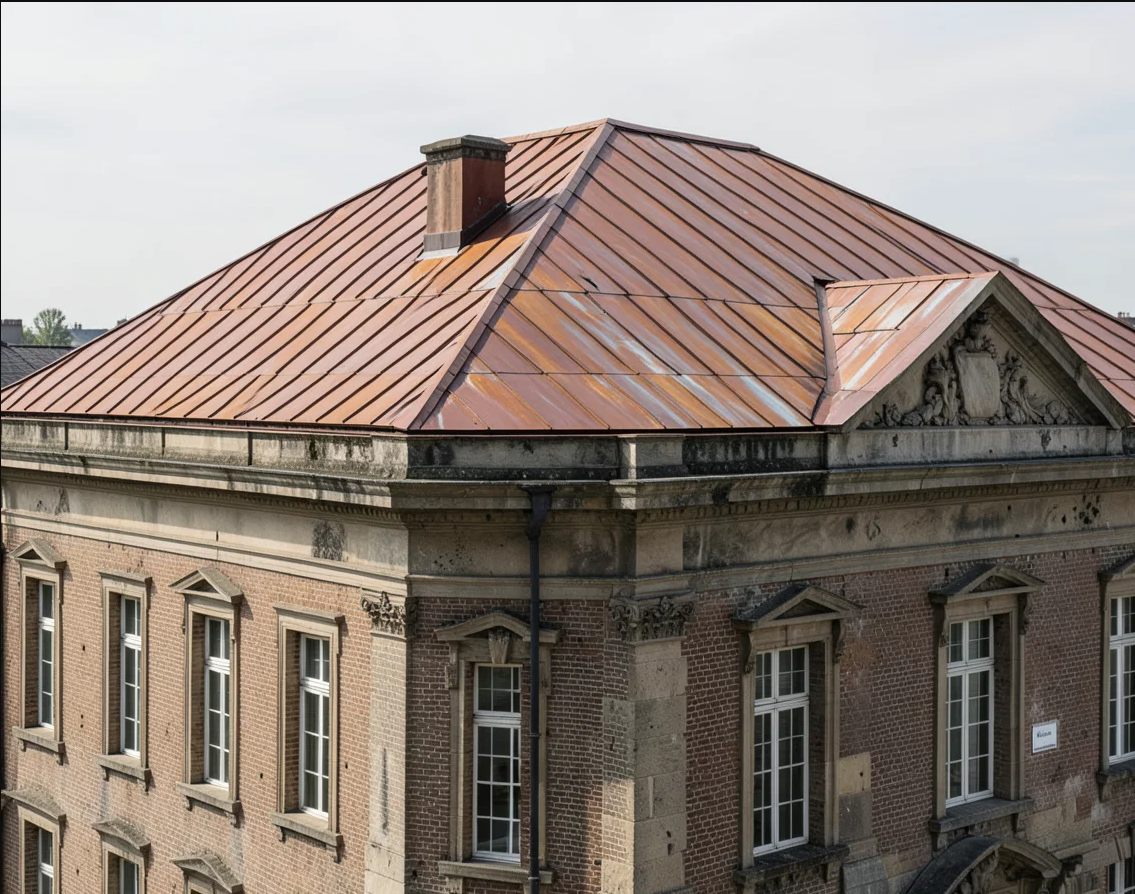
Few building materials carry the prestige of copper roofing. Its progression from the bright, salmon-orange of fresh installation through the deepening browns and purples of early weathering to the distinctive blue-green verdigris that defines historic copper roofs worldwide is one of architecture’s most celebrated material narratives. Walk past Westminster’s Chapter House, Copenhagen’s Christiansborg Palace, or any number of Gothic church spires across northern Europe and you are looking at copper that has been doing its job for decades or centuries — often without significant intervention in between.
That extraordinary track record makes copper an aspirational roofing specification. It also makes it expensive, demanding in its detailing requirements, and occasionally controversial with planning authorities and environmentally minded clients who are concerned about its runoff characteristics. Copper roofing deserves an honest assessment — of what it genuinely delivers, what it genuinely costs, and where its limitations sit.
The Pros of Copper Roofing
1. Unmatched Longevity
The single most important advantage of copper roofing, and the one that frames every other consideration, is how long it lasts. Quality copper roofing correctly installed and detailed has a service life of 100 years or more — and this is not marketing language but a figure supported by the evidence of hundreds of buildings across the world where copper roofing installed more than a century ago is still performing.
Some European copper roofs are significantly older. The copper spires of Scandinavian churches, the domes of historic public buildings, and the flashing details on major cathedrals include copper that has been in continuous service for 150, 200, or in rare cases significantly more years. The Panthéon in Paris, the Kremlin’s towers, and the copper-roofed buildings of colonial Boston are among the many examples of copper performing across generational timescales.
This longevity is not simply impressive for its own sake — it has profound financial implications. A copper roof installed on a building today may not require replacement within the lifetimes of the current owners, their children, or their grandchildren. When the full replacement cost of alternative roofing materials over a 100-year period is calculated — asphalt shingles replaced every 25–30 years, modified bitumen replaced every 20–25 years, even standing seam steel replaced every 50–70 years — the long-term cost of copper becomes considerably more competitive with the initial cost than the upfront price comparison suggests.
2. The Patina: A Living, Self-Protecting Surface
Copper’s colour change is not merely aesthetic — it is the material’s primary corrosion protection mechanism. The patina (verdigris) that forms on exposed copper over years of weathering is a stable, protective layer of copper carbonate, copper sulphate, and copper chloride compounds that forms naturally in response to exposure to air, moisture, and atmospheric compounds. Once the patina is fully established — a process that typically takes 15–30 years depending on climate and atmospheric conditions — it provides an extremely durable, chemically stable surface that resists further corrosion.
Unlike paint on steel or zinc coating on galvanised metal, the copper patina is not a separate applied coating that can be scratched off, abraded away, or delaminated. It is a transformation of the metal surface itself, which means it regenerates if damaged — a scratch or impact that removes the patina locally will repatinate naturally over time. This self-healing characteristic is unusual among roofing materials and contributes significantly to the low maintenance profile of copper roofing over its long service life.
The aesthetic of the patina is the most visually distinctive aspect of copper roofing. Some owners and architects seek to accelerate the patination process through chemical treatments that can produce the green patina within weeks rather than decades. These treatments produce an accelerated patina that is visually similar but chemically somewhat different from naturally weathered copper, and opinions in the architectural and heritage communities on their appropriateness vary.
3. Genuinely Low Maintenance
Copper roofing, once installed and correctly detailed, requires remarkably little maintenance over its lifespan. There are no sealants or coatings that need periodic renewal. There are no individual tiles or shingles that lift, break, or need replacing. The patina is self-maintaining. The primary maintenance requirements are:
- Keeping gutters and downpipes clear to prevent debris accumulation on the copper surface
- Checking and renewing sealant at flashings and penetrations on a periodic basis (though copper-to-copper flashings, correctly designed, require less sealant maintenance than dissimilar-material junctions)
- Inspecting for any physical damage after severe storm events
Copper does not corrode in the way that steel corrodes — there is no progressive rusting that destroys the metal from the surface inward. The patina stabilises the surface and, barring physical damage, the metal beneath it remains structurally intact essentially indefinitely.
4. Workability and Architectural Versatility
Copper is one of the most workable of all roofing metals. Its malleability allows it to be formed into complex shapes, curved surfaces, and intricate details that are difficult or impossible to achieve with stiffer alternatives. Domes, turrets, spires, curved bay extensions, complex valleys and gutters — copper can be formed on-site to accommodate virtually any roof geometry.
This workability makes copper the material of choice for architectural features that demand precise, seamless waterproofing at compound curves or unusual geometries. It is also the reason copper is commonly used for flashing details on other roofing materials — around chimney stacks, at valley gutters, at abutments with walls — even when the main roof covering is slate or tile. The copper flashing can be dressed precisely to the specific conditions, and its longevity means it will outlast many replacements of the primary covering above it.
5. Fire Resistance
Copper is a non-combustible material. It will not ignite, will not contribute to the spread of fire, and meets the highest fire resistance classifications for roofing materials. This makes copper particularly appropriate for buildings where fire resistance requirements are demanding — heritage buildings where fire protection is a primary concern, buildings in areas with wildfire risk, and commercial or institutional structures where insurance or code requirements favour non-combustible roofing.
6. Environmental Credentials (in Context)
Copper has a complex environmental profile that is better than its critics suggest and less straightforwardly positive than its advocates claim. The key facts:
Copper is 100% recyclable and retains essentially all its value and properties through recycling — a copper roof at the end of its service life is a valuable commodity, not waste. A significant proportion of copper in current production is from recycled sources. The energy required to recycle copper is considerably lower than the energy required to produce primary copper from ore.
The service life of copper roofing dramatically reduces the lifecycle environmental impact relative to materials with much shorter service lives. A material that performs for 100 years without replacement requires less embodied energy, less manufacturing input, and less transportation over that period than materials replaced two, three, or four times in the same timeframe.
The counterpoint is that copper mining is environmentally intensive, and the copper ion runoff from copper roofing surfaces is a genuine ecological concern in catchment areas where it can accumulate.
The Cons of Copper Roofing
1. Upfront Cost: The Most Significant Barrier
Copper roofing is among the most expensive roofing materials available. Material costs vary with commodity copper prices, but as a benchmark: copper standing seam roofing typically costs £75–£120 per square metre for materials alone, with installed costs running £150–£300+ per square metre depending on roof complexity, location, and contractor. A full copper roof on a moderately sized house of 150 square metres of roof area might cost £22,500–£45,000 in materials alone, and £45,000–£90,000 or more fully installed.
These are figures that make copper roofing inaccessible for most residential budgets and that require careful justification even for commercial and institutional clients with the means to consider it. The financial case rests on the 100-year lifespan argument — which is compelling over a sufficiently long time horizon — but the upfront cost remains a barrier that eliminates copper from consideration for the vast majority of projects.
Copper prices are also volatile, tracking global commodity markets that are affected by industrial demand (copper is a critical material for electrification and electronics as well as construction). A project specified at one copper price may face significantly different material costs by the time it is tendered.
2. Galvanic Corrosion: The Incompatibility Problem
Copper is electrochemically active. When copper is in contact with, or when copper-rich runoff contacts, other metals — aluminium, zinc, galvanised steel — galvanic corrosion can occur that rapidly degrades the other metal. This is not a problem with copper itself but a serious installation and detailing consideration that affects what materials can be used in combination with copper.
Fixings, gutters, downpipes, flashings, and any metal elements downstream of a copper roof must be copper-compatible. Steel fixings will corrode; aluminium gutters will be attacked by copper-rich rainwater runoff; zinc flashings adjacent to copper will be galvanically compromised. The system design must account for this throughout — specifying copper or copper-compatible stainless steel for all secondary metalwork.
This requirement adds cost and complexity to the installation and is particularly important in retrofit situations where existing secondary metalwork may be incompatible with the new copper roofing.
3. Copper Runoff and Environmental Impact
The copper ions that leach from copper roofing surfaces in rainwater runoff are toxic to aquatic organisms at elevated concentrations. In catchment areas that drain to sensitive water bodies — streams, ponds, and rivers that support invertebrate and fish populations — copper runoff can have measurable ecological effects.
The European REACH regulation has driven research into the environmental impact of copper in building applications, and in some European countries guidance or regulation limits the use of copper roofing in areas with sensitive drainage catchments. In the UK, planning authorities in ecologically sensitive areas may require assessment of the runoff implications of large copper roof areas.
The ecological concern is real, though its significance depends on context. A small copper roof on a domestic building draining to a municipal sewer is a different proposition from a large copper-roofed commercial building draining to an adjacent chalk stream. The runoff issue is manageable through design — green roof buffer systems, gravel drainage filters, or rainwater harvesting can reduce the copper concentration reaching sensitive water bodies — but it is a consideration that should not be dismissed.
4. The Intermediate Phase: Not Everyone Likes the Look
Copper’s visual appeal is, for many people, specifically the blue-green patina of weathered copper — the colour of historic domes and church spires. But copper does not arrive looking like this. Fresh copper is a bright, reflective salmon-orange that some find visually intrusive in a historic or natural landscape setting. As it weathers, it passes through a darker, less vibrant brown phase that some find dull or unattractive. The full patina develops over 15–30 years.
Neighbours, planning authorities, and local residents who are presented with a proposal for copper roofing on a prominent building may respond to representations of the finished, patinated appearance while the actual installation will initially look quite different. This is worth managing proactively in the design and planning consultation process.
Pre-patinated copper — copper that has been chemically treated to produce the patina before installation — is available from specialist suppliers and addresses this concern directly. Pre-patinated copper gives the finished appearance from day one but carries a cost premium over standard copper and, as noted above, produces a chemically accelerated patina that is slightly different from the naturally weathered equivalent.
5. Specialist Contractor Requirement
Copper roofing requires a level of craftsmanship and material-specific experience that goes beyond the competency of a general roofer. Lead working experience helps — the skills overlap — but copper has its own characteristics: different thermal movement behaviour, different joining techniques (welding, brazing, or mechanical seaming), and different detailing requirements for the various copper roofing systems (standing seam, traditional copper shingle, batten roll, and others).
Finding a contractor with genuine copper roofing experience is not straightforward in most parts of the UK, which can both limit the competitive tendering available and extend the programme while a qualified contractor is identified and scheduled. The quality of the installation is critically important for long-term performance — a poorly designed or installed copper roof will not deliver the 100-year lifespan that justifies the investment.
6. Thermal Movement
Copper has a relatively high coefficient of thermal expansion — it expands and contracts more with temperature change than some other roofing metals. This thermal movement must be accommodated in the roof design through appropriate movement joints, the correct standing seam or batten roll profile spacing, and adequate provision for longitudinal movement in longer roof runs.
Failure to accommodate thermal movement in copper roofing leads to stress at fixings and seam locations, noise (the clicking and creaking that metal roofs produce as they heat and cool), and in severe cases, deformation or cracking at constrained points. A competent copper roofing contractor will design the installation around thermal movement as a primary consideration.
Is Copper Roofing Worth It?
The honest answer depends almost entirely on the time horizon of the investment, the architectural context, and the available budget.
Copper roofing is strongly worth its premium when:
- The building is of significant architectural merit or historic importance, where the prestige and longevity of copper are intrinsically appropriate
- The owner is committed to the building’s long-term stewardship and the 100-year lifespan argument is genuinely relevant to their planning horizon
- The architectural context — a formal civic building, a heritage restoration, a contemporary building where the patination process is a deliberate design element — justifies the specification
- Copper flashings and secondary copper elements are appropriate even if the primary roof covering is another material
Copper roofing is harder to justify when:
- Budget constraints are real and the upfront premium cannot be absorbed without genuine hardship
- The building may change ownership or use within a timeframe shorter than 30–40 years, making the long-term value argument less relevant to the current decision-maker
- The drainage catchment is ecologically sensitive and the runoff implications cannot be adequately managed by design
- A standing seam steel or aluminium system at significantly lower cost can meet the architectural and performance requirements
Copper is not the right roofing material for every building. But for the buildings where it is right — where longevity, craftsmanship, and material beauty are the primary values — it is genuinely, comprehensively right. The century-old copper roofs of Europe’s great buildings are not there by accident. They are there because, when the decision was made to build something meant to last, copper was the answer.
About the Author